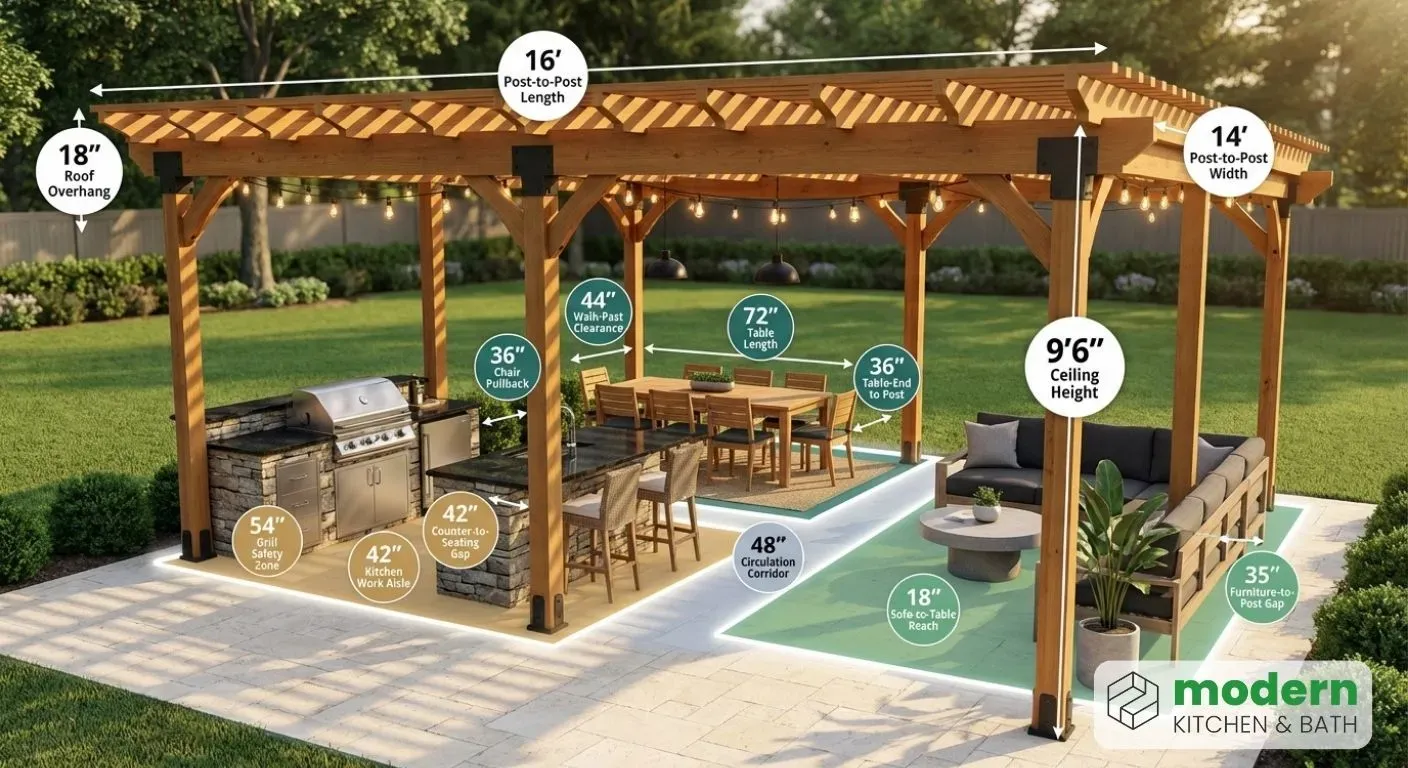
Every pergola project starts with the same instinct: measure the patio, pick a size that fits, and move on. It sounds reasonable, but it is the single most common reason homeowners end up disappointed with the finished result — and contractors across Northern Virginia will tell you it happens on nearly every job where the client sized the structure themselves.
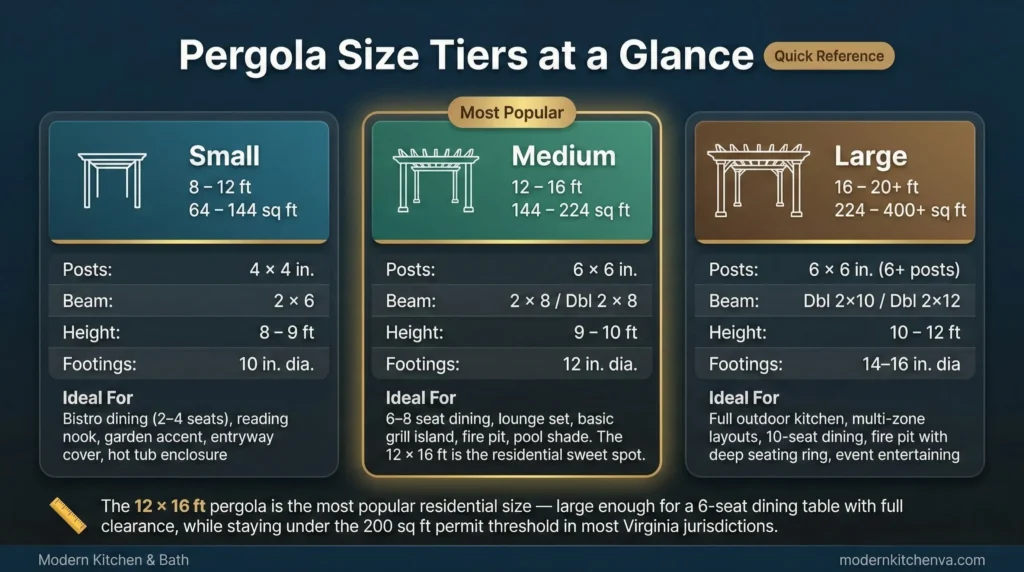
Infographic comparing small 8 to 12 foot, medium 12 to 16 foot, and large 16 to 20 foot pergola size tiers with post dimensions, beam specs, height ranges, footing diameters, and ideal use cases, highlighting the 12 by 16 foot medium pergola as the most popular residential size
Key Takeaways for Pergola Dimensions
• Start with your furniture and activity zones, then size the pergola around them — never the reverse.
• A 12×16-foot pergola is the most versatile residential size, accommodating 6–8 person dining or a generous lounge setup with proper circulation clearance.
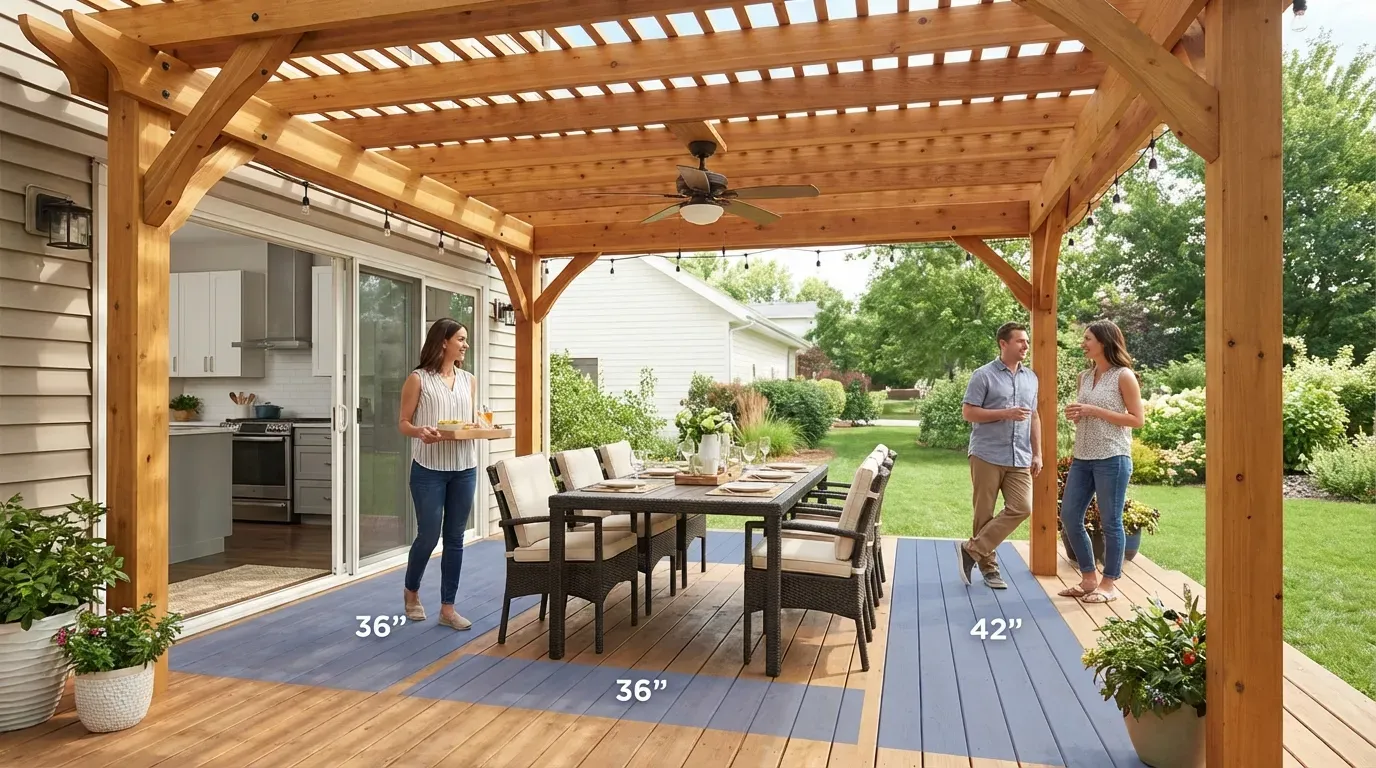
• Always add 36 inches of clearance on every side of a dining table and 42 inches behind seated diners if anyone needs to walk past.
• Advertised pergola dimensions include the overhang. A 12×16-foot pergola yields roughly 9×13 feet of usable post-to-post interior space.
• Your pergola should cover no more than 25–30% of your total usable outdoor area to maintain proportional balance.• Most Virginia jurisdictions require a building permit for attached pergolas or any freestanding structure exceeding 200 square feet.
Table of Contents
Why Pergola Dimensions Deserve More Than a Guess?
A pergola that fits your patio on paper can still feel completely wrong in practice. Too small, and the dining chairs scrape the posts every time someone stands. Too large, and the structure overwhelms a modest backyard, eating into lawn space your family actually uses. The difference between an outdoor room that earns its footprint and one that frustrates you for years comes down to dimensional planning — and most homeowners skip the process that matters most.
The number-one mistake contractors across Northern Virginia report is homeowners sizing their pergola to match the patio slab rather than the activities they intend to host beneath it. A 12×12-foot patio does not automatically call for a 12×12-foot pergola. The right dimensions emerge from a specific sequence: define how you will use the space, identify the furniture and equipment that supports those activities, calculate the clearances required for comfortable human movement around that furniture, and only then select a footprint and height.
This guide walks you through that process step by step. Every measurement is grounded in published ergonomic guidelines, structural engineering limits, and the building codes enforced across Virginia municipalities. Whether you are planning an intimate dining retreat or a full outdoor kitchen and lounge zone, you will leave with the exact dimensions — and the reasoning behind them — to brief your contractor, request an accurate quote, or size a kit pergola with confidence.
Step 1: Start With Your Furniture, Not Your Footprint
The furniture-first method inverts the way most people approach pergola sizing. Instead of choosing a pergola and hoping your furniture fits, you measure every piece of furniture you plan to use, map their footprints on the ground, walk the circulation routes with a serving tray or drink in hand, and let the combined dimensions tell you the pergola size you actually need.
Here is a practical approach: stake four temporary posts at your estimated corners, arrange your actual outdoor furniture inside them, and spend a weekend using the space. Grill dinner, seat six guests, carry plates from the kitchen. Every pinch point and awkward squeeze reveals itself. Only then should you commit to final dimensions.
Common Outdoor Furniture Footprints
| Furniture Piece | Dimensions (L × W) | People Served | Minimum Pergola Footprint |
| Round Bistro Table (42–48 in.) | 48 × 48 in. | 2–4 | 10 × 10 ft. |
| Rectangular Dining (6-seat) | 60–72 × 32–36 in. | 6 | 12 × 12 ft. |
| Rectangular Dining (8-seat) | 84–96 × 36–40 in. | 8 | 14 × 16 ft. |
| Standard Outdoor Sofa | 70–84 × 30–38 in. | 3 | 10 × 12 ft. |
| L-Shaped Sectional | 95–130 in. arms, 7 × 10 ft. footprint | 5–7 | 12 × 14 ft. |
| 4-Seat Conversation Set | Approx. 8 × 8 ft. footprint | 4 | 10 × 10 ft. |
| Grill Island (basic) | 10 linear ft. × 24 in. depth | N/A | 12 × 16 ft. |
| Full Outdoor Kitchen | 16+ linear ft. | N/A | 14 × 18 ft. to 16 × 20 ft. |
| Hot Tub (standard 7 × 7 ft.) | 84 × 84 in. + service access | 4–6 | 12 × 12 ft. |
Minimum pergola footprints above include 36 inches of clearance on each side. Upgrade to 42–44 inches if anyone will walk behind seated diners.
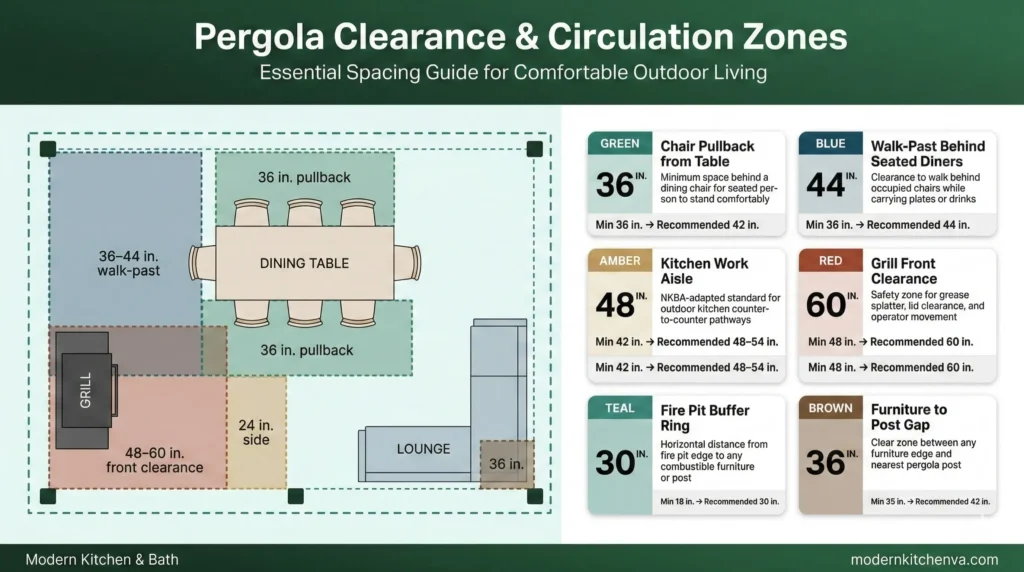
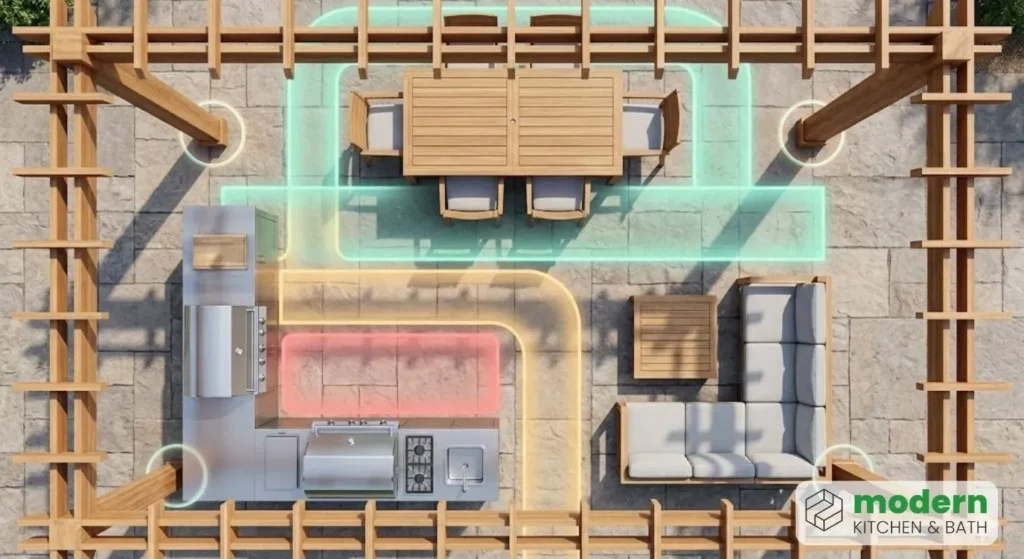
Infographic showing a top-down pergola floor plan with color-coded clearance zones for dining, grilling, and lounge areas alongside six reference cards for 36-inch chair pullback, 44-inch walk-past, 48-inch kitchen aisle, 60-inch grill front clearance, 30-inch fire pit buffer, and 36-inch furniture to post gap
Step 2: Apply Clearance and Circulation Formulas
Clearance is where most pergola projects go wrong. The table fits, but no one can comfortably move around it. Published ergonomic guidelines — including NKBA kitchen planning standards that landscape architects routinely adapt for outdoor use — provide exact measurements that convert a cramped patio into a space that flows.
The Dining Clearance Formula
Minimum Pergola Width = Table Width + 72 inches (36 inches clearance per side)
Minimum Pergola Length = Table Length + 72 inches (36 inches clearance per end)
For a standard 48-inch round table seating four, this formula yields 48 + 72 = 120 inches, or exactly 10 feet on each axis. A 10×10-foot pergola therefore represents the absolute minimum for four-person round-table dining — with zero margin for oversized chairs or a serving cart. For a six-seat rectangular table measuring 66 × 36 inches, you need a minimum 138 × 108 inches, which rounds to roughly 12 × 9 feet. In practice, a 12×12-foot footprint gives substantially more breathing room.
Clearance Reference Table
| Scenario | Minimum Clearance | Recommended Clearance |
| Chair pullback from table edge | 36 in. (3 ft.) | 42 in. (3.5 ft.) |
| Walkway (no one seated nearby) | 30 in. (2.5 ft.) | 36 in. (3 ft.) |
| Walk-past behind seated diner | 36 in. | 44 in. |
| Outdoor kitchen work aisle (single cook) | 42 in. | 48 in. |
| Outdoor kitchen work aisle (two cooks) | 48 in. | 54 in. |
| Grill to nearest furniture | 48 in. (4 ft.) | 60 in. (5 ft.) |
| Fire pit edge to seated user’s knees | 18–24 in. | 30 in. (wood-burning) |
| Fire pit seating radius (center to seat) | 4–6 ft. | 6 ft. (wood-burning) |
| Behind fire pit seating (circulation) | 24–36 in. | 36 in. |
| Furniture edge to pergola post | 35 in. (90 cm) | 42 in. |
| Hot tub service access corridor | 24 in. | 24 in. on accessible sides |
These clearances are additive. A fire pit zone surrounded by a sectional with a circulation path behind it can easily push required pergola dimensions to 16×20 feet or larger. This is exactly why the furniture-first method matters — you discover these real-world spatial demands before you pour footings, not after.
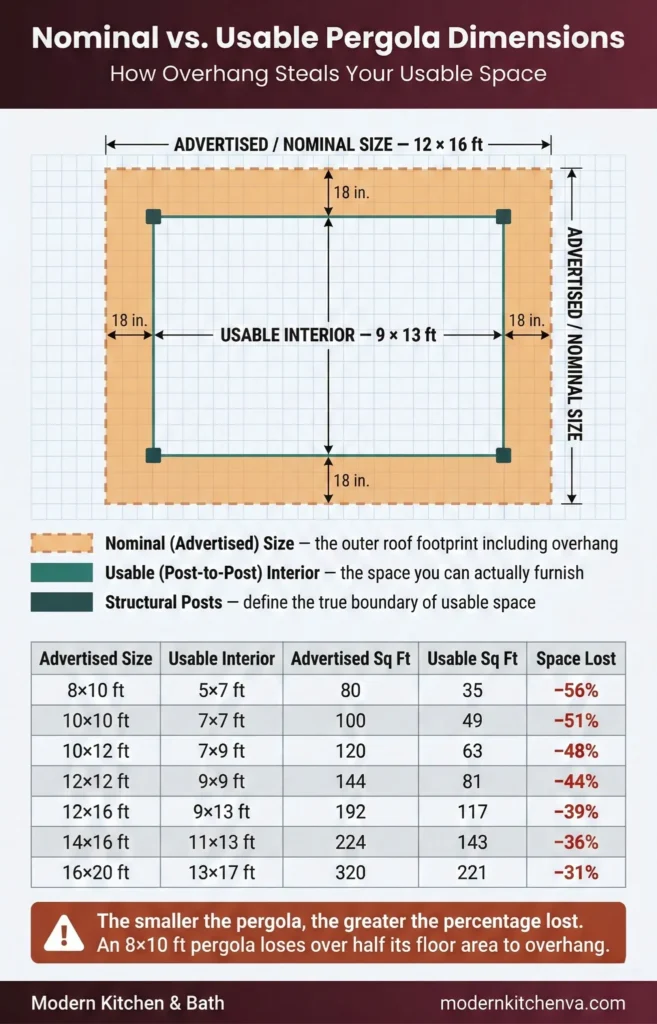
Infographic showing a top-down diagram of a 12 by 16 foot pergola with 18-inch overhang on all sides reducing usable interior to 9 by 13 feet, plus a comparison table of seven common pergola sizes showing advertised versus usable square footage and percentage of space lost
Step 3: Understand Nominal vs. Usable Pergola Dimensions
One of the most overlooked facts in pergola planning: the advertised size includes the overhang. That 12×16-foot pergola you are pricing does not give you 192 square feet of interior space. With an industry-standard 18-inch overhang on each side, the post-to-post interior measures roughly 9×13 feet — just 117 square feet of usable floor area.
This discrepancy catches homeowners off guard because they plan furniture around the advertised footprint and then discover the posts sit nearly three feet inboard from the roofline edges. When reviewing manufacturer specifications, always ask for or calculate the post-to-post interior clearance, not the overall roof footprint.
| Advertised Size | Overall Area | Post-to-Post Interior* | Usable Area* |
| 10 × 10 ft. | 100 sq. ft. | 7 × 7 ft. | 49 sq. ft. |
| 10 × 12 ft. | 120 sq. ft. | 7 × 9 ft. | 63 sq. ft. |
| 12 × 12 ft. | 144 sq. ft. | 9 × 9 ft. | 81 sq. ft. |
| 12 × 16 ft. | 192 sq. ft. | 9 × 13 ft. | 117 sq. ft. |
| 14 × 16 ft. | 224 sq. ft. | 11 × 13 ft. | 143 sq. ft. |
| 16 × 20 ft. | 320 sq. ft. | 13 × 17 ft. | 221 sq. ft. |
| 20 × 20 ft. | 400 sq. ft. | 17 × 17 ft. | 289 sq. ft. |
*Assuming industry-standard 18-inch overhang on all sides. Verify with your manufacturer’s specifications.
Pergola Size Tiers: Small, Medium, and Large
The outdoor living industry groups residential pergolas into three size categories, each structurally optimized for different spatial capacities. Understanding where your project falls helps you select the right post size, beam dimensions, and foundation approach.
Small Pergolas: 64–144 Square Feet
Typical configurations: 8×8, 10×10, 10×12, and 12×12 feet. These suit compact urban terraces, narrow side yards, and intimate 2–4 person setups like a bistro table with two chairs or a small conversation pair. A 4×4-inch post system works at this scale, with maximum spans of 8–10 feet between posts. Material costs run lower, but the fundamental limitation is that 4×4 posts lack the lateral stiffness to resist wind-induced sway (called racking) on taller or wider structures.
Medium Pergolas: 144–224 Square Feet
Configurations: 12×14, 12×16, 12×20, and 14×14 feet. This tier covers most suburban family patios, comfortably handling 4–8 person dining, standard lounge sets, and single-purpose outdoor kitchens. The 12×16-foot size is widely considered the residential sweet spot because it accommodates an 8-seat dining table with full circulation clearance or a generous L-shaped sectional with side tables.
At this scale, 6×6-inch posts become essential. They deliver approximately four times the section strength and six times the bending stiffness of 4×4 posts, enabling spans up to 14 feet between columns. This means a 12×16-foot pergola can stand on just four corner posts with no intermediate supports interrupting the floor plan.
Large Pergolas: 224+ Square Feet
Configurations: 14×16, 16×16, 16×20, 18×18, and 20×20 feet. These serve expansive estate yards, multi-zone entertainment areas, outdoor kitchens with island seating, and hot tub enclosures combined with adjacent lounge space. Structures exceeding 12×20 feet typically require six or more posts to keep beam spans within safe structural limits, and the foundation engineering becomes proportionally more demanding.
Pergola Dimensions by Use Case
The table below maps common residential activities to specific dimensional recommendations. Minimum dimensions assume slim furniture and tight clearances. Recommended dimensions provide the comfortable experience most homeowners actually want.
| Primary Use Case | Minimum Size | Recommended Size | Height | Key Constraint |
| Dining (4 seats, round table) | 10 × 10 ft. | 10 × 12 ft. | 8–9 ft. | Chair pullback zone |
| Dining (6 seats, rectangular) | 10 × 12 ft. | 12 × 12 ft. | 8–9 ft. | Walk-past clearance |
| Dining (8 seats, rectangular) | 12 × 14 ft. | 14 × 16 ft. | 9–10 ft. | End-chair access |
| Lounge / conversation set | 10 × 10 ft. | 12 × 12 ft. | 8–9 ft. | Coffee table clearance |
| L-sectional + fire pit | 14 × 16 ft. | 16 × 20 ft. | 9–10 ft. | Fire safety radii |
| Outdoor kitchen (basic grill) | 10 × 12 ft. | 12 × 16 ft. | 10–11 ft. | Work aisle + ventilation |
| Outdoor kitchen (full) | 12 × 16 ft. | 16 × 20 ft. | 10–11 ft. | Counter run + island clearance |
| Hot tub enclosure | 10 × 10 ft. | 12 × 12 ft. | 9–10 ft. | Entry headroom + service access |
| Pool-adjacent shade | 10 × 14 ft. | 12 × 16 ft. | 9–10 ft. | 4–5 ft. from pool coping |
| Multi-zone (dining + lounge) | 16 × 16 ft. | 16 × 20 ft. | 9–10 ft. | Zone separation + throughway |
| Garden walkway / arbor | 4–6 ft. wide | 5–8 ft. wide | 8–9 ft. | Passage width + headroom |
Pair these dimensional recommendations with proper orientation to maximize afternoon shade coverage during Northern Virginia’s hot summers.
How Tall Should a Pergola Be?
Pergola height is measured from the finished ground surface to the underside of the lowest horizontal beam or rafter. The standard residential range is 8 to 10 feet, with 9–10 feet being the most popular choice because it accommodates standing adults, ceiling fans, and hanging light fixtures while promoting natural cross-ventilation in hot climates.
Height directly affects both the feel of the space and its practical performance. Lower ceilings create intimacy and retain warmth in cooler months. Taller ceilings allow low-angle sun to penetrate further beneath the canopy, reducing effective shade. In Northern Virginia, where summer solar angles are high and winters are mild enough for three-season outdoor use, a 9-foot clear height hits the best balance.
| Height Range | Classification | Best For |
| Below 8 ft. | Sub-standard | Rarely appropriate; feels claustrophobic and limits fan/light installations |
| 8–8.5 ft. | Minimum / Intimate | Small structures, garden walkways, cooler climates where trapped warmth is desirable |
| 9–10 ft. | Standard Residential | Most versatile; fits fans, pendant lights, promotes airflow; recommended default |
| 10–12 ft. | Grand / Commercial | Large footprints, pool areas, outdoor kitchens requiring ventilation hood clearance |
The Hidden Height Math
When you specify 8 feet of clear headroom, the actual structure will be taller. A double 2×8 beam adds approximately 8–9.5 inches, and the perpendicular rafters on top add another 6–8 inches. Your 8-foot clearance target results in a structure that stands 9.5–10 feet at the peak. In regions with a frost line — Northern Virginia’s sits at 18–24 inches — an additional 2–3 feet of post length must be buried below grade for proper footing depth.
Height and Proportion Rules
Two proportion rules prevent a pergola from looking visually awkward:
The Golden Ratio (1:1.618): If your pergola is 14 feet wide, divide by 1.618 to find the harmonizing interior height: approximately 8 feet 8 inches. Conversely, if height is constrained at 9 feet (perhaps by a second-story window or roof eave), multiply by 1.618 to find the ideal width: approximately 14 feet 7 inches.
The 75–80% Rule: A simpler heuristic holds that pergola height should be 75–80% of the structure’s width. A 12-foot-wide pergola looks best at 9–9.6 feet tall. An 8-foot-wide structure built to 12 feet creates an uncomfortable vertical “chimney effect,” while a 16-foot-wide structure at only 8 feet feels oppressively low.
Scaling Your Pergola to Your Property
The 25–30% Rule: Your pergola should cover no more than 25–30% of your total usable outdoor area. A 600-square-foot backyard patio and lawn area calls for a pergola of 150–180 square feet — roughly a 12×14 or 12×16 structure. Exceeding 30% can make the yard feel dominated by the structure rather than enhanced by it.
Leave a minimum of 3 feet of open space on all sides of the pergola for visual breathing room and practical access. For attached pergolas, keep the structure within the width of the main wall section it anchors to, and position the ledger board 1–2 feet below the home’s eaves to maintain a clear architectural hierarchy.
Attached vs. Freestanding: How Configuration Changes Your Dimensions
Attached pergolas mount directly to your home’s exterior wall via a structural ledger board, eliminating the need for posts on the house side. This configuration is the most space-efficient option for compact patios because it frees the square footage that would otherwise be consumed by two structural posts. The trade-off is that your maximum height is constrained by the existing roofline, eaves, and window placements. Attached structures become permanent, inflexible extensions of the home and almost always require a building permit in Virginia.
Freestanding pergolas are self-supporting structures anchored by four or more posts. They consume slightly more floor area due to the full post footprint, but they offer complete freedom of placement anywhere on your property (subject to setback requirements). Freestanding designs can push to 10–12-foot heights without conflicting with residential rooflines and can be repositioned in the future if your landscape plan evolves. For Northern Virginia homeowners with larger lots, a freestanding pergola placed to create a distinct outdoor room away from the house is often the more versatile choice.
Structural Span Limits That Define Your Open Floor Plan
The number of posts interrupting your floor plan depends on how far horizontal beams can safely span between them. Wider spans mean fewer posts and more usable space — but also heavier beams and more demanding foundations.
| Beam Span | Minimum Beam Size | Post Size Required | Foundation Notes |
| 8–10 ft. | 2 × 6 | 4 × 4 or 6 × 6 | Standard 12 in. diameter footing |
| 10–12 ft. | 2 × 8 | 6 × 6 | 12–16 in. diameter footing |
| 12–14 ft. | 2 × 10 or double 2 × 8 | 6 × 6 | 16 in. diameter footing |
| 14–16 ft. | Double 2 × 10 | 6 × 6 | 16–24 in. diameter footing |
| 18–20 ft. | Double 2 × 12 | 6 × 6 + intermediates | 24 in. diameter footing; 6+ posts required |
Rafter spacing also affects the usable experience. Rafters at 12 inches on center provide maximum shade density. At 16 inches on center (the most common residential spacing and generally code-compliant), you get moderate shade with pleasant dappled light. Spacing rafters at 24 inches on center creates an open, airy canopy with minimal shade.
Building Codes and Permits: Virginia Requirements
Building codes are the hard ceiling on your dimensional ambitions. No amount of elegant proportion math matters if your municipality rejects the permit application or, worse, orders demolition of a non-compliant structure.
Under the International Residential Code (IRC R105.2), structures under 200 square feet are exempt from permits in many jurisdictions. However, numerous Virginia localities — including Fairfax County, Arlington, and Loudoun County — have amended this threshold downward to as little as 120 square feet. Attached pergolas almost universally require permits regardless of size because they structurally modify the home.
Key Code Parameters for Virginia Homeowners
| Requirement | Typical Virginia Standard |
| Maximum height | 12 ft. per IRC Appendix H; local overlays may reduce |
| Minimum headroom clearance | 6 ft. 8 in. (80 in.) |
| Side-yard setback | 5 ft. from property line (most common); verify locally |
| Rear-yard setback | 3–10 ft. depending on jurisdiction |
| Front-yard placement | Generally prohibited or heavily restricted |
| Footing depth | Below frost line: 18–24 in. in Northern Virginia |
| Permit threshold (freestanding) | Under 120–200 sq. ft. often exempt; confirm locally |
| Permit threshold (attached) | Almost always required regardless of size |
| HOA review | Required in most Virginia planned communities |
Before committing to any dimensions, contact your local building department and review your HOA covenants. The 30 minutes you spend verifying requirements can save thousands in redesign costs or removal penalties.
Special Use Cases: Fire Pits, Hot Tubs, and Outdoor Kitchens
Fire Pit Integration
Placing a fire pit under a pergola demands specific safety clearances that dramatically expand the required footprint. You need at least 8 feet of vertical clearance between the fire surface and any overhead combustible material (10 feet for wood-burning pits), plus a 36-inch horizontal buffer from the burner to any combustible structure. Gas fire pits rated under 195,000 BTU are significantly safer under a pergola than wood-burning alternatives.
A large sectional surrounding a central fire pit needs the central unit itself, an 18–24-inch knee buffer, 4–6 feet of seating depth, and a 24–36-inch rear circulation path — all simultaneously. This commonly pushes the required pergola size to 14×18 or 16×20 feet.
Hot Tub Enclosures
A standard 7-foot hot tub inside a 12×12-foot pergola leaves roughly 2.5 feet of service access on each side after accounting for the overhang-to-post discrepancy. Height is the critical overlooked variable: a 6-foot-tall person standing on a 2-foot hot tub entry step reaches an 8-foot eye level. An 8-foot pergola creates a collision risk. Specify 9–10 feet of clearance minimum for any hot tub installation.
Outdoor Kitchens
Outdoor kitchens stack multiple clearance demands: counter depth (typically 24–30 inches), a 42–48-inch work aisle, island or bar depth if applicable, and seating clearance beyond the island. A basic grill setup fits within a 12×16-foot pergola. A full outdoor kitchen with counter run, island, and bar seating requires 14×18 to 16×20 feet. Height should reach 10–11 feet for ventilation hood clearance and rapid heat dissipation.
Pergola ROI and Property Value Impact
Pergolas are not just aesthetic additions — they deliver measurable financial returns. The global pergola market reached $4.55 billion in 2025 and is projected to grow to $5.95 billion by 2032, reflecting sustained homeowner demand. Within the U.S., outdoor living structures represent an $892.9 million sector growing at 5.3% annually, with pergolas commanding a 63.6% revenue share.
Homeowners typically recoup 50–80% of their pergola investment at resale, with premium installations in outdoor-focused markets reaching 100% or more. According to the National Association of Realtors, homes with well-designed outdoor living spaces sell for up to 15% more than comparable properties without them. Average installed costs range from $2,100 to $6,400, with a per-square-foot cost of $30–60 depending on material.
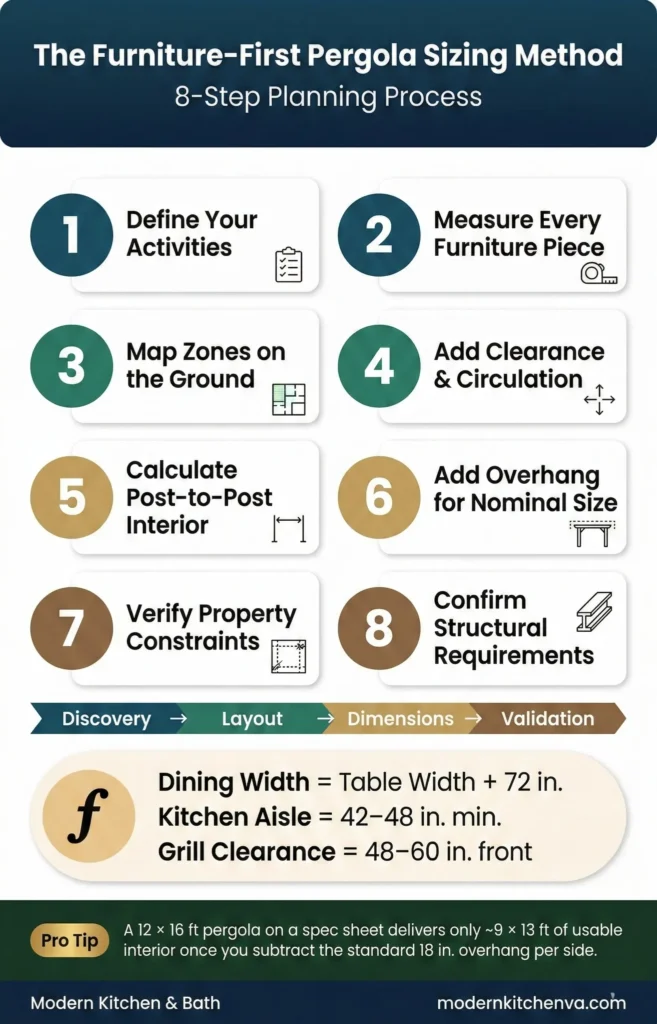
Infographic illustrating the 8-step furniture-first pergola sizing method from defining activities through confirming structural requirements, with color-coded Discovery, Layout, Dimensions, and Validation phases plus core sizing formulas for dining width, kitchen aisle, and grill clearance
The 8-Step Pergola Dimension Planning Process
Use this process to move from concept to confirmed dimensions. It is structured for HowTo schema markup.
Step 1: Define your primary and secondary activities.
List every activity you plan to host under the pergola. Rank them by frequency. Your primary activity dictates the minimum footprint; secondary activities determine whether you need to scale up.
Step 2: Measure your furniture and equipment.
Record the exact dimensions of every table, chair, sofa, grill, and accessory. Include operational dimensions like grill lid swing radius and refrigerator door clearance.
Step 3: Map activity zone footprints on the ground.
Using chalk, tape, or stakes, lay out each furniture piece at full scale on your patio or lawn. Include side tables, planters, and anything that takes up floor space.
Step 4: Add clearance and circulation bands.
Apply the clearance formulas from this guide: 36–44 inches around dining, 42–48 inches for kitchen aisles, safety radii for fire elements. Walk the routes with items in hand.
Step 5: Determine post-to-post interior dimensions.
The total footprint from Step 4 defines your required interior clear space. This is your post-to-post measurement, not the advertised pergola size.
Step 6: Add overhang to calculate advertised size.
Add 18 inches per side (or your manufacturer’s stated overhang) to convert post-to-post dimensions to the nominal pergola size you will order or specify.
Step 7: Verify against property constraints.
Check setbacks, height limits, HOA rules, and the 25–30% property coverage guideline. Adjust dimensions if any constraint is binding.
Step 8: Confirm structural requirements.
Based on final span distances, confirm beam sizing, post dimensions (4×4 vs. 6×6), footing diameters, and whether intermediate posts are needed. Consult a structural engineer for spans exceeding 14 feet.
Frequently Asked Questions About Pergola Dimensions
What is a standard pergola size?
The most common residential pergola sizes are 10×10 and 12×12 feet for single-purpose use, and 12×16 feet for versatile multi-use setups. There is no single industry standard; the right size depends entirely on your intended activities, furniture dimensions, and circulation clearances.
What size pergola do I need?
Start by measuring your furniture and adding 36 inches of clearance on all sides for dining, or 42–48 inches for kitchen work aisles. The post-to-post interior must accommodate these combined dimensions. Then add 18 inches per side for the overhang to get the nominal pergola size.
Is a 10×10 pergola big enough?
A 10×10 pergola works well for 2–4 people around a small round table or a compact conversation set. Its post-to-post interior of roughly 7×7 feet limits you to a 42–48 inch table with tight clearances. For six or more guests, plan for at least 12×12 feet.
What size pergola for a 6-person dining table?
A minimum of 12×12 feet accommodates a standard 6-seat rectangular table with 36 inches of clearance on each side. If you want guests to walk comfortably behind seated diners or plan to add a serving cart, increase to 12×14 or 12×16 feet.
How big should a pergola be compared to my patio?
Your pergola should cover approximately 25–30% of your total usable outdoor area. A pergola that matches the patio slab exactly leaves no open space for unshaded activities, potted plants, or visual breathing room around the structure.
How tall should a pergola be?
Standard residential pergola height ranges from 8 to 10 feet, measured from the ground to the underside of the beams. Nine to ten feet is the most popular range because it accommodates ceiling fans, pendant lighting, and standing adults while promoting natural airflow.
What is the maximum height for a pergola?
The IRC Appendix H sets a general maximum of 12 feet for residential accessory structures. Local jurisdictions may impose lower limits, and structures within 2 meters of a property boundary often face additional height restrictions.
What size pergola for an outdoor kitchen?
A basic grill station fits within a 12×16-foot pergola. A full outdoor kitchen with a counter run, island, and bar seating requires 14×18 to 16×20 feet. Height should be 10–11 feet to accommodate ventilation hoods and heat dissipation.
How far apart should pergola posts be?
Standard residential post spacing ranges from 8 to 10 feet for 4×4 posts and up to 14 feet for 6×6 posts with properly sized beams. Exceeding 14 feet between posts without intermediate supports requires engineered beams or a commercial-grade aluminum system.
What size pergola posts do I need?
Use 6×6 posts for most residential pergolas. They are mandatory for structures wider than 10–12 feet, taller than 9 feet, or located in high-wind areas. Reserve 4×4 posts for compact structures under 10×10 feet with heights below 8–9 feet.
Do I need a permit for a pergola in Virginia?
In most Virginia jurisdictions, freestanding pergolas under 120–200 square feet do not require a building permit. Attached pergolas almost always require one. Always confirm with your local building department and HOA, as amended thresholds vary significantly by county.
Should a pergola be the same size as my patio?
No. A pergola matching the patio exactly leaves no uncovered transition space and can overwhelm the yard visually. Target 25–30% coverage of the total outdoor area, which usually means a pergola smaller than the full patio footprint.
What is the best pergola orientation for shade?
Orient rafters east-to-west to block direct midday sun — the hottest and highest-angle sunlight of the day. North-south oriented rafters provide more morning and afternoon shade but less midday coverage. Depth in the direction of low-angle sun matters more than overall width for shade effectiveness.
Attached vs. freestanding — which should I choose?
Choose attached for compact patios where eliminating house-side posts reclaims critical floor space, and when seamless indoor-outdoor flow is a priority. Choose freestanding for larger properties, pool decks, or when you want placement flexibility and easier permitting.
How much does pergola size affect cost?
Size is the primary cost driver. Average installed costs range from $30 to $60 per square foot. A 10×10 pergola (100 sq. ft.) typically costs $3,000–$6,000 installed, while a 16×20 (320 sq. ft.) runs $9,600–$19,200. Material choice — aluminum, cedar, pressure-treated pine, or vinyl — shifts these ranges significantly.
What is the best rafter spacing for a pergola?
Sixteen inches on center is the most common residential rafter spacing, offering a balanced mix of shade and light. Twelve-inch spacing maximizes shade density. Twenty-four-inch spacing creates an open, airy canopy with minimal shade — best suited for climates where heat buildup is not a concern.
Final Thought
A well-dimensioned pergola earns every square foot it covers. It frames dinner parties without cramping them, shelters an outdoor kitchen without trapping exhaust, and anchors a sprawling backyard without dominating it. The difference between getting it right and settling for close enough is measured in inches — the 36 inches behind a dining chair, the 18-inch overhang that shrinks your usable interior, the 24-inch footing depth that keeps the whole structure standing through a Northern Virginia winter.
If your project involves a structure over 200 square feet, an attached configuration, or spans exceeding 14 feet, invest in a consultation with a licensed contractor or structural engineer before finalizing dimensions. The planning you do now determines how your outdoor space performs for the next 20 years.