A beautifully designed pergola can transform your outdoor living space into a year-round retreat. But even the most stunning structure won’t deliver on its promise if it’s positioned poorly. The secret to maximizing comfort under your pergola lies in understanding how the sun moves across your property and how prevailing winds flow through your backyard. Whether you’re considering a traditional wooden pergola, a modern aluminum pergola, or a fully automated bioclimatic pergola system, orientation is the foundation of outdoor comfort.
Here’s everything Northern Virginia homeowners need to know about orienting a pergola for optimal shade and airflow—including insights from solar path analysis, airflow simulation principles, and the latest in motorized louvered technology.
Table of Contents
Understanding Solar Path Analysis for Pergola Placement
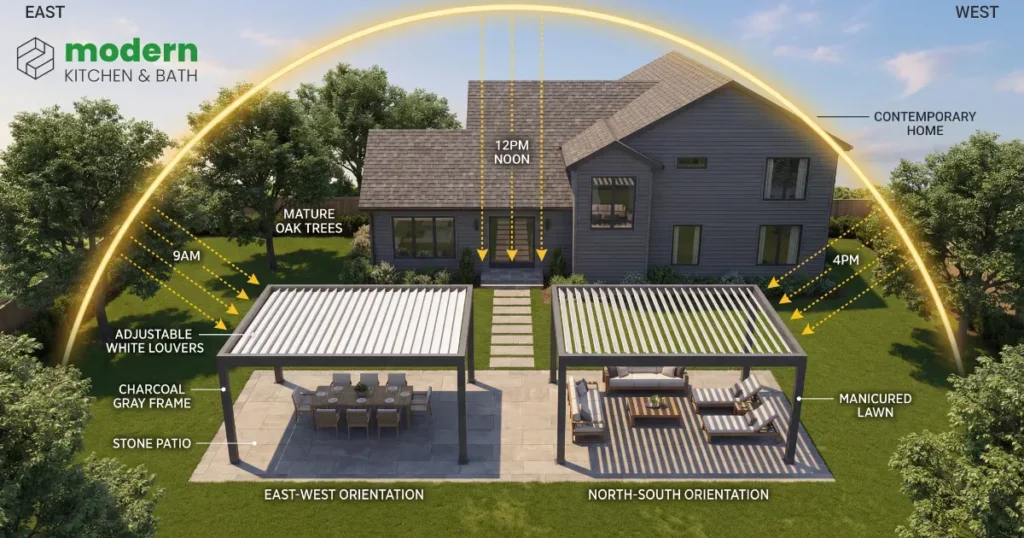
Before selecting a pergola orientation, it’s essential to understand how the sun travels across your outdoor space. Professional designers use solar path diagram analysis to determine the precise geometric relationship between the sun’s trajectory and pergola structures at specific latitudes. In Virginia (approximately 38-39 degrees latitude), the sun rises in the east, reaches its highest point in the southern sky around midday, and sets in the west.
During the summer solstice, the sun’s arc is higher and broader, meaning more intense overhead exposure. In winter, the sun sits lower on the horizon and casts longer shadows. This solar geometry directly impacts how shade falls beneath your pergola throughout the day and across the seasons. Understanding your location’s solar altitude helps determine ideal louver spacing and slat angles for maximum shade during peak heat hours.
North-South vs. East-West Rafter Orientation
The orientation of your pergola’s rafters—the horizontal beams that create the signature slatted roofline—determines when and where shadows fall. This choice is arguably the most consequential decision in pergola placement, especially for summer solstice shade maximization.
East-West Rafters
When your rafters run from east to west, they block the high midday sun most effectively. This orientation creates consistent shade during the hottest hours of the day—typically between 11 AM and 3 PM. If your primary goal is relief from intense afternoon heat, especially during Virginia’s humid summers, this configuration is often the smarter choice for fixed-slat pergolas.
North-South Rafters
Orienting rafters from north to south allows more sunlight to filter through during midday but provides better shade coverage in the early morning and late afternoon. This setup works well for homeowners who want a brighter, more open feel beneath the pergola or who primarily use the space during cooler morning and evening hours. However, you may need to consider retrofitting with angled shade sails to address low-angle morning or evening sun that overhead slats cannot block.
Optimizing Airflow and Ventilation
Shade is only half the comfort equation. Airflow plays an equally vital role in keeping your outdoor space pleasant, especially during Virginia’s muggy summer months. Engineers use CFD (Computational Fluid Dynamics) simulation to visualize how wind moves through louvered versus solid roof pergolas, revealing that poorly designed structures can create heat traps rather than comfortable retreats.
Understanding Wind Rose Data
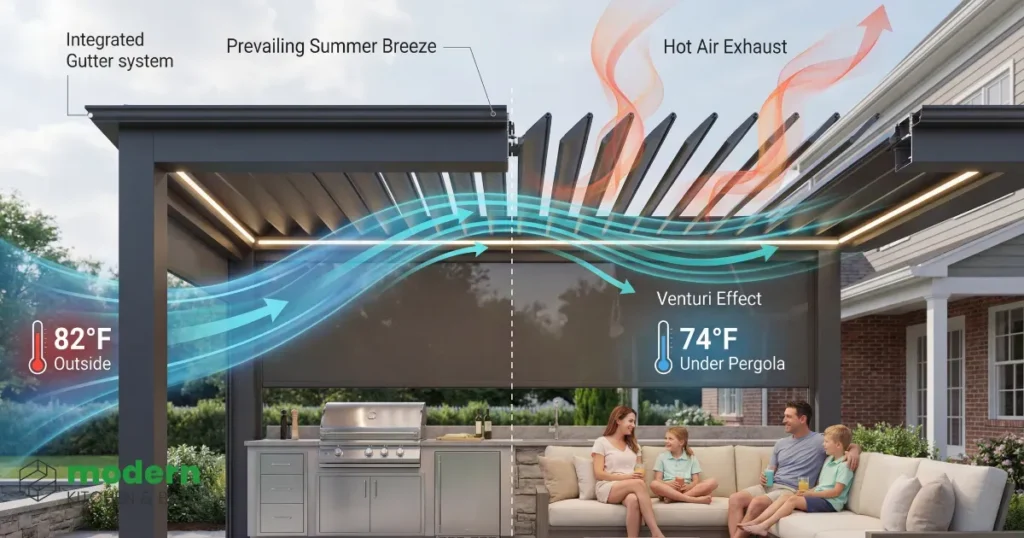
Prevailing winds in the Northern Virginia and Sterling area typically flow from the southwest during summer and shift to the northwest in winter. Professional designers analyze historical wind rose data to position open-sided garden structures for maximum breeze capture. To maximize natural ventilation, orient your pergola so that the longer, open sides face the direction of prevailing summer breezes.
The Venturi Effect in Pergola Design
Advanced bioclimatic construction incorporates Venturi effect design principles for semi-enclosed outdoor structures. By strategically narrowing wind channels within the pergola design, you can accelerate airflow for a cooling breeze effect without blocking views. This is particularly effective when combined with thoughtfully placed privacy screens or landscaping elements.
Avoiding Wind Tunnel Effects
One common mistake is placing a pergola too close to the house, which can create uncomfortable high-velocity wind channels between structures. Proper pergola setback design prevents these wind tunnel effects while maintaining the visual connection between indoor and outdoor living spaces.
Material Considerations: Aluminum vs. Wood
The material you choose affects more than just aesthetics. Thermal emissivity and albedo ratings determine how different materials absorb or reflect solar radiation, directly impacting the radiant heat felt underneath your structure.
Aluminum pergolas with light-colored finishes reflect more solar radiation, keeping the space beneath cooler. They also offer superior durability in high-wind coastal zones and require minimal maintenance. Wood pergolas provide natural beauty and lower initial thermal conductivity, but require regular sealing and may retain more heat over time. Modern aluminum louvered systems offer the best of both worlds: cool-running materials with the warmth of powder-coated finishes that complement any architectural style.
The Bioclimatic Pergola Advantage
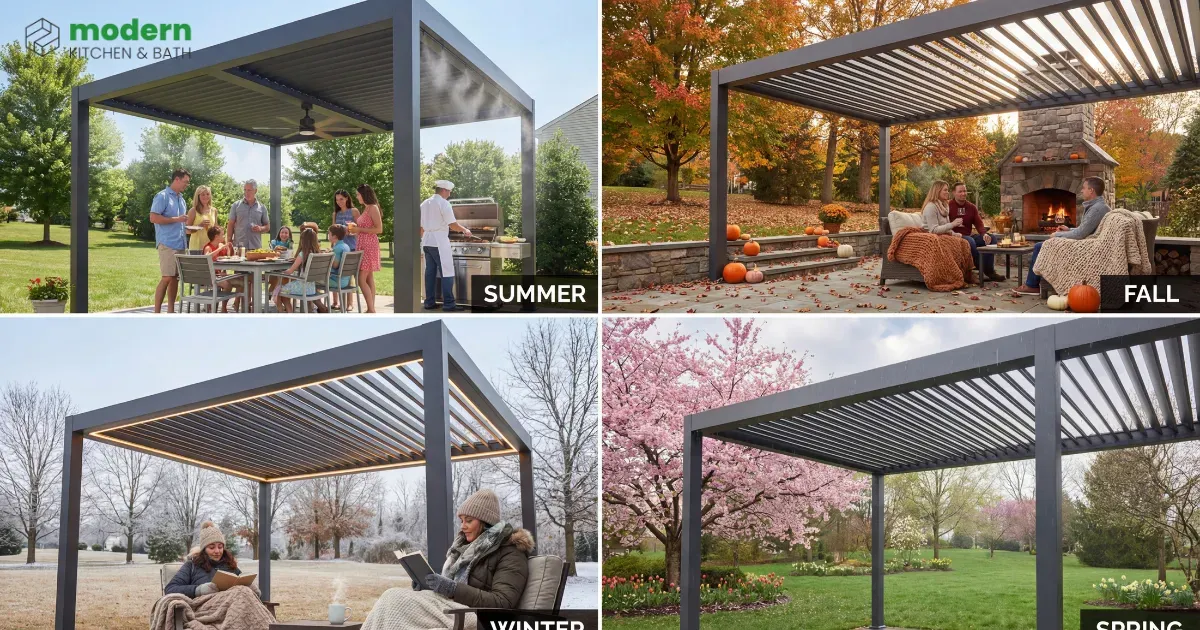
Traditional fixed-slat pergolas lock you into a single orientation decision. That’s why many homeowners are upgrading to automated bioclimatic pergola systems with sun-tracking louvers. These motorized louvered pergolas use sensors and control logic to actively adjust roofing elements in real-time based on weather conditions.
Open the louvers fully on overcast days to maximize natural light. Angle them to block harsh afternoon rays while still allowing soft morning sunshine. Close them completely during rain showers to keep the space dry without retreating indoors. Many systems integrate with KNX and other smart home automation platforms, allowing voice control and scheduled adjustments throughout the day.
For coastal properties, the choice between retractable canopy vs. fixed airfoil louvers often comes down to wind load ratings. Fixed aluminum louvers typically withstand higher wind speeds, making them ideal for exposed locations.
Advanced Cooling Strategies
Evaporative Cooling and Misting Systems
In Virginia’s variable humidity, misting systems can provide significant cooling when conditions are right. Understanding psychrometric principles—the thermodynamic properties of moist air—helps determine whether misting will actually cool your space or simply increase humidity. Generally, misting works best on drier days with good airflow.
Green Roof and Living Pergola Options
For homeowners interested in sustainability, green roof pergola integration can help mitigate urban heat island effects. Living plant layers absorb heat and transpire moisture, cooling the air beneath through natural evaporation. Alternatively, training deciduous vines like wisteria or grape provides dense shade in summer while dropping leaves in winter to allow warming sun—acting as a biological louver system.
Practical Tips for Getting It Right
- Observe your yard at different times. Spend a few weekends tracking how sunlight and shade move across your intended pergola site. Mark where the sun hits at 10 AM, noon, 3 PM, and 6 PM.
- Consider your usage patterns. Do you envision morning coffee rituals or evening dinner parties? Tailor the orientation to provide optimal shade during your peak usage times.
- Account for nearby structures and trees. Existing buildings, fences, and mature trees cast shadows that interact with your pergola’s coverage.
- Think about seasonal use. If you plan to enjoy your outdoor space in cooler months, prioritize capturing winter sun. For summer focus, blocking midday heat becomes the priority.
- Check local regulations. Legal setbacks and easement restrictions for detached accessory structures vary by locality. Verify permit requirements before finalizing your design.
- Don’t forget about views. Ensure your chosen orientation preserves or enhances the sightlines you most enjoy from beneath the pergola.
Frequently Asked Questions
Which orientation provides better shade in the late afternoon?
North-south oriented rafters typically provide better late afternoon shade coverage because they block the lower-angle western sun. However, for comprehensive all-day shade, especially during peak midday heat, east-west rafters are more effective. Many homeowners find that motorized louvered systems offer the best solution, allowing adjustment throughout the day.
| Season | Solar Phenomenon | Geometric Challenge for Pergola | Operational Goal |
| Summer | Altitude ~75° | Near-vertical rays penetrate gaps. | Total Blockage: Create continuous shadow density. |
| Winter | Altitude ~28° | Long shadows; low penetration. | Passive Gain: Allow deep light penetration. |
| Equinox | Azimuth Shift | Rapid change in sunrise/set points. | Adaptability: Track rapid daily changes. |
| Summer Evening | Low Altitude/West Azimuth | Glare enters beneath roofline. | Vertical Defense: Block horizontal rays (screens/walls). |
Does a completely flat roof trap hot air underneath a pergola?
Yes, solid flat roofs can create heat traps by preventing hot air from rising and escaping. Louvered pergolas solve this problem by allowing heated air to vent upward when louvers are angled or partially open. Even closed, many louvered systems maintain small gaps that promote passive ventilation.
How do I calculate the ideal louver spacing based on my location’s solar altitude?
The ideal louver spacing depends on your latitude and the sun angles you want to block. At Virginia’s latitude (roughly 38-39°), the summer noon sun reaches about 75° altitude. A professional designer can create a solar path diagram for your specific location to determine optimal spacing. As a general rule, tighter spacing blocks more midday sun, while wider spacing allows more light penetration.
Does a metal pergola radiate more heat downwards than a wooden one?
Metal conducts heat more readily than wood, but modern aluminum pergolas with light-colored, reflective powder coatings actually stay cooler than dark-stained wood. The key factors are color (lighter is cooler) and whether the material is solid or louvered. Louvered aluminum with proper ventilation typically provides the coolest environment.
Can I integrate motorized pergola sensors with a smart home automation system?
Yes, most modern motorized louvered pergolas offer integration with popular smart home platforms including KNX, Google Home, Amazon Alexa, and Apple HomeKit. This allows you to control louver position via voice commands, smartphone apps, or automated schedules based on time of day, weather conditions, or sun position.
How far should a pergola be from the house to avoid creating a wind tunnel?
Generally, maintaining at least 8-10 feet between your pergola and house walls helps prevent uncomfortable wind acceleration. However, the ideal setback depends on your home’s height, local wind patterns, and the pergola’s size. A design professional can assess your specific site conditions to recommend optimal placement.
Where can I find historical wind direction data for my specific zip code?
The National Oceanic and Atmospheric Administration (NOAA) provides historical climate data including wind patterns. Weather Underground and local airport weather stations also offer wind rose diagrams. Your pergola installer should be familiar with regional prevailing winds and can advise on optimal orientation for your area.
Do I need a permit for a pergola if it is not attached to the house?
Permit requirements vary by jurisdiction in Virginia. Most localities require permits for structures over a certain size (often 200 square feet) or height (typically 10-12 feet). Detached pergolas may have different setback requirements than attached structures. Always check with your local building department before beginning construction.
What wind speed rating is required for pergolas in hurricane zones?
Coastal and hurricane-prone areas typically require structures rated for 110-150 mph wind speeds depending on the specific wind zone. Quality aluminum louvered pergolas often meet or exceed these requirements. Retractable fabric canopies generally have lower wind ratings and should be retracted during storms.
Which fast-growing vines are non-invasive and safe for pergola structures?
Good options for Virginia include crossvine (Bignonia capreolata), trumpet honeysuckle (Lonicera sempervirens), and clematis varieties. Avoid aggressive species like English ivy or oriental bittersweet. For a food-producing option, grape vines work well and provide excellent seasonal shade. Always ensure your pergola structure can support the weight of mature vines.
At what humidity level do misting systems stop being effective?
Misting systems become less effective above 60-70% relative humidity. In Virginia’s humid summer months, misting works best during drier afternoon periods or when combined with good airflow that helps evaporate the water droplets. High-pressure misting systems produce finer droplets that evaporate more efficiently even at higher humidity levels.
Designing Your Perfect Outdoor Space
The ideal pergola orientation balances multiple factors: solar path geometry, shade timing, airflow patterns, material properties, and how you intend to use the space. There’s no single correct answer—only the right solution for your specific property and lifestyle. By understanding the principles of solar geometry, wind dynamics, and bioclimatic design, you can make an informed decision that maximizes comfort and enjoyment for years to come.
At Modern Kitchen, we specialize in helping Northern Virginia homeowners create outdoor living spaces that work beautifully in every season. Our modern louvered pergola systems feature adjustable louvers with automated sun-tracking capability, integrated LED lighting with dimmable brightness, and completely waterproof construction rated for Virginia’s variable climate. Whether you’re envisioning a shaded retreat for hot summer afternoons or a versatile entertainment space for year-round gatherings, we’ll guide you toward the perfect solution.
Ready to transform your backyard?
Contact us today for a free estimate and discover how a professionally designed pergola can elevate your outdoor living experience.