
Black cabinetry stopped being a dare a while ago. In 2026 it reads as structure, not shock value, a way to give a kitchen weight and quiet luxury without leaning on the cold white-and-gray formula that ran the last decade.
The data backs the shift. The National Kitchen & Bath Association surveyed 634 design professionals for its 2026 Kitchen Trends Report, and 96% named warm neutrals as the dominant palette, while 59% reported a surge in demand for dark wood finishes. Transitional remains the most-requested style at 72%, with organic modern close behind at 58%. Black fits all of it, but the way it gets used now is different. The finishes are deeper and more tactile, the metals are warmer, and almost nobody is wrapping an entire room in flat black anymore.
What follows is a working guide to how black kitchens actually get designed in 2026: the finishes, the layouts, the hardware rules that changed, the countertop pairings that hold up, and an honest look at where the trend may be heading. If you are planning a remodel in Northern Virginia, treat this as a planning document rather than a mood board.
Four Design Languages Driving the Black Kitchen
Black behaves differently depending on the design story it sits inside. Four concepts dominate the high end of the market right now, and each one asks black to do a slightly different job.
| Concept | What it asks of black | Palette and texture | Market signal |
|---|---|---|---|
| Quiet Luxury | Minimal form, flush and concealed elements, craft you feel rather than see | Warm neutrals, matte black, smoke-toned walnut, honed stone | The leading high-end residential direction |
| Organic Modern | Clean geometry softened by nature-inspired texture | Sage, clay, warm greige, white oak, soft black | Backed by 58% of surveyed designers |
| Japandi Comfort | Scandinavian utility meets Japanese restraint | Earthy tones, sand, charcoal oak, soft butter yellows | A core driver of warm, tactile minimalism |
| Transitional | Classic millwork with streamlined, contemporary finishes | Creams, rich dark woods, unlacquered brass | The most requested style at 72% |
Matte Black and the Finish Debate
Matte still leads. A flat, light-absorbing surface gives black its velvety depth and shifts subtly as daylight moves across the room, which is the quality that makes the color feel expensive rather than heavy. Matte also forgives the things glossy black punishes: it hides minor scratches and the haze of everyday use far better than a high-shine lacquer, which now looks dated outside of very contemporary rooms.
There is a real disagreement worth knowing about before you commit. Some designers treat matte black as a permanent baseline for graphic, high-contrast kitchens. Others are quietly steering clients toward softer dark finishes, charcoal, deep smoke-toned walnut, and grain-forward stains that carry the same drama with more warmth. Both camps agree on one thing: a pure black door needs texture, grain, or sheen variation to keep it from going flat under the light.
Black, but Not Only Black
The most current move is to read black as the deep end of a saturated color story rather than a single paint code. Sherwin-Williams built its Colormix Anthology Vol. II around exactly this idea, with palettes that run from soft snow whites down to inky near-black, plus restorative darks like deep auburn and plum-brown. When clients want the gravity of black with a little more personality, designers reach for tones like Behr’s “Hidden Gem,” a smoky green-blue, alongside midnight navy, forest green, and merlot. From across the room they read as black. Up close they have a pulse.
Two-Tone, Islands, and the Invisible Kitchen
Wrapping a whole room in solid black absorbs too much light and starts to feel oppressive. So designers layer it. Black anchors a zone while everything around it stays bright, which is why two-tone layouts remain a top choice for roughly one in five renovating homeowners.
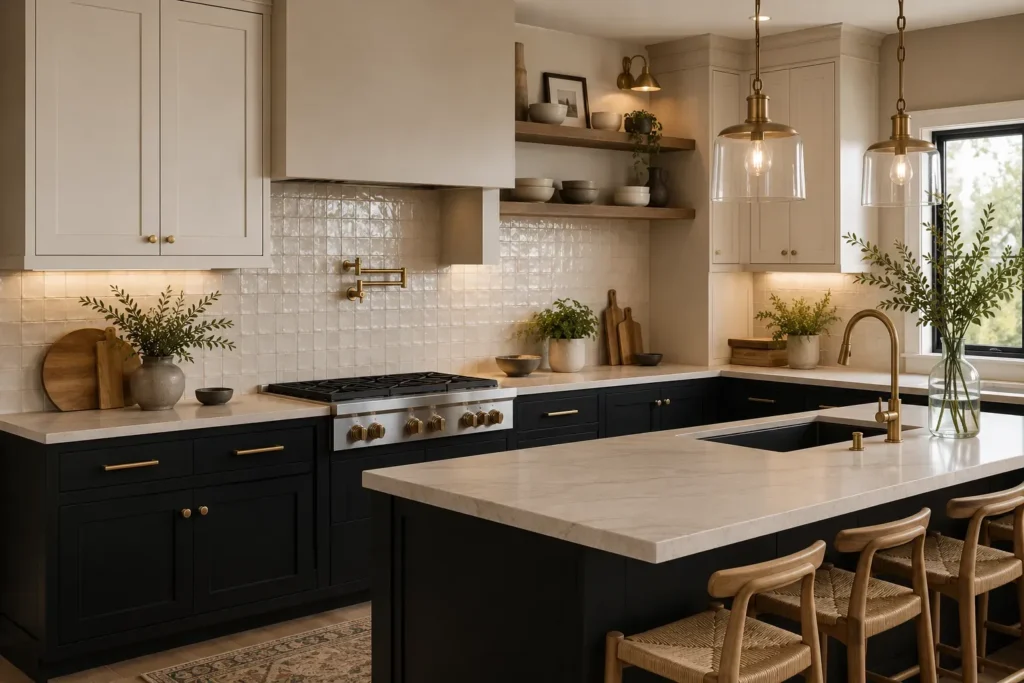
The old tuxedo formula of stark white uppers over black lowers is loosening up. The 2026 version pairs matte black bases with creamy off-whites, warm taupes, and mushroom-toned uppers for a softer contrast. The logic is practical as well as visual: dark lower cabinets swallow scuffs and footmarks in the busiest part of the kitchen, while lighter uppers bounce daylight back into the room. More adventurous clients flip the script entirely, putting black on the uppers above caramel or walnut-stained lowers, which lands as grounded and surprisingly elegant. A black perimeter around a natural wood island is another reliable combination.
In open floor plans, a large black island does the heavy lifting as a single focal anchor while perimeter runs recede in lighter tones. To keep the upper half of the room from feeling top-heavy, designers swap solid upper cabinets for open wood shelving, thick floating panels, or glass-front inserts.
The newest layout idea at the luxury end is the invisible kitchen. The working zone, the range, sink, and prep counter, tucks behind pocket doors or full-height panels that close flush with the wall. Shut them and the kitchen reads as a clean dining or living space. Because those sliding systems have to nest into shallow pockets, counter depths in hidden kitchens often run shallower than the standard 24 to 25 inches, which is a detail worth raising early with your designer.
Worried black will turn a small kitchen into a cave? It is a fair concern, and the honest answer is that solid black struggles in small or low-light rooms, where it absorbs daylight and can feel cramped. The fix is to ration it rather than skip it. Keep black on the lower cabinets or the island, leave the uppers light, layer in good lighting, and pair it with a pale counter and backsplash. Used that way, black adds depth without closing the room in.
Storage and Zoning Are Doing More Work
The single open room is giving way to defined, task-driven spaces, and black cabinetry is a useful tool for separating them. Storage has become a headline feature rather than an afterthought, with homeowners asking for purpose-built zones that keep the counters clear.
| Zone | Why it earns the space | Prevalence |
|---|---|---|
| Pantry cabinets and walk-ins | Pull-outs, spice racks, and appliance garages that keep small appliances off the counter | 47% want a pantry, 16% a walk-in |
| Multifunctional islands | Prep, seating, and integrated appliances in one hub, often in black with a waterfall stone edge | 50% of renovated islands run over 7 feet |
| Butler’s pantries and prep zones | A secondary kitchen that hides the mess during entertaining | Specified by 7% of renovators |
| Task-specific stations | Coffee bars, baking centers, and beverage nooks with their own lighting and organizers | Replacing one-size-fits-all layouts |
Door Profiles: Cleaner Lines, More Texture
Bulky raised-panel doors are on the way out. Three profiles carry the black kitchen in 2026, and the trend within all of them is toward thinner frames and subtle surface texture rather than ornament.
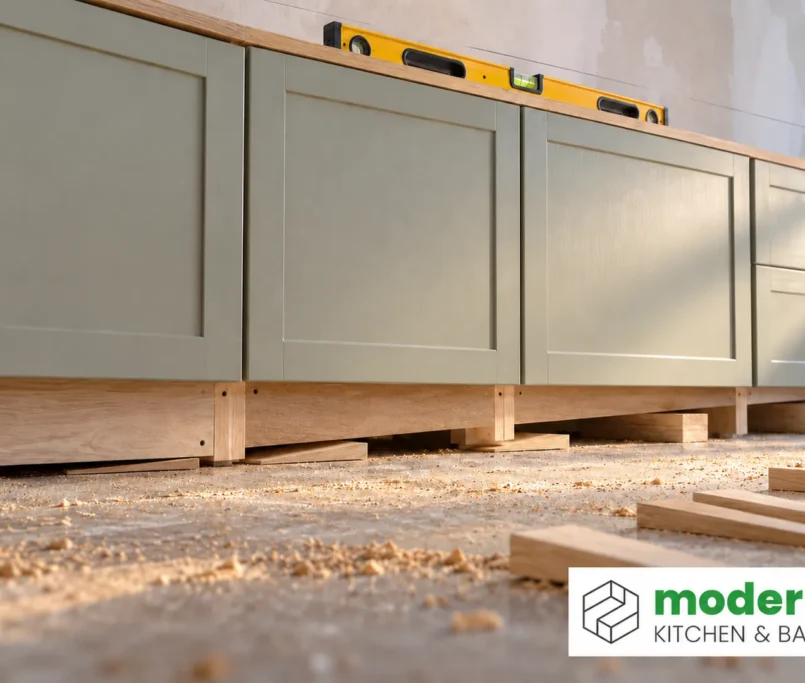
The slim shaker keeps the familiar framed look but trims the rails down for a tighter, more modern proportion that still plays well in transitional and farmhouse rooms. Flat slab doors go the other way, offering an uninterrupted face that shows off either a velvety matte finish or a strong wood grain. European frameless boxes are spreading fast because they squeeze more storage out of the same footprint while reading as one continuous plane. To keep large dark runs from going flat, designers add fluting, reeding, or wire-brushed texture that catches light and shadow across the fronts.
| Door style | Role | Best pairings | Where it fits |
|---|---|---|---|
| Slim shaker | Thin-border bridge between traditional and modern | White oak, matte charcoal, deep plum-brown | Transitional, modern farmhouse, soft coastal |
| Flat slab (frameless) | Minimalist plane that highlights grain or matte black | Walnut, smoked oak, matte black laminate | European contemporary, hidden kitchens |
| Fluted or reeded | Grooved texture that breaks up solid dark surfaces | White oak, cherry, plaster range hoods | Island backs, beverage bars, accent banks |
| Mixed-glass inserts | Lightness and display in heavy dark runs | Reeded, hammered, antique, or tinted glass | Tall perimeter cabinets |
Hardware: Living Metals and the Rule That Changed
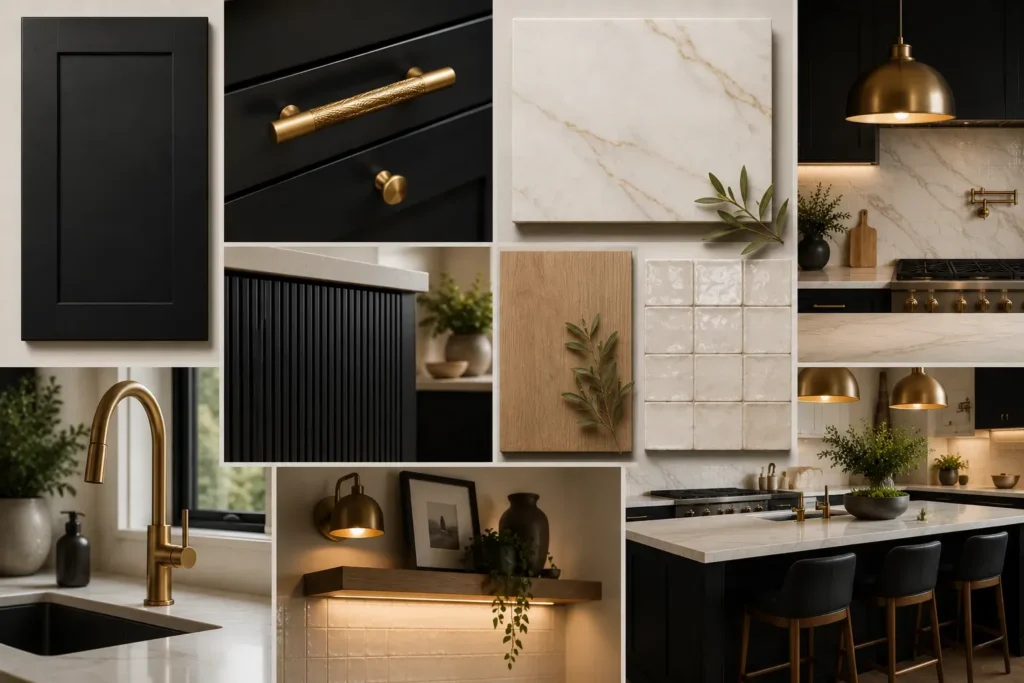
Hardware is where a black kitchen earns its warmth. The cool polished chrome and nickel of the last decade have given way to warm, living metals. Brushed brass, champagne gold, and unlacquered brass lead the field. Unlacquered brass is the one designers single out, because it ages into a unique patina over time, the kind of slow character that fits the wabi-sabi appreciation for wear. Aged bronze and deep copper round out the warm side, and they look especially good against smoke-toned walnut or charcoal oak.
The rule that flipped: stop putting flat matte black hardware directly on black cabinets. It vanishes against the door and loses any ability to define drawer proportions. If you want a monochrome look, use texture instead, blackened steel, brushed black metal, knurled-grip handles, or integrated channel pulls, so the hardware reads through depth rather than color.
Profile matters too. Long, slim bar pulls in the 8 to 18 inch range and low-profile edge pulls suit flat slab fronts, and bar pulls generally outsell simple knobs. Mixing metals is no longer a mistake as long as one metal clearly leads. A common luxury formula runs unlacquered brass on the cabinets, polished nickel or stainless on the plumbing, and matte black or bronze on the lighting. For the cleanest look, integrated pulls, touch-to-open latches, and flush J-pulls remove the hardware from the picture entirely.
Countertops and Backsplashes
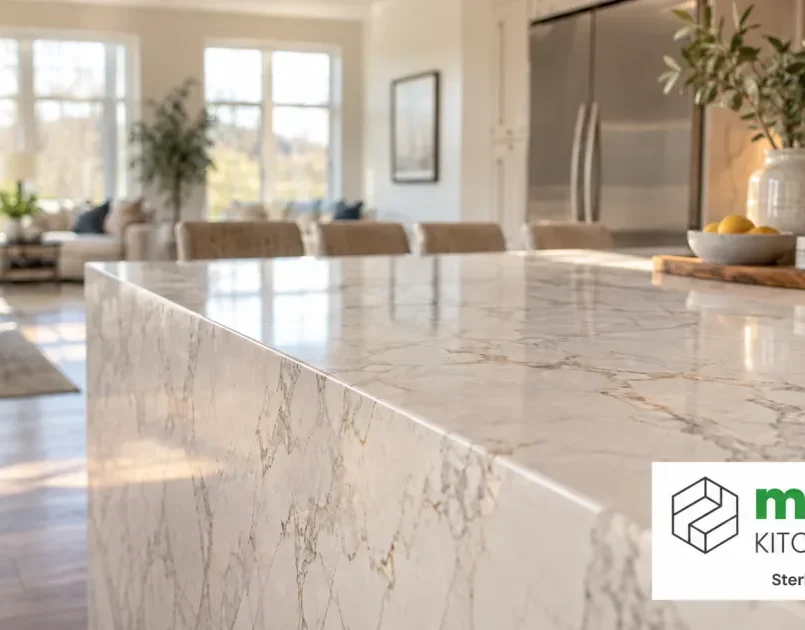
High contrast is still the safe and timeless play. White or light stone against black cabinetry keeps the room bright and lets the cabinets do the dramatic work. White quartz holds its lead on low maintenance, but the genuine shift this year is toward natural quartzite. Varieties like Taj Mahal, Perla Venata, and Mont Blanc give you the look of marble with far better resistance to scratching, etching, and heat, which matters in a kitchen that actually gets cooked in.
Two finishing moves define the high end. The first is the full-height stone backsplash, where the same slab runs from the counter up the wall so the veining flows without a single grout line. The second is the waterfall island, where the stone turns the corner and runs to the floor. On dramatic veined stone, ask your fabricator about bookmatching so the pattern mirrors itself behind the cooktop. Polished surfaces are also giving way to honed, leathered, and matte finishes that cut glare and feel more organic under the hand.
For tile, handmade Moroccan Zellige is the standout against black cabinets. Its slightly irregular surface catches light unevenly and adds a quiet shimmer that keeps the room from feeling sterile, usually in creamy whites, soft sage, dusty blue, or terracotta. A simple layout change does similar work: setting subway tile in a vertical stack or herringbone over a black perimeter gives you a fresh graphic rhythm without any extra material cost.
| Countertop | Backsplash pairing | Effect | Execution tip |
|---|---|---|---|
| Natural quartzite (Taj Mahal, Perla Venata) | Full-height matching slab | Continuous veining, no grout lines, quiet luxury | Bookmatch the cuts behind the cooktop |
| Marble-look quartz (white, gold veining) | Handmade Zellige tile | Organic modern, irregular glaze softens the stone | Warm white grout, straight stack or herringbone |
| Dark granite (Absolute Black, Steel Gray) | White herringbone tile | High contrast that draws the eye up | Keep herringbone to the range wall only |
| Butcher block (island) | Handmade ceramic, earthy tones | Warm farmhouse balance against dark bases | Seal thoroughly near the sink splash zone |
| Porcelain slab | Matching porcelain backsplash | Monolithic, stain and heat resistant | Plan seams and outlets early with your contractor |
Natural Wood Keeps Black Honest
Wood is the warmth that stops a black kitchen from feeling cold. White oak is the most-requested species for 2026, valued for a subtle grain and a tone that sits comfortably next to both light and dark schemes. Walnut brings deep chocolate tones that pop against pale stone, while cherry and alder add a rustic note. For more drama, smoked and charred oak deliver a tactile, almost architectural surface.
The sustainability angle has moved from talking point to spec sheet. Designers are now pairing composite cabinets made from reclaimed materials, including recycled PET, with rich cherry accents, a deliberate conversation between industrial sourcing and traditional craft. Reclaimed oak shelving and butcher-block counters do the same job with less impact. Practically, the easiest places to bring wood into a black kitchen are open shelves, the island base, a wood-wrapped range hood, and the flooring underfoot.
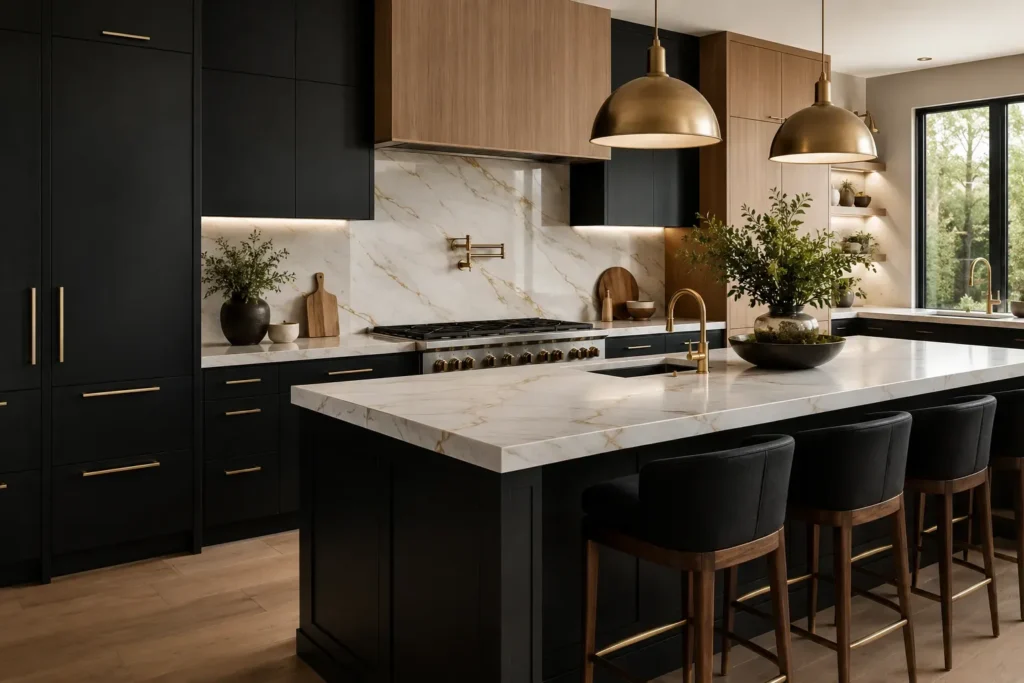
Lighting Is Not Optional in a Black Kitchen
Black absorbs light, so a single overhead fixture will leave the room feeling like a cave. The fix is layering, and 2026 lighting has gotten genuinely interesting.
Over the island, sculptural statement pendants act as the jewelry of the room, often asymmetrical and made from blown glass, textured metal, or colored ceramic. Hang them 30 to 36 inches above the counter and space them evenly. To keep those pendants from having to do the work of task lighting, narrow-beam downlights sit directly over the prep zones for precise, glare-free light. Under-cabinet LEDs brighten the work surface and graze textured stone, while in-cabinet and toe-kick strips add a soft glow that makes heavy black bases look like they float off the floor. Adjustable sconces above open shelving turn a utilitarian wall into something that feels lived in.
Color temperature counts. Stay in the 2700K to 3000K range so the light flatters wood and warm metals instead of fighting them. At the high end, lighting now ties into the smart home: voice and app control for scenes, plus circadian systems that shift from cool, energizing light in the morning to warm amber in the evening.
Mixing Materials Without the Mess
The black kitchens that actually work treat material mixing as the whole point. Glass-front uppers over solid black lowers add transparency. Stainless, brass, and copper catch the light. Textured backsplashes like limestone or fluted marble give the eye something to do behind smooth cabinet faces. The trick is keeping one element clearly dominant so the supporting materials complement rather than compete.
A simple ratio to plan by: roughly 60% dark cabinetry, 30% lighter contrasting surfaces, and 10% wood or metal accents. It keeps a black kitchen from tipping into either flat monochrome or visual noise.
The Honest Counterpoint
Not every designer is sold on black, and it would be dishonest to pretend otherwise. Janiece Lonvelin of Velène Design House predicts that all-black kitchens will begin to decline in popularity in 2026, arguing that solid black can lack the warmth and dimension homeowners increasingly want. As palettes drift toward textured, nature-inspired tones, colors with depth like greige, soft charcoal, muted earth tones, and rich stained woods may feel more inviting than stark black on its own.
There is data behind the caution. MasterBrand’s 2026 survey found light stains ranked as the number one preferred cabinet finish for the first time in nine years of surveys, and a 15% rise in color on the kitchen perimeter points to a hunger for richer, more personal palettes. None of this kills the black kitchen. It just confirms what the best designers already do: use black as a deep foundation, not the entire story.
Resale and the Investment Case
For anyone weighing the spend, black cabinetry holds up as a sound choice. Homes with black cabinets, especially in tuxedo-style configurations, can sell for roughly $6,000 more than comparable homes with standard cabinetry. Black signals a recently updated, design-conscious kitchen, it photographs exceptionally well in listings, and it appeals to a wide range of buyers.
To protect that return, balance black with lighter elements: pale stone counters, strong lighting, and quality hardware. Matte finishes age better in buyers’ eyes than dated gloss, and warm brass or gold pulls add the touch of luxury that justifies a higher asking price.
Maintenance: Plan for It, Don’t Fear It
Here is the honest version, because the internet tends to oversell how carefree black cabinets are. A dark, non-reflective surface shows oil-based residue clearly. Greasy fingerprints, cooking splatter, and water spots leave shiny marks that break up the matte look. The good news is that a consistent, gentle routine keeps them pristine, and the routine is not complicated. It just has rules.
The big one: protect the matte coating. Cleaners with ammonia, bleach, alcohol, silicone, or abrasive powder can strip or scratch it and leave permanent shiny patches that will not buff out. Skip paper towels, which shed lint, and scouring pads, which scratch. A soft microfiber cloth is the only tool you need for daily work.
Two more realities worth planning for: matte and painted black can show fine scratches, and a painted finish may fade slightly over years of sun and scrubbing. Neither is a dealbreaker. Choose a quality factory or UV-cured finish over a cheap painted one, keep abrasive pads away from the doors, and ask your cabinet maker for a small touch-up kit in your exact color so a chip never turns into an eyesore.
| Task | Use this | Avoid this | How often |
|---|---|---|---|
| Daily spot cleaning | Warm water with a few drops of mild pH-balanced dish soap | Paper towels, abrasive sponges, harsh sprays | Daily, or right after cooking |
| Weekly dusting | Dry or barely damp microfiber cloth | Static dusting wipes | Weekly, including cabinet tops |
| Deep grease removal | 70% warm water, 30% distilled white vinegar, a hint of soap, sprayed onto the cloth | Undiluted vinegar, glass cleaner, ammonia | Monthly, around hinges and pulls |
| Tough stains | Baking soda and warm water paste | Bleach, paint strippers, steel wool | As needed on local spots |
One detail people forget: wood movement. If your cabinets are natural wood under a dark stain, keep indoor humidity between 40% and 50%. Too humid and the wood swells and sticks; too dry and joints can shrink and crack. A range hood during cooking and a dehumidifier in wet months handle most of it, and small cabinet-door bumpers stop doors from sticking to frames in a humid Virginia summer.
Quick-Reference Style Matrix
| Style | Door | Hardware | Countertop | Wood accent |
|---|---|---|---|---|
| Modern minimalist | Flat slab, frameless | Integrated or edge pull | White quartz | Open walnut shelving |
| Transitional | Slim shaker | Brushed brass pulls | Quartzite or marble | White oak flooring |
| Farmhouse | Slim shaker | Unlacquered brass | Butcher block island | Reclaimed wood |
| Organic modern | Fluted or reeded | Aged bronze | Honed quartzite | White oak, sage tile |
| Tuxedo / high-contrast | Two-tone shaker | Champagne gold | Calacatta-look quartz | Walnut island base |
| Japandi | Flat slab | Recessed or knurled black | Soapstone or quartzite | Charcoal oak flooring |
The Takeaway
The black kitchen of 2026 is less about the color and more about everything you put around it. Dramatic, light-absorbing cabinetry can absolutely live alongside organic warmth, smart lighting, and durable, low-glare stone. The kitchens that succeed pair clean geometry with rich, light-catching texture, lean on two-tone layouts and wood accents to introduce movement, and treat warm living metals as the finishing detail rather than an afterthought.
Done well, black is the foundation that makes every other material in the room read warmer, brighter, and more considered. Done carelessly, it just makes a room dark. The difference is planning.
Frequently Asked Questions Black Kitchen Cabinet Trends for 2026
Solid all-black kitchens appear on several designers’ dated lists for 2026, but black itself is not over. The shift is toward using black as a grounding layer inside a warmer, richer scheme rather than wrapping a whole room in flat black. The NKBA 2026 report found 96% of designers naming warm neutrals as the dominant palette and 59% reporting a surge in dark finishes, with black layered alongside wood, stone, and warm metals.
Yes, more than light cabinets. Glossy black shows every fingerprint, while matte hides smudges better but still reveals oily marks and dust. A simple routine handles it: wipe with a soft microfiber cloth and mild pH-balanced dish soap, use a 70% water and 30% white vinegar mix for grease, and avoid ammonia, bleach, alcohol, silicone, paper towels, and abrasive pads.
They can if the room is small or low on natural light, because black absorbs light and can feel cramped or cave-like. The fix is not to avoid black but to limit it: put black on the lower cabinets or the island only, keep uppers light, add layered lighting, and pair it with a light countertop and backsplash so the space stays open and airy.
Matte and painted black finishes can show scratches and may fade over time, so they need gentle care and the occasional touch-up. Use only soft microfiber and mild soap, never abrasive pads or harsh cleaners that strip the matte coat, and ask your cabinet maker for a touch-up kit in the exact finish. A quality UV-cured or factory finish resists wear far better than a cheap painted one.
Light stone against black is the timeless high-contrast choice. White quartz stays popular for low maintenance, but natural quartzite such as Taj Mahal, Perla Venata, and Mont Blanc is surging for its marble look with better durability. Warm wood, brass or aged-bronze hardware, and creamy or taupe two-tone uppers all soften black and keep the room from feeling heavy.
They can. Homes with black cabinetry, especially in tuxedo-style configurations, can sell for roughly $6,000 more than comparable homes with standard cabinetry. To protect that return, balance black with lighter elements such as pale stone counters, strong lighting, matte finishes, and quality warm-metal hardware, and consider two-tone or island-only black in lighter-leaning markets.
Matte is the easier daily finish and the leading look for 2026. It hides minor marks and gives black a velvety depth, while glossy black reflects light but shows every fingerprint and speck of dust. Matte does scratch more visibly, so the trade-off is fewer smudges for slightly more care around wear. Glossy can help bounce light in a small, dark kitchen if you do not mind extra wiping.
Thinking about a black kitchen in Northern Virginia?
Modern Kitchen & Home Solutions designs and builds black, two-tone, and warm-wood kitchens across Sterling and the greater DMV. Bring us your space and we will help you balance the drama with the daylight.
Book a Consultation: (571) 517-128947100 Community Plaza #132, Sterling, VA 20164
Found this helpful? Make us your go-to source on Google
If our content has been useful, you can tell Google to show more of it when you search. Click below, then check the box next to Modern Kitchen and Bath on the page that opens. It takes about five seconds.

You'll need to be signed in to your Google account. One click, then tick the box next to our name.