You want a kitchen island. Maybe you’ve been cooking around a cramped countertop for years. Maybe you just saw one at a friend’s house and thought, “I need that.” Fair enough. But the price range is all over the place—$150 for a rolling cart you can order tonight, $30,000 for a custom build with a cooktop, sink, and seating for six.
So what should you actually budget? That depends on the type of island, what it’s made of, and how much work goes into installing it. This guide breaks all of that down with real 2026 numbers—pulled from contractor estimates, industry data, and our own project experience here in Northern Virginia.
Keep in mind: a kitchen island is often part of a larger renovation. If you’re planning a full kitchen overhaul—new cabinets, countertops, flooring, appliances—the island is just one line item in a much bigger budget. Islands now account for roughly 18% to 22% of total renovation spending, according to 2026 industry data. For a complete breakdown of what a full renovation runs this year (including the impact of the current 25% cabinet tariff), see this detailed guide on kitchen remodeling cost. The national average sits around $27,000–$35,000 for a mid-range remodel, but that number climbs significantly in high-cost markets like Northern Virginia.
2026 Pricing Guide
How Much Does a Kitchen Island Cost?
National averages • Northern Virginia data • Updated March 2026
National Average
$5,000
Most homeowners spend $4,000 – $8,000 | Range: $150 – $30,000+
Cost by Island Type
Rolling Cart / Portable
5–10 year lifespan
$150 – $900
Prefab Stationary
15–25 year lifespan
$800 – $5,000
Semi-Custom Build
30+ year lifespan
$3,000 – $7,000
Fully Custom
40+ year lifespan
$6,000 – $15,000+
Elite Appliance Hub
Sink, cooktop, dishwasher • 40+ years
$15,000 – $30,000+
Countertop Material Costs
Per square foot, installed (material + fabrication)
Utility Integration Add-Ons
🚰
Sink + Faucet
$600 – $2,200
🧳
Dishwasher
$1,200 – $3,200
🔥
Gas Cooktop
$1,000 – $2,600
⚡
GFCI Outlets (2)
$350 – $800
💡
Pendant Lights (3)
$600 – $2,400
📜
Permits
$50 – $500+
Northern Virginia vs. National Labor Rates
Why your NOVA quotes run 10–20% higher
Trade
National
NOVA
Premium
Master Plumber
$50–$75/hr
$100–$150/hr
+100%
Master Electrician
$50–$70/hr
$90–$130/hr
+85%
Finish Carpenter
$45–$65/hr
$60–$95/hr
+45%
General Labor
$25–$40/hr
$40–$60/hr
+50%
Edge Profile Surcharges
Eased / Square
Included
Bullnose
$8–$20/ft
Ogee / Dupont
$15–$35/ft
Mitered (thick)
$20–$50/ft
Waterfall Side
$1,500–$2,500
per side
50–80%
ROI at resale
18–22%
Share of total reno budget
25%
Current cabinet tariff
Jan 2027
Tariff jumps to 50%
Cost by Function
Function
Semi-Custom
Fully Custom
Storage + prep
$3K – $8K
$6K – $13K
Seating island
$3.5K – $9K
$6K – $13K
Prep + wash (sink)
$4K – $8K
$7K – $14K
Full working island
$4K – $10K
$8K – $14K
Cooking (cooktop + hood)
$5.5K – $15K
$9K – $15K+
Top Kitchen Island Trends for 2026
Ready to plan your kitchen island?
Free estimates • Sterling, VA • Serving all of Northern Virginia & Washington DC
(571) 325-2454 | Get a Free Quotemodernkitchenva.com • Data: Angi, HomeGuide, Fixr, RSMeans, NKBA 2026 • Updated March 2026
Kitchen Island Cost: The Quick Numbers
Most homeowners spend between $4,000 and $8,000 on a kitchen island in 2026. The national average sits around $5,000.
That said, the range is enormous:
| Category | Typical Cost (Installed) | Expected Lifecycle |
|---|---|---|
| Rolling cart / portable | $150 – $900 | 5–10 years |
| Prefab stationary | $800 – $5,000 | 15–25 years |
| Semi-custom build | $3,000 – $7,000 | 30+ years |
| Fully custom | $6,000 – $15,000+ | 40+ years |
| Elite appliance hub | $15,000 – $30,000+ | 40+ years |
Those numbers include materials and labor. Countertop material alone can account for 30–75% of the total, depending on whether you go with laminate or natural stone.
Kitchen Island Cost by Size
Size is the first thing contractors ask about, because everything—cabinetry, countertop material, labor hours—scales with square footage. A rough rule of thumb: $200 per square foot for a mid-range island, though that figure can double or triple based on material rarity and utility integration.
One detail most estimates leave out: slab yield. A standard large island often requires two full slabs of stone to ensure the veins match and avoid ugly seams. That alone can add $3,000 to $7,000 in material cost before anyone picks up a tool.
| Size (sq ft) | Dimensions | Function | Estimated Cost (NOVA) |
|---|---|---|---|
| 10 sq ft | 2′ × 5′ | Small prep island | $2,000 – $2,500 |
| 15 sq ft | 3′ × 5′ | Standard single-tier | $3,000 – $4,000 |
| 22 sq ft | 3.5′ × 6′ | Seating for 3 | $4,500 – $6,000 |
| 30 sq ft | 4′ × 7.5′ | Full utility + seating | $6,000 – $9,000 |
| 40+ sq ft | 4′ × 10′+ | Entertainer / double sink | $8,000 – $15,000+ |
Minimum clearance: 42 inches on all sides, 48 inches preferred for multi-cook households. If your kitchen can’t support that, you may be looking at structural modifications ($5,000–$15,000) to move a wall or relocate a perimeter counter—costs that can double the project budget before the island itself is purchased.
Types of Kitchen Islands (and What Each One Costs)
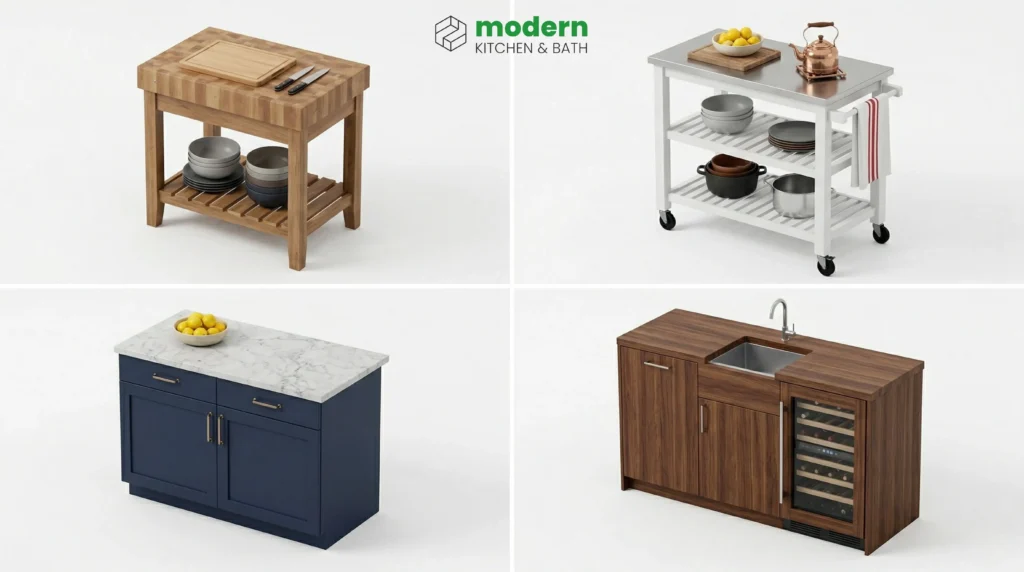
Rolling Cart Island
The entry point. A rolling cart with shelves and a countertop surface costs $150 to $900. You can find decent ones at IKEA, Amazon, or Costco. No installation needed—just unbox it. The tradeoff? Limited storage, no built-in appliances, and a 5–10 year lifespan at best.
Butcher Block Island
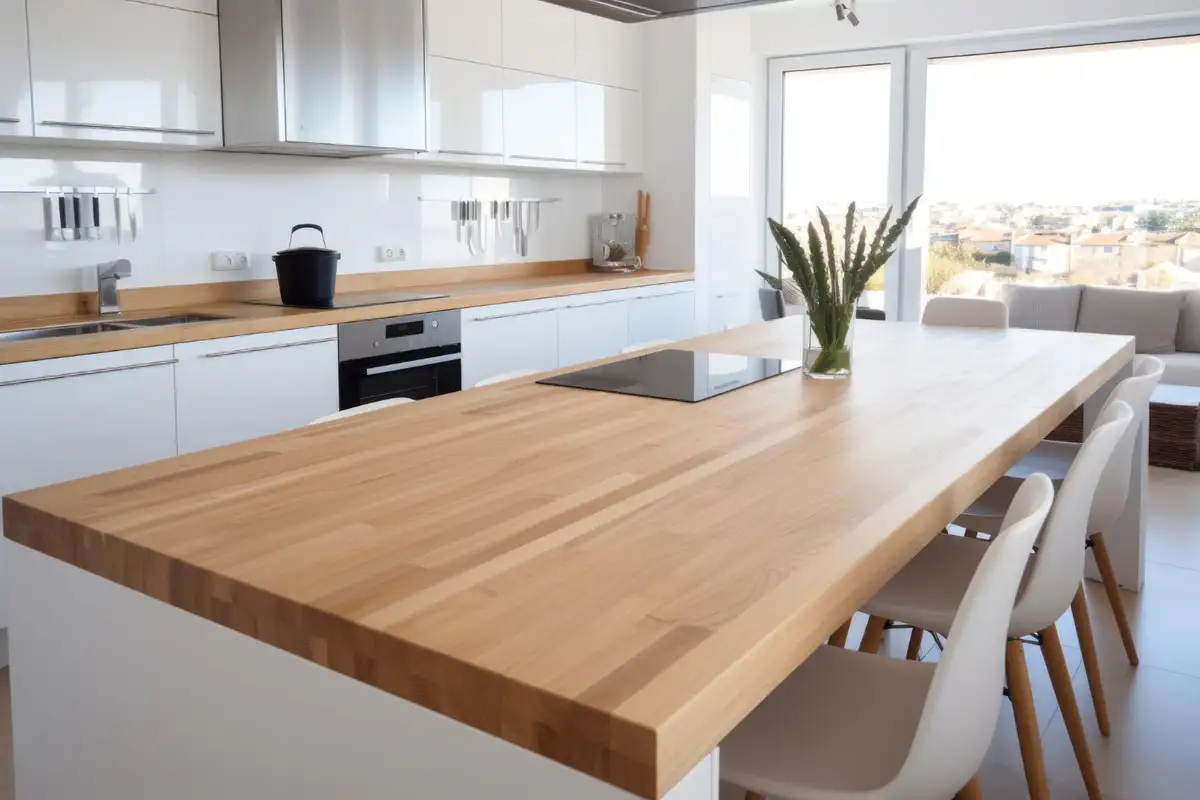
A wooden-top island with or without base cabinets. A basic 2′ × 3′ butcher block runs about $200 without cabinets, $300 with. Swap the wood for laminate and you’re looking at closer to $500. These are solid for small kitchens where you just need more chopping room.
Table Island
Exactly what it sounds like—a freestanding table you use as an island. Prices run from $200 at the low end to $10,000 for a heavy reclaimed-wood piece. No contractor required. No plumbing, no wiring, no permits. For a rental or a first home, this can be a perfectly reasonable choice.
Prefab Stationary Island
A factory-built island in a standard size, usually with cabinets and a countertop included. Expect to pay $800 to $5,000. The main limitation: you can’t customize the dimensions, and most prefab models don’t have slots for a sink or dishwasher. Still, the quality has improved a lot over the past few years, and brands like IKEA and RTA cabinet suppliers offer semi-customizable options in the $1,000–$3,000 range.
Base Cabinet Island With Countertop
This is where things get more serious. A 48″ × 30″ base cabinet island with a separate countertop costs $350 to $5,000, depending on the cabinet type and countertop material. Stock cabinets bring it in on the low end ($100–$500 per linear foot installed). Semi-custom cabinets push it to $150–$700 per linear foot. Custom cabinetry? $500–$1,200 per linear foot.
Custom-Built Island
A custom island is designed from scratch to fit your kitchen’s exact layout, your workflow, and your style. The average cost falls between $3,000 and $10,000. Add a sink, dishwasher, or cooktop, and that can climb to $15,000 or more.
Island With Built-In Appliances
An island with a sink and dishwasher typically costs $3,500 to $8,000 for the appliance integration—on top of the island base. Add a cooktop and range hood, and you’re looking at $6,500 to $10,000+. These islands need plumbing lines ($200–$1,000), electrical wiring ($7–$10 per linear foot), and often a gas line ($500–$2,000). Factor those into your budget early, because they add up fast.
Kitchen Island Countertop Costs by Material
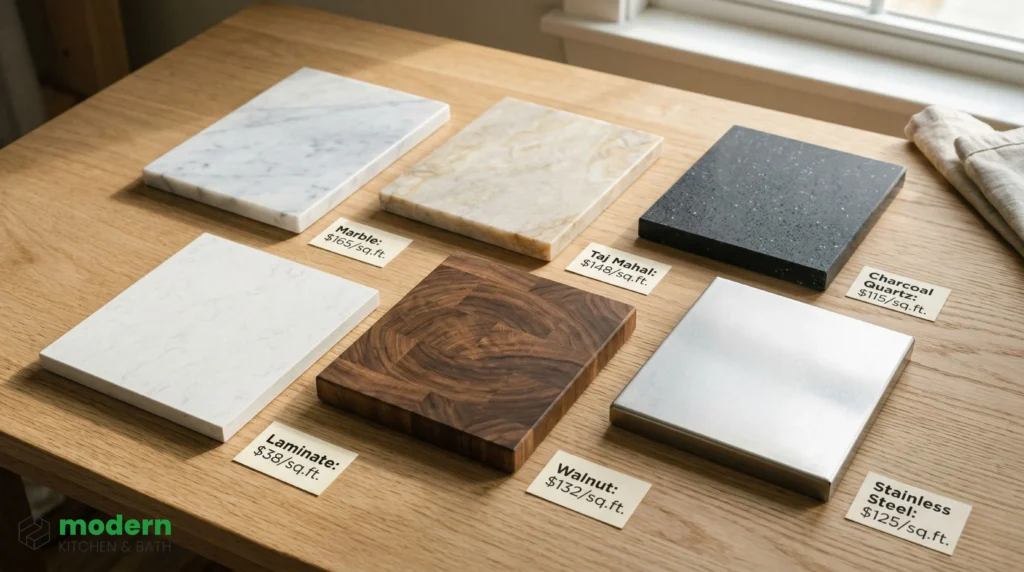
The countertop is usually the most visible—and most expensive—part of the island. In 2026, there’s a clear hierarchy of materials driven by geological rarity and performance. Here’s what each costs per square foot, including material and standard fabrication:
| Material | Installed / Sq Ft | Durability | Maintenance |
|---|---|---|---|
| Laminate | $20 – $60 | Low–moderate | Low – wipe clean |
| Butcher block / wood | $55 – $200 | Medium | High – oil & seal |
| Granite (Level 1) | $45 – $80 | High | Medium – seal annually |
| Granite (exotic) | $150 – $200 | High | Medium – seal annually |
| Quartz (standard) | $70 – $120 | Very high | Very low – non-porous |
| Quartz (premium) | $120 – $200 | Very high | Very low – non-porous |
| Quartzite (standard) | $100 – $150 | Exceptional | Medium – seal periodically |
| Quartzite (Taj Mahal, Cristallo) | $150 – $220+ | Exceptional | Medium |
| Marble (Carrara) | $100 – $250 | Medium (etches) | High – seal often |
| Dekton | $68 – $138 | Excellent | Very low |
| Stainless steel | $80 – $225 | High | Low (shows fingerprints) |
| Concrete | $50 – $100 | Good (can crack) | High – seal regularly |
Quartz remains the market leader in the mid-range and mid-luxury segments. It’s non-porous, maintenance-free, and the advanced slabs now mimic rare Calacatta marble with convincing fidelity. If budget is tight, laminate has improved dramatically—modern versions look like stone at a fraction of the price.
The Quartzite Surge
The rising star of 2026 is natural quartzite. Homeowners want the authenticity of natural stone but need more durability than marble gives them. Quartzite—a metamorphic rock formed from sandstone—delivers extreme hardness and heat resistance that marble can’t match. The catch is the price. Standard quartzite runs $100–$150 per square foot installed. Premium varieties like Taj Mahal or Cristallo push past $220.
Here’s what that math looks like on an actual island: a 30-square-foot countertop in Taj Mahal quartzite at $220/sq ft comes to $6,600 for the surface alone. That single number validates why high-end custom islands land in the $10,000–$15,000 range.
Budget alternative: Some homeowners are choosing “Super White” or “Fantasy Brown” stones—technically dolomitic marbles, not true quartzites—for $50–$80 per square foot. Similar aesthetic, significantly lower price. Another smart play: use a premium quartz on the main work surface and a butcher block on the breakfast bar side. You get the visual interest of mixed materials while cutting the total square footage of expensive stone.
Labor and Installation Costs
Labor typically accounts for about half of the total project cost. On a $5,000 island, expect roughly $2,500 in labor. But the exact number depends on what’s involved—and where you live.
| Work Item | Cost |
|---|---|
| Sink & faucet (supply, drain, install) | $600 – $2,200 |
| Dishwasher (unit + install + drainage venting) | $1,200 – $3,200 |
| Gas cooktop (install + gas line run) | $1,000 – $2,600 |
| GFCI outlets (2 outlets, dedicated circuits) | $350 – $800 |
| Pendant lighting (3 fixtures, installed) | $600 – $2,400 |
| Permits (varies by municipality) | $50 – $500+ |
| Old island demolition & removal | $200 – $500 |
Why Northern Virginia Costs More
If you live in Sterling, Ashburn, Fairfax, McLean, or anywhere in the NOVA region, your quotes will run 10–20% above the national average. In affluent areas like Great Falls or North Arlington, add another 15–25% on top of that. Here’s why—the labor market here is brutal:
| Trade | National Avg / Hr | NOVA Avg / Hr | Variance |
| Master plumber | $50 – $75 | $100 – $150 | +100% |
| Master electrician | $50 – $70 | $90 – $130 | +85% |
| Finish carpenter | $45 – $65 | $60 – $95 | +45% |
| General labor | $25 – $40 | $40 – $60 | +50% |
The competition for master electricians and plumbers in Loudoun and Fairfax counties is fierce. Commercial projects for data center firms drain the residential subcontractor pool, pushing rates to nearly double the national average. If you’re relying on a generic online cost calculator, those numbers will lowball you by 30–40% in this market.
Always get at least three written, line-itemized estimates from licensed, insured contractors. Compare trade-by-trade, not just the bottom number.
What Does a Kitchen Island Cost by Function?
Not every island does the same job. A prep-only island costs a lot less than one built for cooking:
| Island Function | Semi-Custom | Fully Custom |
| Storage + prep only | $3,000 – $8,000 | $6,000 – $13,000 |
| Seating island | $3,500 – $9,000 | $6,000 – $13,000 |
| Prep + wash (sink) | $4,000 – $8,000 | $7,000 – $14,000 |
| Full working island | $4,000 – $10,000 | $8,000 – $14,000 |
| Cooking island (cooktop + hood) | $5,500 – $15,000 | $9,000 – $15,000+ |
The jump from “storage + prep” to “cooking island” isn’t just the cooktop. It’s the range hood, the gas line, the electrical, the ventilation ductwork—those ancillary costs are where budgets get blown.
Cost to Replace an Existing Kitchen Island
Replacing an old island adds demolition and removal on top of the new installation. Budget $200 to $500 for removal, or more if plumbing and electrical need disconnecting.
If the plumbing and wiring from your old island are still in good shape, the replacement is simpler and cheaper. A contractor can often reuse existing connections rather than running new ones from scratch.
Total replacement cost: Add $300–$600 to whatever you’d pay for a brand-new island of the same type.
DIY vs. Hiring a Professional
Can you install a kitchen island yourself? Yes—if it’s a prefab or RTA unit with no plumbing or electrical. DIY installation costs $200 to $1,500 in materials and saves you $500–$2,000 in labor.
Anything involving a sink, dishwasher, cooktop, gas line, or new electrical circuit needs a licensed professional. Improperly installed plumbing can flood your kitchen. Bad wiring can start a fire. And unpermitted work can tank your home’s resale value.
A middle ground: buy RTA cabinets and assemble them yourself, then hire a plumber and electrician for the hookups. You save on cabinet labor while keeping the risky stuff in expert hands.
What Drives Kitchen Island Cost Up (or Down)
Countertop Material
Already covered in detail above. The countertop is the single biggest variable. Laminate at $20/sq ft versus Taj Mahal quartzite at $220/sq ft is a $6,000 difference on a 30-square-foot island. Pick the countertop before you finalize the budget.
Cabinet Quality and the 2026 Tariff Window
Stock cabinets: $100–$500 per linear foot installed. Semi-custom: $150–$700 per linear foot. Custom: $500–$1,200 per linear foot. The cabinet choice alone can swing the total by $3,000 or more.
One factor worth flagging: a 25% tariff on imported kitchen cabinets remains in effect through 2026, with a planned increase to 50% in January 2027. That tariff has narrowed the price gap between budget imports and entry-level domestic semi-custom lines—domestic manufacturers have used the “tariff umbrella” to maintain margins rather than lower prices. If you’re planning a late-2026 project, lock in cabinet pricing before the Q4 bottleneck hits. Industry insiders expect a surge of orders as homeowners rush to beat the January 2027 hike.
Island Shape and Fabrication Surcharges
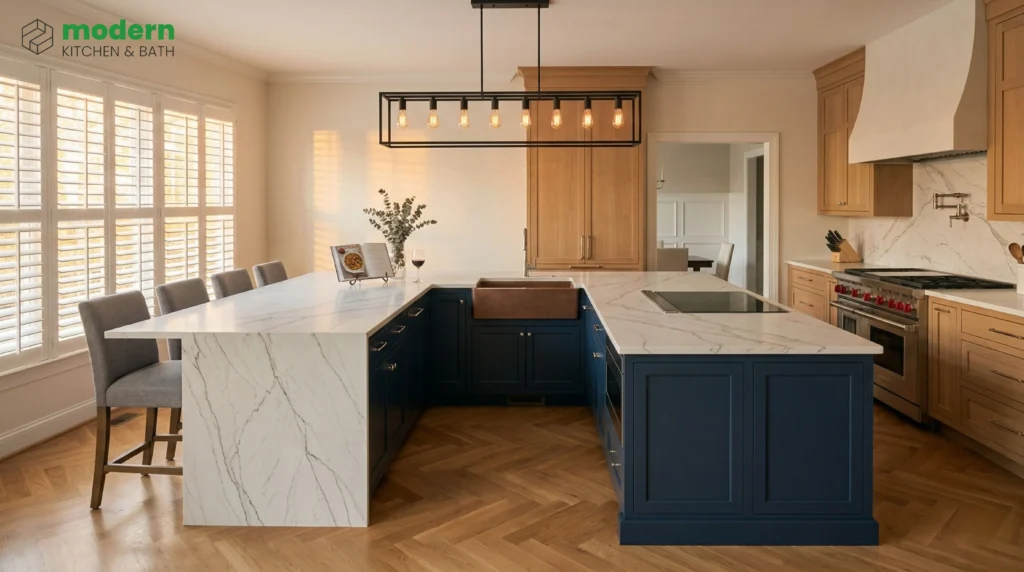
Rectangular islands cost the least. Curved and organic shapes—a major 2026 trend—require custom cabinetry manufacturing and curved stone edges (bullnose, large-radius corners) that add $10–$30 per linear foot in extra labor. Expect a 15–30% premium over a standard rectangle.
Waterfall Edges: Beautiful, Expensive
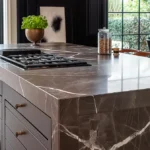
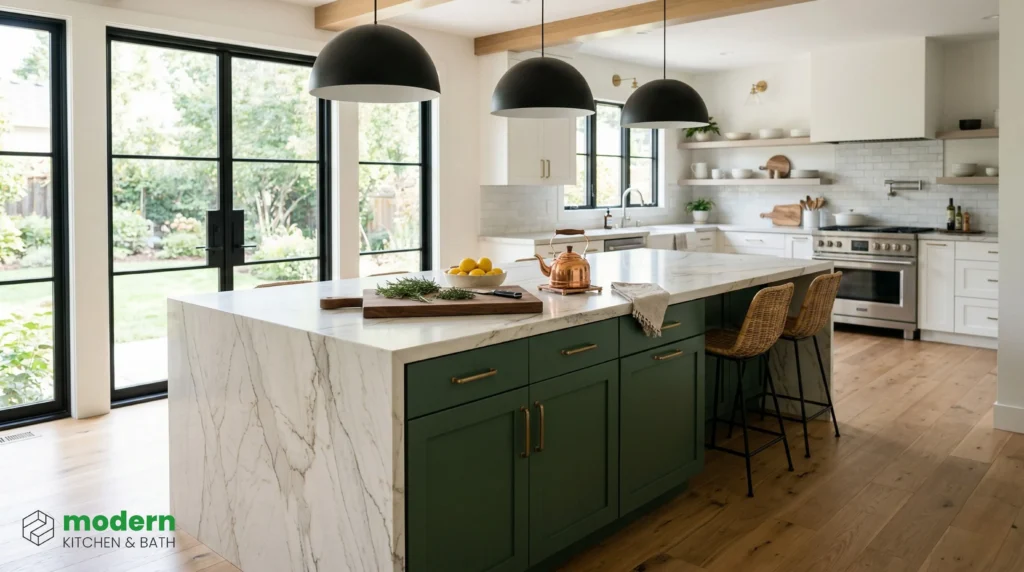
A waterfall edge—where the countertop material continues vertically down the sides to the floor—is stunning with boldly veined stone. It’s also a budget multiplier. Each waterfall side adds $1,500 to $2,500 in 2026. The stone must be cut at a precise 45-degree mitered joint so the veins align as they “pour” over the edge. That CNC machining and hand-finishing adds $20–$100 per linear foot on top of the slab cost.
A two-sided waterfall on a quartzite island can add $3,000–$5,000 to the countertop budget alone. Factor that in before you fall in love with the Pinterest photo.
| Edge Profile | Cost Per Linear Ft |
|---|---|
| Eased / square (standard) | $0 (included) |
| Beveled / bullnose | $8 – $20 |
| Ogee / Dupont | $15 – $35 |
| Mitered (thick look) | $20 – $50 |
| Waterfall side | $1,500 – $2,500 per side |
Appliance Integration
Every appliance you add increases cost significantly. A combined sink and dishwasher installation can easily add $3,500 to $8,000. Add a gas cooktop and you’re looking at another $1,000–$2,600 including the gas line run. Plan these out before construction starts—retrofitting is always more expensive.
Lighting
Pendant lights run $100 to $300 each installed. Most islands look best with 2–3 pendants. Three pendants fully installed (fixtures + labor) can total $600–$2,400. In 2026, oversized statement pendants and asymmetric multi-fixture arrangements are the move.
Kitchen Island Trends Shaping 2026
Island design is shifting. Here’s what we’re seeing in our projects and across the industry:
- Curved and organic shapes. Rounded edges, organic silhouettes, and softened corners—expect a 15–30% premium, but the result feels like furniture rather than a box.
- Mixed-material surfaces. Stainless steel for the prep zone paired with a timber breakfast bar on the seating side. Leathered granite next to a polished slab. Functional zones with visual contrast.
- Waterfall countertops. The countertop continues down the sides to the floor—$1,500–$2,500 per side, but dramatic with boldly veined marble or quartzite.
- Multi-functional hubs. Split-level designs, built-in charging stations, wraparound seating. Islands pulling triple duty as prep stations, home offices, and gathering spots.
- Warm, earthy finishes. Honey and walnut wood tones. Statement colors like petrol blue, ochre, or forest green on the island base. The sterile all-white kitchen is fading fast.
- Sculptural lighting. Oversized pendants at varying heights, chrome and brass finishes. Lighting treated as three-dimensional installations, not afterthoughts.
- Hidden tech. Concealed induction hobs, pop-up outlets, wireless charging pads, and sensor-equipped storage that tracks pantry inventory from your phone.
Does a Kitchen Island Increase Home Value?
Short answer: yes, almost always. Industry estimates put the return at 50% to 80% of the cost. The 2025 Cost vs. Value Report found that minor kitchen remodels—which often include island additions or upgrades—deliver roughly 113% ROI nationally.
The return depends on execution. An island that fits the kitchen, uses quality materials, and adds real functionality will outperform a cramped afterthought that blocks traffic flow.
In Northern Virginia (Sterling, Reston, Fairfax, Ashburn, Leesburg, and surrounding areas), a kitchen island is practically expected in mid-to-upper-range homes. Not having one can actually hurt your listing.
6 Ways to Save Money on Your Kitchen Island
- Choose stock or RTA cabinets instead of fully custom. You can save $2,000–$5,000. In 2026, high-end RTA lines are often indistinguishable from custom work once the countertop and hardware are installed.
- Use laminate or butcher block for the countertop. At $20–$75 per square foot installed, you’ll save thousands compared to stone.
- Skip the plumbing. A prep-only island without a sink or dishwasher avoids $1,000–$3,000 in plumbing costs.
- Reuse existing connections if replacing an old island. Same plumbing location, same electrical—less labor.
- Shop local cabinet makers. Custom shops in Sterling, Manassas, and Chantilly often match national premium brand quality at 15–25% lower cost due to reduced shipping and marketing overhead.
- Lock in cabinet pricing before Q4 2026. The January 2027 tariff hike to 50% will trigger a rush of orders, extending lead times and pushing installation labor rates up temporarily.
Frequently Asked Questions
How much does a kitchen island cost on average?
The national average is about $5,000 in 2026. Most homeowners spend between $4,000 and $8,000. Simple prefab models start under $1,000, while fully custom islands with appliances can exceed $15,000.
How much does it cost to build a custom kitchen island?
A custom-built kitchen island typically costs $3,000 to $10,000, depending on size, cabinetry, countertop material, and features. Larger islands with integrated appliances can reach $15,000 to $30,000.
How much does it cost to install a kitchen island with a sink?
A combined sink and dishwasher installation adds $3,500 to $8,000 on top of the base island cost, including plumbing lines, drainage venting, the sink, faucet, and electrical hookups.
Is it cheaper to buy a prefab island or build one?
Prefab is almost always cheaper. A prefab stationary island runs $800 to $5,000, while building a comparable custom island starts at $3,000. The gap narrows with RTA cabinets and DIY assembly.
Can I install a kitchen island myself?
Yes, if it’s a freestanding or RTA model with no plumbing or electrical hookups. For anything involving a sink, dishwasher, cooktop, or new circuits, hire licensed professionals.
Does a kitchen island need a permit?
Usually, yes—if it’s permanently attached or involves plumbing, gas, or electrical work. Permits cost $50 to $500+. In Fairfax County, permit fees saw a 12.5% increase in mid-2025, plus technology surcharges that add to the total.
How much does a waterfall countertop edge cost?
Each waterfall side adds $1,500 to $2,500 in 2026. The mitered joint fabrication—cutting stone at a precise 45-degree angle for vein matching—adds $20–$100 per linear foot. A two-sided waterfall on a quartzite island can add $3,000–$5,000 to the countertop budget.
What is the best countertop material for a kitchen island?
Quartz leads the market for good reason: durable, low-maintenance, wide color range. Quartzite is gaining ground fast for those who want natural stone with real hardness. Laminate works well for budget projects. The “best” choice depends on your budget, cooking habits, and maintenance tolerance.
How long does it take to install a kitchen island?
A prefab island: a few hours. A semi-custom with no plumbing: 1–3 days. A full custom build with appliances: 1–4 weeks, not including material lead times (1–6 weeks for specialty items) or permit processing (1–4 weeks).
How much space do I need for a kitchen island?
Minimum clearance: 42 inches on all sides, 48 inches preferred. The island should not exceed 10% of the kitchen’s total floor area. A 150-square-foot kitchen caps out at a 15-square-foot island.
What’s the ROI on a kitchen island?
50–80% cost recovery is the standard estimate. Minor kitchen remodels that include island work can deliver even higher returns—up to 113% nationally. In competitive markets like Northern Virginia, a well-designed island helps a home sell faster and closer to asking price.
Getting Your Kitchen Island Right
The price tag on a kitchen island covers more than materials and labor. It’s buying counter space, storage, a gathering spot, and—if you play your cards right—a bump in resale value. Whether you’re looking at a $500 rolling cart or a $15,000 custom build with a waterfall quartzite top and an integrated cooktop, the key is matching the island to how you actually use your kitchen.
Start by measuring your space. Figure out what the island needs to do. Then pick materials and features that fit both your budget and your timeline. If you’re in Sterling, VA, or Northern Virginia, we’re happy to walk through the options with you—no pressure, no sales pitch. Just honest guidance from a team that builds these every week.
Modern Kitchen & Home Solutions
47100 Community Plaza #132, Sterling, VA 20164
(571) 325-2454 | info@modernkitchenva.com | modernkitchenva.com
Serving Sterling, Reston, Fairfax, Ashburn, Leesburg, Arlington, Alexandria, Chantilly, Centreville, McLean, and Washington DC
Found this helpful? Make us your go-to source on Google
If our content has been useful, you can tell Google to show more of it when you search. Click below, then check the box next to Modern Kitchen and Bath on the page that opens. It takes about five seconds.

You'll need to be signed in to your Google account. One click, then tick the box next to our name.