The first time we opened up a kitchen wall in a 1998 Sugarland Run colonial and smelled it, we knew the conversation about sustainable kitchens had to change. That kitchen had been re-cabineted in 2009 with what the homeowner was told were “premium” boxes. Twelve years later, the formaldehyde signature coming off the particleboard substrate was still strong enough that the demo crew swapped to N95 masks for the rest of the day.
We’ve rebuilt a lot of NoVA kitchens since that one. Sterling, Ashburn, Reston, Vienna, Herndon, Fairfax, Leesburg. Hundreds of teardowns. And the homeowner question we hear the most in 2026 isn’t about trends. It’s some version of: “How do I make sure I’m not paying for the same problem twice?”
That’s what this guide is about. Not 30 generic “eco-friendly ideas,” but the materials, certifications, rebates, and decisions that actually hold up when you live inside a kitchen for fifteen years. Real 2026 Northern Virginia pricing. Real Virginia rebate dollars. The greenwashing claims we’ve watched fail in the field. And the choices that earned their premium back, sometimes inside a single year.
<!– ========================================================== STANDALONE INFOGRAPHIC — SUSTAINABLE KITCHEN REMODELING 2026 Modern Kitchen & Bath (modernkitchenva.com) ========================================================== PURPOSE: Single-page hero infographic for social distribution, Pinterest pinning, or embedding at the top of the article. – Zero CSS classes, zero blocks — fully inline – Brand colors: Green: #2D9B3A Dark charcoal: #333333 Light gray: #F5F5F5 Accent dark: #1B1B1B ========================================================== –>What “Sustainable” Actually Means When You’re Standing in Your Kitchen
The word sustainable gets stretched so thin in remodeling marketing that it stops meaning anything. So before we get to materials, here’s the working definition we use on every job site.
A sustainable kitchen does three things at once:
The materials inside it came from somewhere accountable. The forest was managed. The factory tracked its inputs. The finish was tested for what it puts into your air. None of that is automatic. It requires certifications you can actually verify.
The air inside the kitchen stays clean for fifteen years. Cabinets, finishes, adhesives, and flooring all off-gas. The question is how much, for how long, and what they emit. A kitchen that smells like a chemistry set for six months after install is not a healthy kitchen, regardless of how it photographs.
The appliances and fixtures use less energy and water than what they replaced. Not just on paper. In the actual house, with the actual usage pattern of the actual family.
If a remodel hits all three, it’s sustainable. If it hits two out of three, it’s better than what you had. If it hits one or zero, it’s marketing.
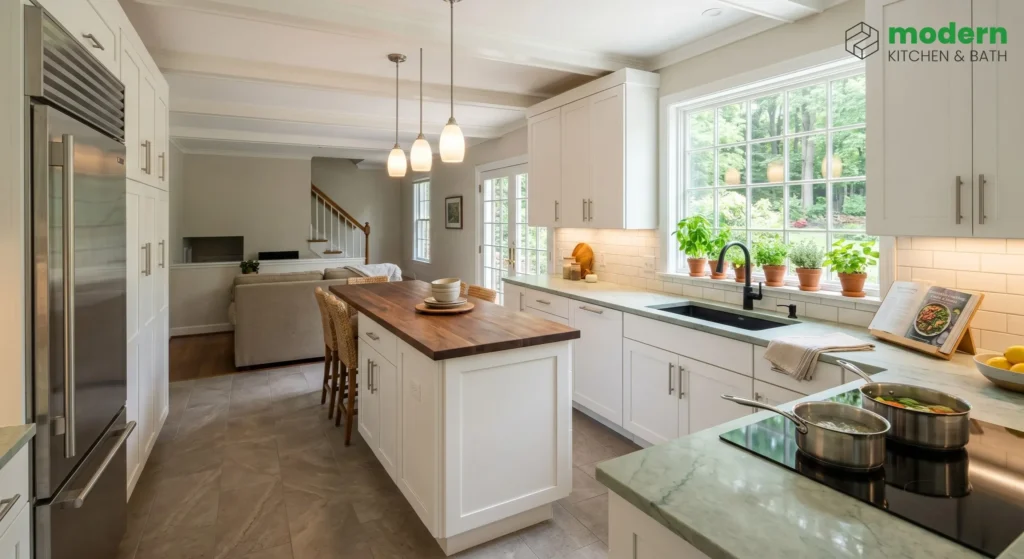
Three Greenwashing Patterns We See in Sterling and Loudoun Showrooms
Before walking through the materials, three traps to know about. Customers bring these to us almost weekly.
“Eco-friendly” with no certification number. A finish that calls itself low-VOC without a GREENGUARD, CARB Phase 2, or TSCA Title VI compliance label is making a claim, not a guarantee. Any reputable manufacturer can produce the third-party test certificate on request. If the rep can’t, the claim is empty.
Bamboo without a source. Bamboo is sold as the sustainable cabinet hero, and properly sourced strand-woven bamboo is excellent. But bulk bamboo from unverified Chinese suppliers can come from pesticide-heavy farms that displaced native forest. The FSC chain-of-custody documentation is what separates real sustainable bamboo from a marketing exercise.
ENERGY STAR labels installed for higher capacity. A 36-inch ENERGY STAR refrigerator that replaces a 28-inch one nets out worse, not better, because the energy savings per cubic foot are eaten by the larger footprint. The label is real. The math is the homeowner’s responsibility.
Eco-Friendly Kitchen Cabinets: What Certifications Mean in the Field
Cabinets are the biggest single material decision in your remodel and the one most exposed to greenwashing. About 32 to 37 percent of NoVA buyers now ask specifically about cabinet sourcing before they sign a contract, up from roughly 12 percent in 2022. The certifications below are the only language that matters once you push past the showroom talking points.
CARB Phase 2 and TSCA Title VI
CARB Phase 2 is the California Air Resources Board emission standard for composite wood products. It caps formaldehyde at 0.05 ppm for hardwood plywood, 0.09 ppm for particleboard, and 0.11 ppm for MDF. TSCA Title VI is the federal EPA equivalent. Every composite wood product manufactured for sale in the U.S. after March 22, 2019 must carry one of these labels.
What this means on the job: every cabinet box you can legally buy in the United States is technically compliant. That’s the floor, not a differentiator. If a brand brags about CARB Phase 2 compliance as if it’s special, they’re padding their pitch. The brands worth paying for go further.
GREENGUARD and GREENGUARD Gold
GREENGUARD Gold is the meaningful step up. Total VOC emissions capped at 220 micrograms per cubic meter (compared to 500 for standard GREENGUARD), formaldehyde capped at 9 micrograms per cubic meter (compared to 61.3 for standard), and phthalate testing included. This is the certification we recommend for any household with children, anyone with asthma or respiratory sensitivity, or kitchens that connect to bedrooms through open layouts.
FSC (Forest Stewardship Council)
FSC certification tracks wood from the forest through the supply chain to the finished product. Three variants exist: FSC 100% (everything came from FSC-certified forests), FSC Recycled (recovered materials), and FSC Mix (a verified percentage from FSC sources plus controlled non-FSC wood). For cabinets, look for FSC Mix Credit or FSC 100%. The chain-of-custody certificate number can be checked at info.fsc.org.
KCMA ESP
The Kitchen Cabinet Manufacturers Association Environmental Stewardship Program is industry-specific. ESP certified cabinet brands are audited annually on material sourcing, waste reduction, manufacturing emissions, and energy use. Crystal Cabinet Works, Shiloh, and David Bradley are three brands we’ve installed repeatedly that hold active ESP certifications.
The Cabinet Materials Worth Specifying
Real sustainable cabinets in 2026 use one or more of the following:
FSC-certified solid hardwood for face frames and doors. Oak, maple, cherry, and walnut all available with verified sourcing. Adds approximately 10 to 18 percent to cabinet cost compared to non-certified equivalents.
Formaldehyde-free MDF or plywood for boxes. Look for “NAF” (No Added Formaldehyde) or “NAUF” (No Added Urea Formaldehyde) on spec sheets. Cabinets using soy-based or PVA adhesives now match the structural performance of traditional urea-formaldehyde boards.
Bamboo with FSC chain-of-custody. Strand-woven bamboo runs harder than oak (Janka rating ~3,000 vs oak’s ~1,290) and harvests in five years instead of forty.
Reclaimed wood for islands, open shelving, or feature pieces. Diverts material from landfill, adds character, and avoids the new-growth supply chain entirely.
Low-VOC water-based finishes. Avoid solvent-based polyurethane and conventional lacquer. Water-based finishes from manufacturers like ML Campbell, General Finishes, and Target Coatings cure to comparable hardness with 80 to 90 percent fewer VOCs released during application and curing.
A fully certified, well-sourced cabinet package in a typical Sterling kitchen runs $14,000 to $32,000 in 2026. Conventional comparable cabinetry runs $11,000 to $26,000. The premium is real but smaller than most homeowners expect, especially when you factor in the longer service life. Properly sourced cabinets routinely last 25 to 35 years. Bargain-tier cabinets fail at the box joinery in 8 to 12 years.
Sustainable Countertop Options for 2026 Northern Virginia Kitchens
“Eco friendly countertops” is the highest-volume search in this entire topic cluster, which tells us homeowners are actively shopping for them. Here’s how the major options actually perform, in price order.
Butcher block (FSC-certified hardwood). Maple, walnut, oak, or cherry from FSC sources. Installed cost in 2026 NoVA: $40 to $75 per square foot. Requires oiling every three to six months. Best for islands, prep stations, or homeowners who want a working, evolving surface. Not ideal as full perimeter countertop for households that hate maintenance.
Recycled glass terrazzo (Vetrazzo, IceStone, Curava). Crushed post-consumer glass set in a cement or resin binder. Installed cost: $60 to $130 per square foot. Highly distinctive look, durable, non-porous. Vetrazzo’s resin variant resists staining better than cement-based options. Heavy, which can complicate Sterling and Reston cabinet installs in older homes with weaker substructure.
Quartz with recycled content (Cambria, Caesarstone EcoLine, MSI Q Premium). Engineered quartz with 25 to 90 percent recycled material. Installed cost: $70 to $145 per square foot. The most popular sustainable countertop choice we install in NoVA. Cambria manufactures in Minnesota (no tariff impact), holds GREENGUARD Gold, and is FSC-aligned. Caesarstone’s EcoLine series uses 50 to 90 percent recycled content.
Paper composite (PaperStone, Richlite). Pressure-compressed recycled paper with a non-petroleum resin binder. Installed cost: $80 to $160 per square foot. Looks like soapstone, feels like soapstone, costs less than soapstone. Surprisingly durable; we’ve installed it in Vienna and Falls Church kitchens with no surface complaints six years later. Develops patina over time.
Reclaimed wood or stone slab. Salvage yards in NoVA (Caboose Commons in Fairfax, Community Forklift in Edmonston) carry reclaimed butcher block sections, vintage soapstone, and salvaged marble. Pricing varies wildly. Specify carefully.
Quartz with recycled content is the sweet spot for most Sterling, Ashburn, and Fairfax kitchens. Performance matches conventional quartz, certification is verifiable, and the cosmetic options have expanded enough that you don’t have to sacrifice design to specify a sustainable slab.
Energy-Efficient Appliances and the Induction Conversion
The single most impactful sustainable upgrade we install in NoVA kitchens isn’t a material. It’s the induction conversion.
Induction Cooktops vs. Gas: The Field Reality
Gas cooktops are about 40 percent efficient. The other 60 percent of the heat escapes around the pan into the room, which is both a comfort problem (your kitchen runs hot all summer) and an indoor air quality problem (combustion byproducts including NO2 vent into the room before the hood catches them).
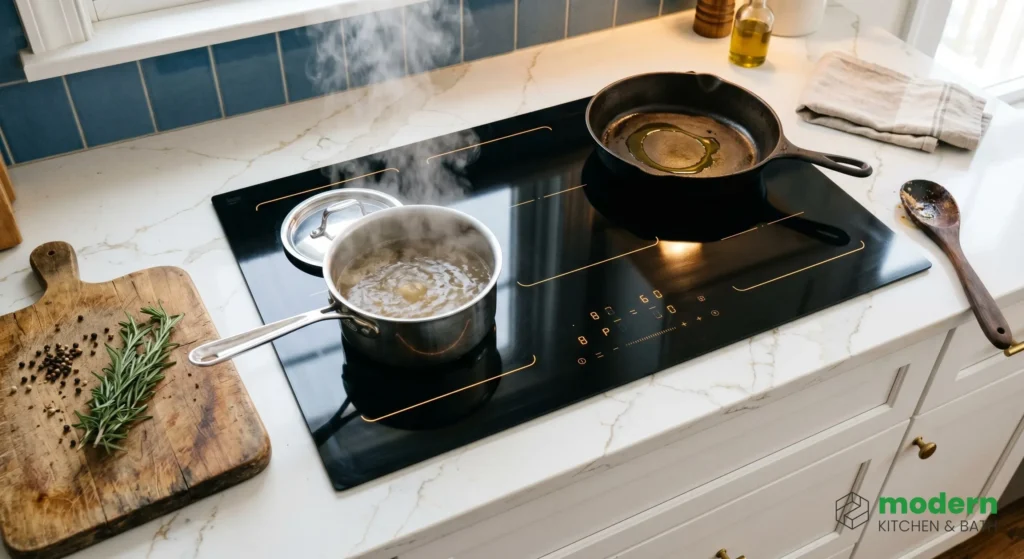
Induction is 85 to 90 percent efficient. The cooktop only heats the pan, not the air. Water boils in 2 to 3 minutes instead of 4 to 6. Indoor temperature in the kitchen during heavy cooking is noticeably lower. And there’s no combustion to ventilate, which matters more than most homeowners realize. The EPA has documented elevated NO2 and PM2.5 levels in homes that cook with gas, particularly in tight-envelope newer construction.
In Northern Virginia, the induction conversion takes one of two paths. If you already have a 240V circuit running to an existing electric range, swapping in induction is straightforward and runs $1,400 to $4,500 for the cooktop itself. If you’re converting from gas, add $800 to $2,000 for the new dedicated 240V circuit and the gas line cap, depending on how far your electrical panel sits from the kitchen.
This is also where Loudoun and Fairfax County panel realities catch people. Homes built between 1978 and 2000 often have 100-amp or 150-amp service. A modern kitchen with induction, a heat pump water heater, an electric oven, and a smart refrigerator can push that capacity past safe limits. Plan on a 200-amp panel upgrade in many of these homes. Budget $2,000 to $4,000 in our market for the upgrade itself, plus permit and inspection.
Heat Pump Water Heaters
Heat pump water heaters use roughly 60 percent less electricity than standard electric resistance models. They take more space (figure 24 to 30 inches of clearance around the unit) and they’re slightly louder than a conventional tank, but the savings show up immediately on the Dominion Energy bill. We typically install them in the garage or utility room, not the kitchen itself, but they belong in a sustainable kitchen budget because hot water demand at the sink is a major energy line item.
Dominion Energy currently offers a rebate of up to $400 on qualifying heat pump water heaters. Combined with the federal 25C tax credit, the net cost difference vs. a conventional electric tank typically lands under $600.
ENERGY STAR Refrigerators and Dishwashers
ENERGY STAR refrigerators use approximately 40 percent less electricity than equivalent models from 2014. Dishwashers with the certification reduce water consumption per cycle by 15 to 20 percent. The marketplace runs deep here. Almost every reasonable brand offers ENERGY STAR options. The bigger decision is sizing.
A common NoVA mistake: replacing a 26-cubic-foot refrigerator with a 36-cubic-foot ENERGY STAR model and assuming the lower per-cubic-foot consumption nets out to savings. It doesn’t. The bigger box uses more total energy. Match capacity to actual household need, not aspiration.
Water Conservation Built Into the Remodel
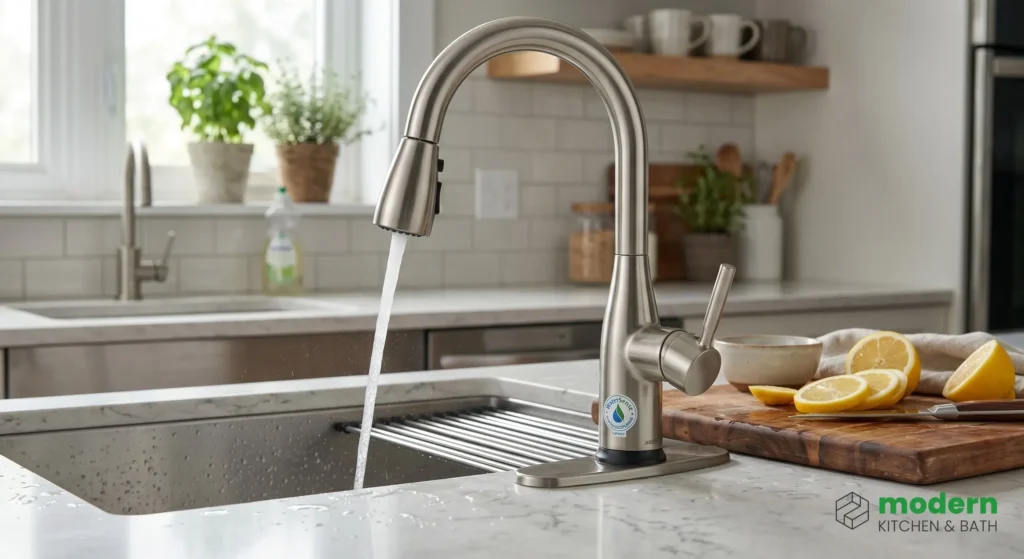
The EPA’s WaterSense program certifies fixtures that use at least 20 percent less water than standard equivalents while delivering equal performance. WaterSense-certified kitchen faucets max out at 1.5 gallons per minute (compared to 2.2 gpm for standard faucets) but use aeration to maintain effective flow.
For a Loudoun County household pulling water from Loudoun Water (the regional utility), switching from a 2.2 gpm faucet to a 1.5 gpm faucet saves approximately 700 gallons per year for an average family of four. Combined with a smart dishwasher running sensor-optimized cycles, total kitchen water savings run 1,800 to 2,400 gallons annually. Not a fortune, but real, and the WaterSense premium over a standard faucet is typically zero to $30 at retail.
A note on Loudoun water hardness. The regional supply runs harder than average for Virginia (the Goose Creek and Potomac source water both carry notable mineral content). Fixtures with ceramic disc valves and quality aerators are more important here than in soft-water markets. We’ve replaced a lot of bargain faucets in Ashburn and Cascades because the valves seized within four years.
Sustainable Flooring for the Kitchen
Cork. Harvested from the bark of cork oaks without killing the tree. Naturally antimicrobial, soft underfoot, and warm. Installed cost: $7 to $15 per square foot. Works well in Sterling, Reston, and Vienna kitchens. Not ideal in homes with pets that scratch.
Bamboo. Strand-woven bamboo runs harder than oak and harvests every five to seven years. Verify FSC source. Installed cost: $6 to $14 per square foot.
Reclaimed hardwood. Aesthetic premium plus actual environmental benefit. Installed cost varies widely ($10 to $30 per square foot) but the look is genuinely unique. Community Forklift in Edmonston (about 30 minutes from Sterling) stocks reclaimed flooring regularly.
Recycled-content porcelain tile. Manufacturers like Crossville and Daltile produce porcelain with 40 to 70 percent recycled material. Performance and cost match conventional porcelain. Installed: $9 to $22 per square foot.
For NoVA kitchens, recycled-content porcelain is the most practical sustainable flooring choice. Survives spills, dog claws, and the Sterling clay-soil temperature swings that wreck floating wood floors.
What a Sustainable Kitchen Actually Costs in Northern Virginia in 2026?
Northern Virginia prices run 25 to 40 percent above national averages. Three drivers: labor rates pulled up by the Loudoun data center construction boom, complex permitting in both counties, and the 25 percent tariff still in effect on imported cabinets and appliances through 2026.
Here’s a working cost map for a 180-square-foot Sterling kitchen, sustainable spec vs. conventional spec, both at the mid-range:
| Element | Conventional Mid-Range | Sustainable Spec | Premium |
| Cabinets (FSC + GREENGUARD Gold) | $11,000–$20,000 | $14,000–$32,000 | 18–35% |
| Countertops (40 sq ft, quartz recycled) | $3,200–$5,600 | $3,800–$7,500 | 12–25% |
| Appliances (ENERGY STAR package) | $6,000–$12,000 | $7,000–$14,000 | 10–18% |
| Induction conversion (vs. gas) | n/a | $2,200–$5,000 | added line |
| Heat pump water heater | n/a | $1,800–$3,200 | added line |
| WaterSense fixtures | $400–$900 | $400–$900 | 0% |
| Flooring (recycled porcelain) | $1,600–$3,000 | $1,600–$3,000 | 0% |
| Low-VOC finishes throughout | n/a | $400–$800 | added line |
| Demo + sustainable waste handling | $1,500–$3,000 | $2,200–$4,500 | 30–50% |
| TOTAL MID-RANGE | $23,700–$44,500 | $33,400–$70,900 | 41–60% |
The 41 to 60 percent premium sounds steep on paper. Two things flatten it in practice.
First, Virginia rebates and federal credits offset 15 to 35 percent of the sustainable premium for most households. (Detailed below.)
Second, sustainable cabinets and appliances last longer. A 25-year cabinet at $22,000 amortizes to $880 per year. A 12-year cabinet at $14,000 amortizes to $1,167 per year. The “cheaper” option is actually more expensive over the home’s lifetime.
Virginia Rebates and Federal Tax Credits for 2026
This is the most overlooked part of sustainable kitchen planning in Northern Virginia. Real dollars are sitting on the table, and the program windows have specific paperwork rules.
Virginia HEAR Program (High-Efficiency Electric Home Rebate)
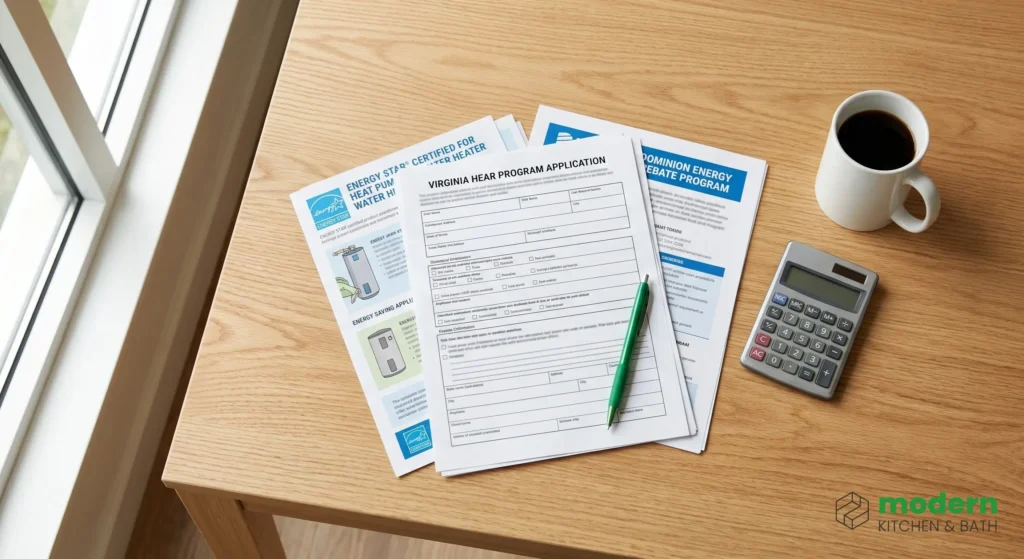
The Virginia Department of Energy administers this program using federal Inflation Reduction Act funding. It provides up to $14,000 per household for qualifying high-efficiency electric appliances. The headline line items relevant to kitchens:
Heat pump water heater: up to $1,750. Electric stove, cooktop, range, or oven: up to $840. Heat pump clothes dryer: up to $840. Electrical panel upgrade: up to $4,000. Insulation, air sealing, ventilation: up to $1,600.
Eligibility caps at 150 percent of area median income for full rebate, with lower percentages available for higher-income households. The program reached partial activation in late 2025 and is in active disbursement through 2026.
Virginia HER Program (Home Efficiency Rebate)
Also funded under the IRA. Up to $8,000 per household for whole-home energy retrofits delivering at least 15 percent measured energy savings, or 20 percent projected savings. Often combinable with HEAR for separate measures (i.e., HEAR for the induction range, HER for the air sealing). Cannot be stacked on the same measure.
Dominion Energy Instant Rebates
Residential customers in Dominion’s Virginia service area (which covers most of Loudoun and Fairfax County) get instant rebates at point of sale through the Dominion Marketplace. Heat pump water heater rebate runs up to $400. Smart thermostat rebates up to $75. ENERGY STAR appliance discounts vary by retailer (Home Depot, Lowe’s, Costco, Best Buy participate).
Federal IRA Tax Credits
Section 25C (Energy Efficient Home Improvement Credit): 30 percent of project cost up to $1,200 per year for qualifying improvements, with a separate $2,000 cap for heat pumps and heat pump water heaters. Section 25D applies to renewable systems (solar, geothermal) at 30 percent with no cap through 2032.
Stacking Rules
The combinations that work: HEAR rebate + 25C federal credit on different measures: yes. HEAR rebate + Dominion instant rebate on the same heat pump water heater: yes (HEAR + Dominion can both apply to the same unit, but check 2026 Virginia Energy guidance for finalized stacking caps). HEAR + HER on the same measure: no. 25C credit + 25D credit on the same equipment: no.
A realistic stacking scenario for a Sterling household at 120 percent AMI doing a full sustainable kitchen with induction range, heat pump water heater, and 200-amp panel upgrade lands roughly $3,400 to $5,600 in combined rebates and credits. That eats most of the sustainable premium.
The paperwork window matters. HEAR rebates require pre-approval and contractor enrollment in the program. Don’t buy the appliance first and then chase the paperwork; the rebate doesn’t work retroactively.
What We Do With the Old Kitchen?
This is where most homeowners haven’t thought past the demo phase. Conventional kitchen tear-outs in NoVA send roughly 80 to 90 percent of the removed material to landfill. A sustainable approach diverts most of it.
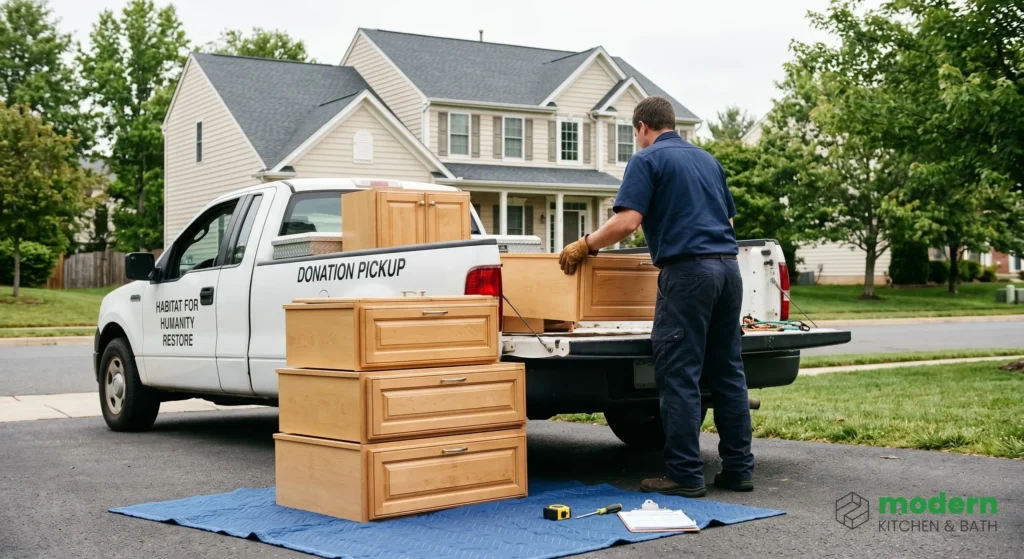
Habitat for Humanity ReStore Loudoun (Sterling) takes intact cabinets, working appliances, fixtures, and tile. They typically pick up by appointment. Habitat ReStore Fairfax (Chantilly) operates similarly. Donation value is tax-deductible.
Community Forklift in Edmonston accepts reclaimed materials including hardwood flooring, doors, and architectural salvage. The drive is about 35 minutes from Sterling but worth it for distinctive pieces.
Loudoun County Solid Waste Management Facility in Leesburg accepts construction debris with material-specific recycling streams for metal, wood, drywall, and concrete. Tipping fees apply.
Cabinet refacing instead of replacement is the most direct sustainability win when the cabinet boxes are sound. New doors, drawer fronts, and hardware on existing boxes runs roughly 40 to 60 percent of full replacement cost and diverts everything except the failing components. We do this routinely in Reston townhomes where the 1990s cabinetry is structurally fine but cosmetically tired.
For a typical Sterling kitchen demo, well-coordinated salvage diverts 50 to 70 percent of removed material from landfill, generates $400 to $1,500 in deductible donation value, and adds about one day to the project timeline. Worth the extra coordination.
How to Plan a Sustainable Kitchen Remodel in Sterling, Loudoun, and Fairfax?
The order of decisions matters, and the order most homeowners follow is backwards.
The conventional approach is: pick cabinets, pick countertops, pick appliances, then think about energy, then worry about rebates. That sequence makes the rebates impossible to maximize because the appliance decisions are already locked.
The order that actually works is the reverse:
1. Get an electrical assessment first. Know your panel capacity and whether a 200-amp upgrade is required. This is a $150 to $300 visit and it determines whether induction is viable without a major panel project.
2. Identify the rebate programs you qualify for and the maximum dollars available. Match appliances to rebate-eligible models before browsing.
3. Specify cabinets with verified certifications. Get the GREENGUARD Gold and FSC chain-of-custody documents from the brand in writing.
4. Plan the demo for material salvage and donation. Schedule Habitat ReStore pickup in advance.
5. Sequence install around the appliance delivery windows. Smart and ENERGY STAR appliances frequently run 4 to 10 week lead times in 2026.
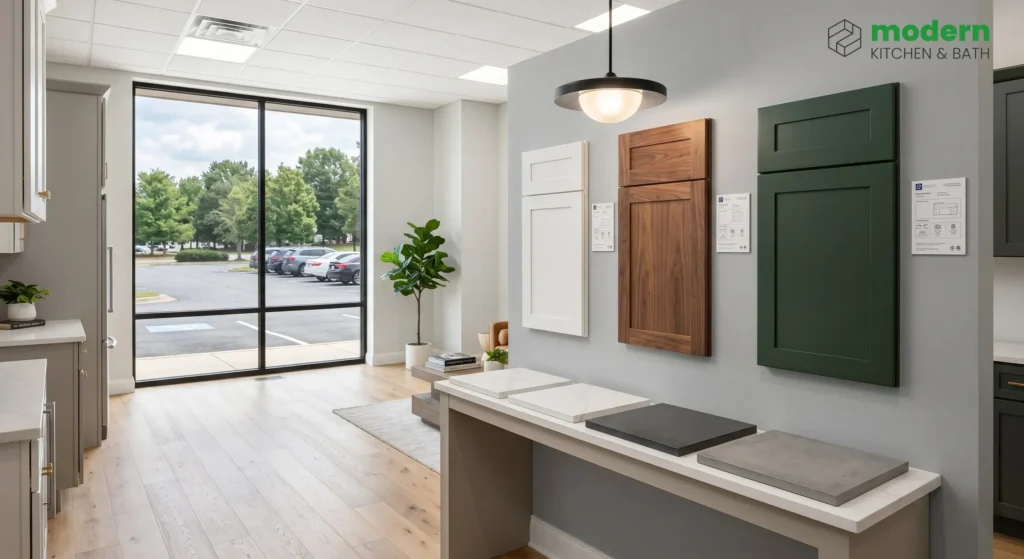
Schedule a free in-home consultation with Modern Kitchen & Bath: call 571-517-1289 or visit our Sterling showroom at 47100 Community Plaza #132. We can walk you through certified cabinet samples, run the rebate math for your specific household, and connect you with licensed DPOR electricians for panel assessments.
Frequently Asked Questions for Sustainable Kitchen Remodel
How much does a sustainable kitchen remodel actually cost in Northern Virginia?
For a typical 180-square-foot Sterling, Ashburn, or Fairfax kitchen, a mid-range sustainable spec runs $33,400 to $70,900 before rebates. After applying Virginia HEAR + federal 25C credits + Dominion rebates, most households recover $3,400 to $5,600. Net out-of-pocket runs roughly 25 to 35 percent above a conventional remodel of the same scope, and that premium pays back through longer service life and lower utility bills.
Are sustainable cabinets actually less durable than conventional ones?
The opposite, generally. FSC-certified solid hardwood and properly bonded plywood outlast bargain particleboard cabinets by a factor of two to three. We’ve replaced 8-year-old cabinets that failed at the box joints. We’ve never replaced an FSC-certified, GREENGUARD Gold cabinet box for structural failure under twenty years.
What certifications should I look for if I only check one thing?
GREENGUARD Gold. It covers both formaldehyde and total VOC emissions at strict thresholds, includes phthalate testing, and applies to the entire cabinet (substrate, finish, adhesive). FSC chain-of-custody is the second priority for verified wood sourcing.
Is induction cooking really more sustainable than gas?
Yes, on three measures: energy efficiency (85 to 90 percent vs. 40 percent), indoor air quality (no combustion byproducts), and HVAC load (less heat dumped into the kitchen). The infrastructure upgrade can be the bigger expense than the cooktop itself in older NoVA homes with 100-amp panels, so factor that in.
Can I combine the Virginia HEAR rebate with the federal tax credit?
For different measures, yes. HEAR for the heat pump water heater plus 25C for the panel upgrade plus 25D for any solar work all coexist. You cannot apply two programs to the same dollar of expense. Check the Virginia Energy website (energy.virginia.gov) for the current finalized stacking rules.
What’s the single most impactful sustainable kitchen upgrade if I only do one?
Switch from gas to induction. The energy savings, indoor air quality improvement, and lower kitchen heat gain together deliver more measurable benefit than any other single decision. For households already on electric ranges, the highest-impact swap is a heat pump water heater.
How long do sustainable cabinets last compared to conventional?
Properly sourced cabinets with FSC and GREENGUARD Gold certifications typically deliver 25 to 35 years of service. Mid-tier conventional cabinets average 15 to 20 years. Bargain particleboard cabinets fail at box joints, drawer slides, or hinges between 8 and 12 years.
Do sustainable kitchen choices increase resale value in NoVA?
In Loudoun and Fairfax County, yes, particularly in the $700,000 and above bracket. Real estate agents in Ashburn, Reston, and Vienna report that buyers in 2026 actively ask about cabinet certifications, induction cooking, and ENERGY STAR appliance packages. A mid-range kitchen remodel recovers 75 to 80 percent of its cost at resale; sustainable specifications can push the recovery rate to 80 to 90 percent because they signal a kitchen that won’t need redoing for fifteen-plus years.
Modern Kitchen & Bath (Modern Kitchen & Home Solutions) has been designing and installing kitchens for Northern Virginia homeowners for more than a decade. Our crew handles design, demolition, electrical, plumbing, carpentry, and finish work in-house. No third-party subcontractors for the core scope, which means the person who installed your cabinets is the same person who knows your panel capacity and your home’s quirks. Visit our Sterling showroom or call 571-517-1289 to schedule a free consultation.
Found this helpful? Make us your go-to source on Google
If our content has been useful, you can tell Google to show more of it when you search. Click below, then check the box next to Modern Kitchen and Bath on the page that opens. It takes about five seconds.

You'll need to be signed in to your Google account. One click, then tick the box next to our name.