Almost every kitchen quote you collect will put your cabinets in one of three groups: stock, semi-custom or custom. The labels sound like a simple ladder of price and quality. They are not quite that.
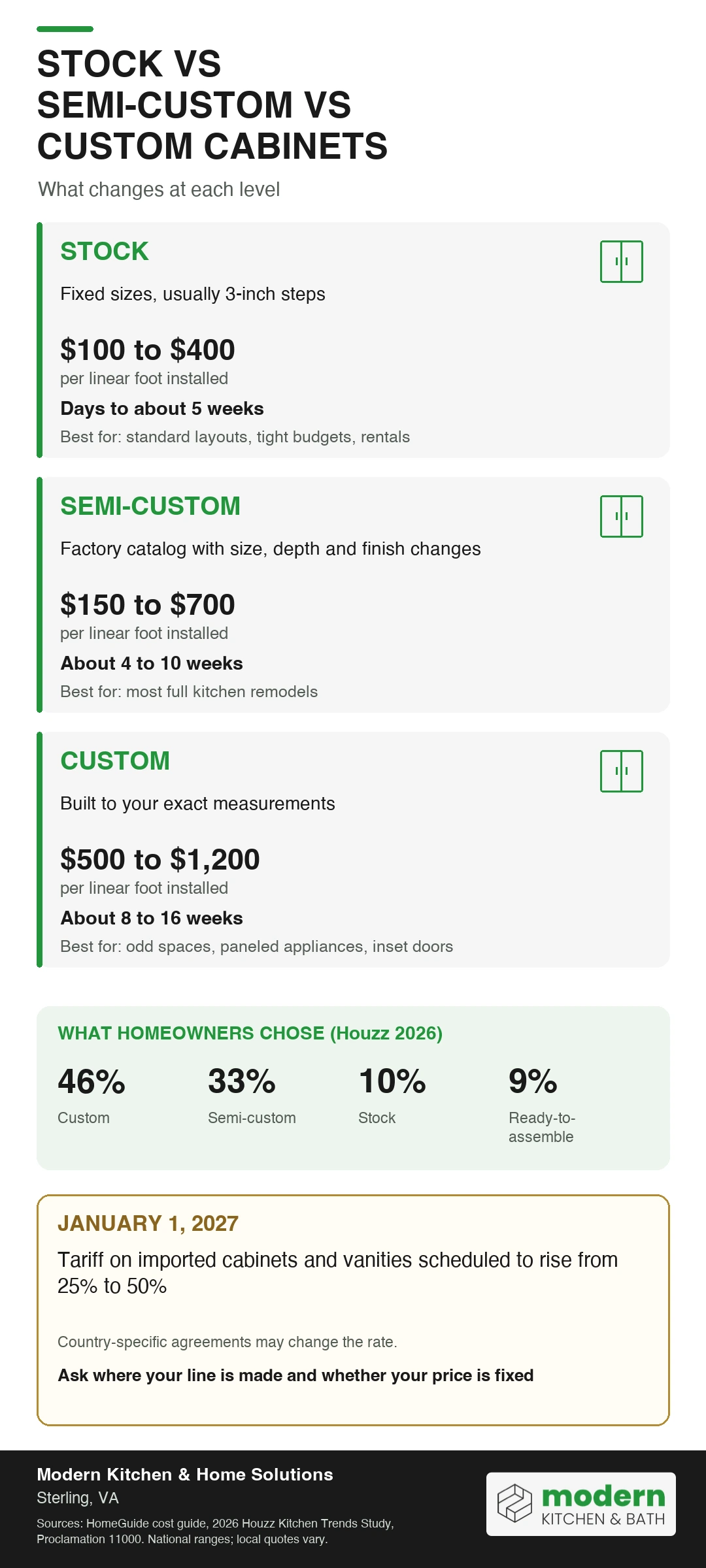
In the 2026 Houzz Kitchen Trends Study, which surveyed 1,780 homeowners who were planning, in the middle of or recently finished with a kitchen renovation, 46% chose custom cabinets, 33% semi-custom, 10% stock and 9% ready-to-assemble. So most people renovating a kitchen land on one of the top two tiers, and the choice between them is where most of the money and the confusion sits.
This year there is a second reason to get the choice right before you sign. On January 1, 2027, the tariff on imported kitchen cabinets and vanities is scheduled to rise from 25% to 50%, and the three tiers are not equally exposed to it.
What this covers
- The three tiers side by side
- What stock, semi-custom and custom actually mean
- What each one costs, with a worked example
- How long each takes to arrive
- Which tier the January 1 tariff hits hardest
- How to check quality whatever the label says
- How to choose for a Northern Virginia kitchen
The Three Tiers Side by Side
Here is the short version. Prices are installed national ranges per linear foot of cabinetry from HomeGuide’s cost guide. Lead times are typical ranges and vary by manufacturer and season.
| Stock | Semi-custom | Custom | |
|---|---|---|---|
| What it is | Factory cabinets in a fixed set of sizes, doors and finishes | Factory cabinets from a catalog, with changes to sizes, depths, finishes and interiors | Built to order for your kitchen, by a local shop or a custom factory line |
| Sizes | Usually 3-inch steps, gaps closed with fillers | Depends on the line, often finer steps plus depth and height changes | Any size the space needs |
| Installed cost per linear foot | $100 to $400 | $150 to $700 | $500 to $1,200 |
| Typical lead time | Days to about five weeks | About four to ten weeks | About eight to sixteen weeks |
| Best fit | Standard layouts, tight budgets, rentals, laundry rooms | Most full kitchen remodels | Odd spaces, paneled appliances, inset doors, furniture-style detail |
The overlap in the price column matters. A well-specified stock line can cost as much as a basic semi-custom one, and the top of semi-custom can reach the bottom of custom. The label tells you how the cabinet is made and ordered. It does not settle the price or the quality on its own.
Stock Cabinets
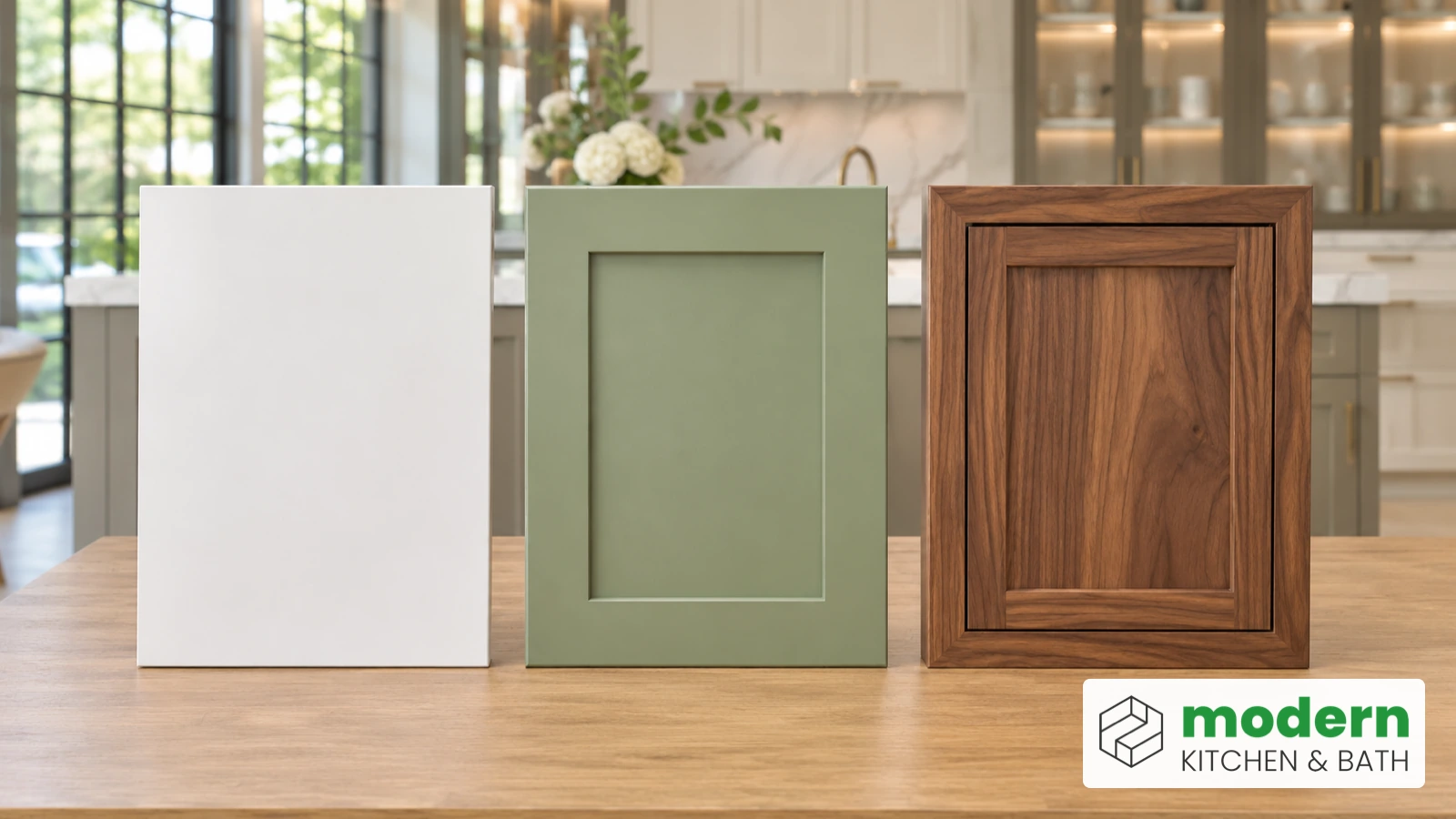
Stock cabinets are built in advance in standard sizes, usually in 3-inch steps of width, typically from 9 to 36 inches for base cabinets plus a few wider sink bases. You choose from a short list of door styles and finishes. Some lines are sold assembled from a warehouse, and some come flat-packed as ready-to-assemble (RTA) kits.
Because walls are rarely a neat multiple of 3 inches, a stock kitchen relies on filler strips to close the gaps at walls and corners. That is normal and, done well, nobody notices them. Fillers are also needed where a cabinet meets a wall that is out of plumb, so a door or drawer can open without scraping.
Where stock works
- A kitchen that keeps its current, fairly standard layout
- A rental, a basement kitchenette, a laundry room or a garage
- A tight budget where the money is better spent on the counters or the appliances
- A project that has to be done quickly, since in-stock lines can arrive within days
Where stock falls short
The limits show up at the edges. Tall ceilings leave a gap above the wall cabinets. A wall that measures 127 inches gets several inches of filler. Finished end panels, deeper drawers and interior fittings are limited or not offered. And box construction varies widely between stock lines, from particleboard to plywood, so two stock kitchens at the same price can be very different products.
Semi-Custom Cabinets
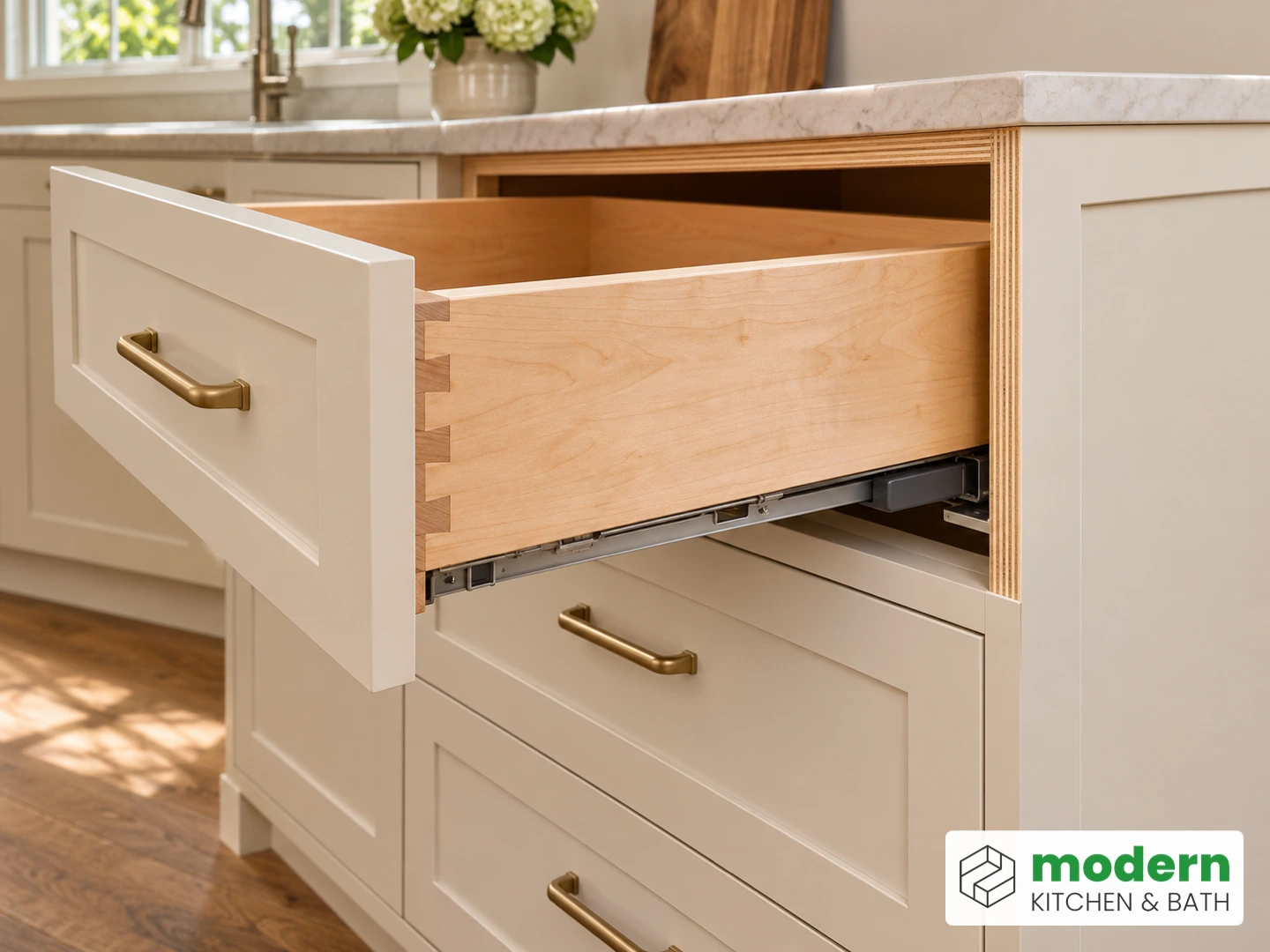
Semi-custom cabinets are still made in a factory from a catalog, but the catalog is much bigger and the factory will change things. Typical options include adjusting the width, depth or height of a cabinet, extra door styles and paint or stain colors, matching finished end panels for exposed sides, interior fittings such as pull-outs and drawer organizers, and a choice of box material.
“Semi-custom” is a sales term, though, not a standard. On Reddit’s cabinetry forums, designers and installers point out that some lines sold as semi-custom still come only in 3-inch steps with a few custom options added, while better lines can be ordered in finer steps and are hard to tell apart from fully custom work once installed. The only way to know which you are getting is to ask the questions in the checklist further down.
For most full kitchen remodels, semi-custom is where the value is. You get close to a made-to-measure fit, a far wider choice of finishes, and a factory warranty, at well under custom pricing.
Custom Cabinets
Custom cabinets are built for one kitchen. Every width, height and depth is set by your measurements, and the finish, door style, wood species and interior are up to you and your designer. They come from two kinds of maker: a local cabinet shop, or a manufacturer’s custom line built in a factory to your order.
Custom earns its price in specific situations:
- Paneled appliances. A refrigerator or dishwasher hidden behind cabinet panels has exact dimensions that vary by model. One cabinetmaker on Reddit’s cabinetry forum wrote that every paneled refrigerator he had done was hard both to make and to install, because each model has its own requirements.
- Inset doors, where the door sits flush inside the frame. They need tight, consistent gaps, and many semi-custom lines either do not offer them or charge heavily for them.
- Odd spaces, such as sloped ceilings, angled walls, very tall ceilings or an older house where nothing is square.
- Furniture-style detail, such as a hutch, a built-in bench, matched wood grain across a run of doors, or an island that has to look like a piece of furniture.
Two things to check with a local shop. The first is the warranty: a small maker may offer one year where a factory line offers a limited lifetime warranty. One homeowner on Reddit weighing a local shop against two factory lines was stuck on exactly that difference. The second is the finish. Ask how it is applied and cured, because a sprayed factory finish and a shop finish can wear differently.
What Each Tier Costs
National cost guides put installed cabinets in these ranges per linear foot. Use them to check whether a quote is in the right area. A local quote for your own layout is the only reliable number.
| Tier | Installed, per linear foot | Example: about 20 linear feet of cabinets |
|---|---|---|
| Stock | $100 to $400 | $2,000 to $8,000 |
| Semi-custom | $150 to $700 | $3,000 to $14,000 |
| Custom | $500 to $1,200 | $10,000 to $24,000 |
The example is simple arithmetic on HomeGuide’s ranges. HomeGuide puts a typical custom kitchen at $15,000 to $30,000 installed, and a stock or semi-custom kitchen at $4,500 to $15,000.
For the whole room, the Houzz study puts the median major kitchen remodel at $55,000 and the median minor remodel at $20,000. Cabinets are often the largest single line in that budget, which is why the tier you choose moves the total more than almost any other decision.
Where the money goes within a tier
Inside any tier, a handful of choices move the price more than the label does:
- Box material: plywood usually costs more than particleboard or MDF
- Door style and finish: painted inset doors cost more than a stained slab door
- Drawers: more drawers and fewer doors raise the price, but they are also what most people want
- Finished end panels, moldings and light rail on every exposed side
- Interior fittings: pull-out pantries, trash pull-outs, spice racks, drawer dividers
Our guide to the cost of kitchen cabinets breaks these down further, and our guide to cabinet wood types covers species and materials.
How Long Each Tier Takes to Arrive
Lead time often decides the whole remodel schedule, because good contractors do not tear out a kitchen until the new cabinets are on hand or close to it. Typical ranges look like this, though they vary by manufacturer and season:
- In-stock and ready-to-assemble: days to about two weeks
- Stock lines: about two to five weeks
- Semi-custom: about four to ten weeks
- Custom and imported frameless lines: about eight to sixteen weeks
Ask for the lead time on the exact line and finish you choose, in writing. A rare paint color or a special modification can add weeks to a line that is normally quick. Our article on how long a kitchen remodel takes shows how the cabinet order fits into the rest of the schedule.
Which Tier the January 1 Tariff Hits Hardest
Imported kitchen cabinets, vanities and the parts imported to make them have carried a 25% Section 232 tariff since October 14, 2025. Under a proclamation signed on December 31, 2025, that rate is scheduled to rise to 50% on January 1, 2027. Lower caps apply to some trading partners: 10% for the United Kingdom and 15% for the European Union, Japan, South Korea and Taiwan.
The duty is charged when cabinets clear customs, on their import value. That is why the three tiers are exposed differently:
- Ready-to-assemble and budget stock lines are often made overseas, so they carry the duty directly. These are the prices most likely to move in January.
- Semi-custom lines are often built in the United States, which keeps the finished cabinet outside the tariff. But the tariff also covers imported parts, such as doors, drawer boxes and hardware assemblies, so a US-built cabinet can still carry some of it.
- Local custom shops build here, so the finished cabinets are not imported. The materials they buy can still be affected.
- Canadian-made cabinets are imported too. Reuters reported on November 5 that the duty on Canadian kitchen cabinets is set to double on January 1.
Ask before you sign. Where is this line made, including the doors and boxes? Is my order already in a US warehouse? If it clears customs after January 1, what is my price? Is the price on this quote fixed, or does it have a tariff clause? The increase has been postponed once before and could change again, so get the answers in writing. Our article on kitchen cabinet tariffs in 2027 covers the details.
How to Check Quality Whatever the Label Says
Since “stock”, “semi-custom” and “custom” describe how a cabinet is ordered, quality has to be checked separately. These questions work for any quote:
| Ask | Why it matters |
|---|---|
| What is the box made of, and how thick? | Plywood generally holds screws and resists water damage better than particleboard. Thickness of sides and backs varies by line. |
| Is it framed or frameless? | Framed cabinets have a face frame around the opening, common in East Coast kitchens. Frameless gives slightly more interior space and a cleaner modern look. Neither is better in itself. |
| How are the drawers built? | Look for solid drawer boxes, dovetail or dowel joints, and full-extension soft-close slides. |
| Are the interiors and the undersides of wall cabinets finished to match? | Some factory lines use a clear melamine interior and leave the underside of wall cabinets unfinished. The underside of a wall cabinet is visible from a seated position. |
| Are finished end panels included for exposed sides? | An island or the end of a run needs a matching panel. Leaving it off the quote is a common way to make a price look lower. |
| In what size steps is the line made? | 3-inch steps mean more filler. 1-inch steps and depth changes mean a closer fit. |
| Is the line KCMA certified? | See below. |
| What does the warranty cover, and for how long? | Compare finish, structure and hardware separately. One year and limited lifetime are very different promises. |
The KCMA seal
The Kitchen Cabinet Manufacturers Association, based in Reston, runs a certification program under the ANSI/KCMA A161.1 standard for kitchen and vanity cabinets. To carry the seal, a cabinet line has to pass 14 tests at an independent laboratory, covering structural strength, door and drawer operation, and finish durability. Both framed and frameless cabinets can be certified.
The seal does not tell you whether a cabinet is stock, semi-custom or custom, and plenty of good local shops never apply for it. It is a useful check on factory lines, though, and especially on lower-priced ones.
How to Choose
Start from the kitchen. These situations point fairly clearly to one tier:
| Your situation | Usually the right tier |
|---|---|
| Same layout, standard 8-foot ceilings, tight budget | Stock, with good fillers and finished ends |
| Full remodel, layout change, standard ceiling height | Semi-custom |
| Ceilings over 9 feet and you want cabinets to the ceiling | Semi-custom with height options, or custom |
| Paneled refrigerator or dishwasher | Custom, or a top semi-custom line with matching panel kits for your exact model |
| Inset doors or furniture-style detail | Custom |
| Older house with walls out of square | Semi-custom in fine size steps, or custom |
| Rental, basement kitchenette or laundry room | Stock or ready-to-assemble |
| Ordering imported cabinets after January 1 | Get a written price and the country of manufacture before deciding |
You can mix tiers
Many good kitchens use more than one. A common approach is semi-custom cabinets for the perimeter and a custom island as the centerpiece, or semi-custom throughout with one custom piece where a standard size will not fit. Check that door styles and finishes can actually be matched across makers before you commit, because paint colors from different factories rarely match exactly.
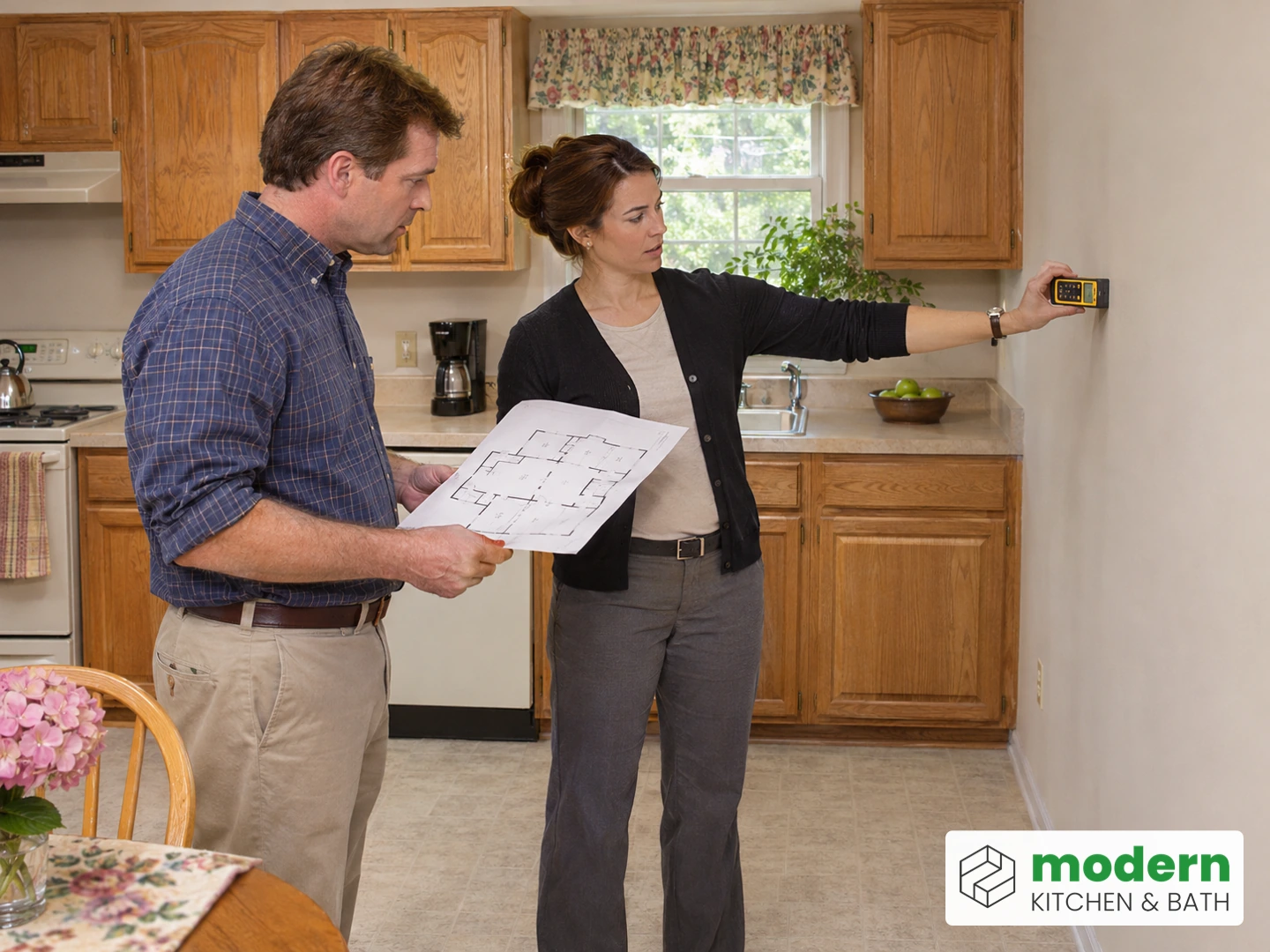
A quick test for any quote. Ask the designer to show you, on the drawing, every filler strip and every finished end panel. Fillers wider than a few inches are a sign the line’s sizes do not suit your room, and missing end panels are a sign the quote is incomplete.
What This Looks Like in Northern Virginia
The housing stock here shapes the answer more than people expect.
The builder homes across Ashburn, Brambleton, South Riding and much of western Fairfax were mostly built from the 1990s onward with standard room sizes and 8- or 9-foot ceilings. Their kitchens usually fit stock and semi-custom sizes well. For most of them, a good semi-custom line covers everything except an unusual island or a paneled refrigerator.
Older houses inside the Beltway and in established parts of Fairfax and Arlington are different. Walls that have settled, soffits hiding ductwork and kitchens built around older appliance sizes are common, and that is where fine size steps or custom work saves you a row of wide fillers.
Townhouses and condos add their own limits: narrow galley layouts, delivery through a stairwell or an elevator, and sometimes building rules on work hours. A designer who measures the delivery route as well as the kitchen will save you trouble with long tall cabinets.
Most same-layout cabinet replacements need no building permit in Virginia. Moving plumbing, gas or walls, or adding circuits, does. Our guide to remodeling permits in Northern Virginia covers what each county requires.
Rated 4.8 out of 5 from 68 Google reviews
Modern Kitchen & Home Solutions, Sterling VA · November 2026
Frequently Asked Questions About Stock, Semi-Custom and Custom Cabinets
What is the difference between stock, semi-custom and custom cabinets?
Stock cabinets are made in advance in fixed sizes, usually 3-inch steps, with a short list of doors and finishes. Semi-custom cabinets come from a factory catalog but can be changed in size, depth, finish and interior. Custom cabinets are built to the exact measurements and design of one kitchen. The terms describe how cabinets are made and ordered. They do not guarantee a level of quality.
How much do semi-custom kitchen cabinets cost?
National cost guides put semi-custom cabinets at about $150 to $700 per linear foot installed, against $100 to $400 for stock and $500 to $1,200 for custom. For about 20 linear feet of cabinets, that works out to roughly $3,000 to $14,000 for semi-custom. Box material, door style, finish and interior fittings move the price within that range. A local quote for your layout is the only reliable figure.
Are semi-custom cabinets worth it?
For most full kitchen remodels, yes. They fit the room more closely than stock, offer far more finishes and interior options, and usually come with a factory warranty, at well under custom pricing. They are less worth it for a simple same-layout replacement on a tight budget, where good stock cabinets may do the job, and they can fall short for paneled appliances or inset doors.
Are custom cabinets better quality than semi-custom?
Not automatically. Custom means built to your measurements, not built better. A well-made semi-custom line can outlast a poorly built custom job. Compare box material, drawer construction, hinges and slides, finish, KCMA certification and warranty, whatever the label.
How long do semi-custom cabinets take to arrive?
Typically about four to ten weeks after ordering, depending on the manufacturer, the finish and the time of year. Stock lines usually take days to about five weeks, and custom about eight to sixteen weeks. Ask for the lead time of the exact line and finish in writing.
Do I need custom cabinets for a paneled refrigerator?
Often, though not always. Paneled appliances have exact dimensions that vary by model, and the panels have to line up with the cabinets around them. Some semi-custom lines offer panel kits for specific models. If yours does not, custom is the safer choice. Pick the appliance before the cabinets are ordered either way.
What is the difference between semi-custom and ready-to-assemble cabinets?
Ready-to-assemble cabinets come flat-packed and are put together by you or the installer, in fixed sizes and a limited range of finishes. Semi-custom cabinets are factory-assembled to order with size and finish options. In the Houzz 2026 study, 9% of renovating homeowners chose ready-to-assemble cabinets and 33% semi-custom.
Will the 2027 tariff make semi-custom cabinets more expensive?
It depends where they are made. The Section 232 tariff on imported cabinets and vanities is scheduled to rise from 25% to 50% on January 1, 2027, and it applies when cabinets and imported parts clear customs. Semi-custom lines made in the United States are not imported as finished cabinets, but imported parts can still carry the duty. Ask where the line is made and whether your price is fixed.
What does KCMA certified mean?
It means the cabinet line has passed the tests in the ANSI/KCMA A161.1 standard at an independent laboratory: 14 tests covering structural strength, door and drawer operation, and finish durability. The Kitchen Cabinet Manufacturers Association, based in Reston, Virginia, runs the program. Framed and frameless cabinets can both be certified.
Can I mix stock, semi-custom and custom cabinets in one kitchen?
Yes, and many kitchens do, for example semi-custom perimeter cabinets with a custom island. Check that door styles and finishes match across makers before you order. Paint colors from different factories rarely match exactly, so a contrasting island color is often the easier route.
What is a filler strip?
A strip of matching wood or panel that closes the gap between a cabinet and a wall or appliance. Stock and many semi-custom cabinets come in 3-inch steps, so fillers make up the difference. They also let doors and drawers open clear of an uneven wall. Narrow fillers are normal. Very wide ones suggest the cabinet sizes do not suit the room.
Comparing Cabinet Quotes in Northern Virginia?
We design kitchens from our Sterling showroom for homeowners across Loudoun and Fairfax counties. Bring your floor plan or your current quotes, and we will walk you through what each option means for your kitchen and your budget.
Sources
- Houzz, 2026 U.S. Houzz Kitchen Trends Study. Online survey of 1,780 US Houzz users planning, in the middle of or recently finished with a kitchen renovation, fielded July 6 to 30, 2025. Cabinet types p. 49; median spend p. 10.
- HomeGuide, custom cabinets cost guide, comparison of installed cost per linear foot for stock, semi-custom and custom cabinets. Retrieved November 2026. The 20-linear-foot example is our arithmetic on its ranges.
- Proclamation 10976 (September 29, 2025) and Proclamation 11000 (December 31, 2025, published in the Federal Register January 9, 2026), Section 232 tariffs on kitchen cabinets, vanities and parts.
- Reuters, reported by BNN Bloomberg, “US tariffs squeeze Canadian cabinet makers facing doubling of Trump duty”, November 5, 2026.
- Kitchen Cabinet Manufacturers Association, KCMA A161.1 Quality Cabinet Certification FAQs.
- Discussions in Reddit’s r/cabinetry and r/Remodel forums, 2026, read for common homeowner questions and installer experience.
- Lead times are typical planning ranges, not a cited source. Google review rating for Modern Kitchen & Home Solutions verified November 2026.
This article is planning information. Prices are national ranges and will differ for your kitchen. It is not legal or customs advice.
Related Reading
Found this helpful? Make us your go-to source on Google
If our content has been useful, you can tell Google to show more of it when you search. Click below, then check the box next to Modern Kitchen and Bath on the page that opens. It takes about five seconds.

You'll need to be signed in to your Google account. One click, then tick the box next to our name.