Short answer: in Northern Virginia, you need a permit the moment your project touches structure, electrical, plumbing, mechanical, or gas. You do not need one for purely cosmetic work like paint, flooring, or swapping cabinets in place. Fees are usually calculated as a percentage of construction value, and plan review runs anywhere from a few days in Arlington to six weeks or more in Fairfax during the busy season.
Permits are the part of a remodel homeowners understand least and worry about most, and the rules genuinely differ from one county to the next even though Virginia uses a single statewide building code. This guide lays out what triggers a permit, what each Northern Virginia jurisdiction charges, how long review actually takes, and what happens if you skip the process. If you are still working out budget, our cost guides for kitchen remodels, bathrooms, and basements cover the rest of the picture.
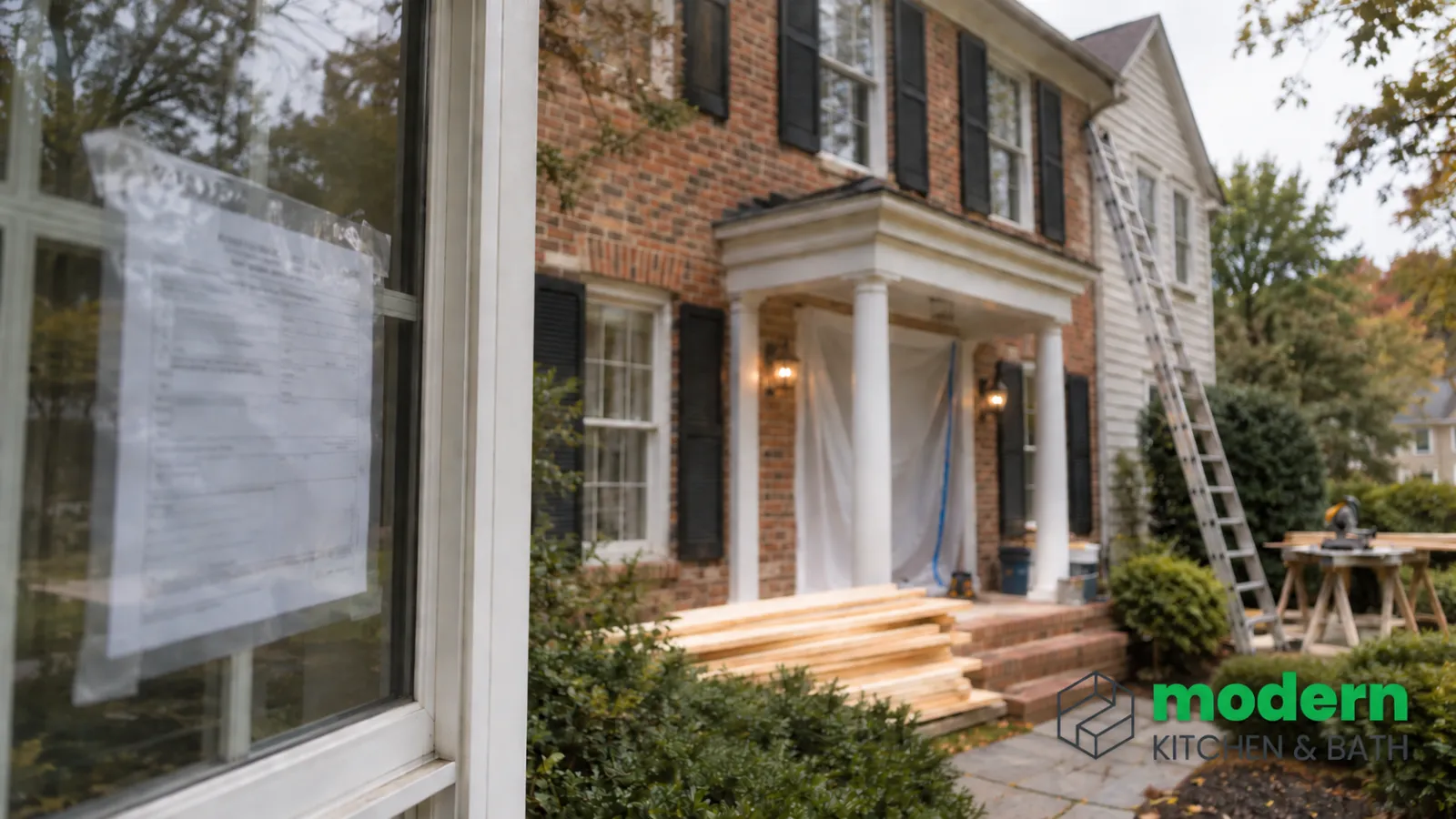
What Needs a Permit, and What Does Not
Virginia’s Uniform Statewide Building Code sets one standard statewide, but each county and city administers it with its own portal, fees, and review process. The trigger is consistent everywhere: if you change the structure or touch a system, you need a permit.
Work that requires a permit
- Removing, moving, or adding walls, including any load-bearing change
- Additions and any increase in finished floor area
- Finishing a basement
- New or relocated plumbing fixtures, supply lines, or drains
- New electrical circuits, outlets, service panel upgrades, or rewiring
- HVAC changes, new ductwork, or a new gas line
- Decks, and in most cases pergolas and other accessory structures depending on size and attachment
- Window and door openings that change the structural opening
- Egress windows and window wells
Work that is exempt
The Virginia Construction Code specifically exempts several common remodeling tasks:
- Paint, wallpaper, and other wall finishes
- Floor finishes, including hardwood, carpet, and ceramic tile
- Installing or replacing cabinetry and trim
The exemption everyone misreads: being exempt from a permit does not mean exempt from the code. Health, safety, accessibility, energy, and water conservation requirements still apply to exempt work. A cabinet swap needs no permit, but the moment you move the sink to a new wall, you are back in permit territory.
Building Permits vs. Trade Permits
Most homeowners expect one permit and are surprised to receive several. A remodel typically involves a parent building permit plus separate trade permits for each system touched:
- Building permit for structural work. This is the primary permit and the one that triggers plan review.
- Electrical permit for circuits, outlets, lighting, and panel work
- Plumbing permit for fixtures, supply, and drain work
- Mechanical permit for HVAC and ductwork
- Gas permit where a gas line is added or moved
Trade permits are usually filed as sub-records under the parent building permit, and each carries its own inspection. A licensed contractor normally pulls all of them, and that is worth confirming in writing before work starts.
Permit Fees and Review Times by County
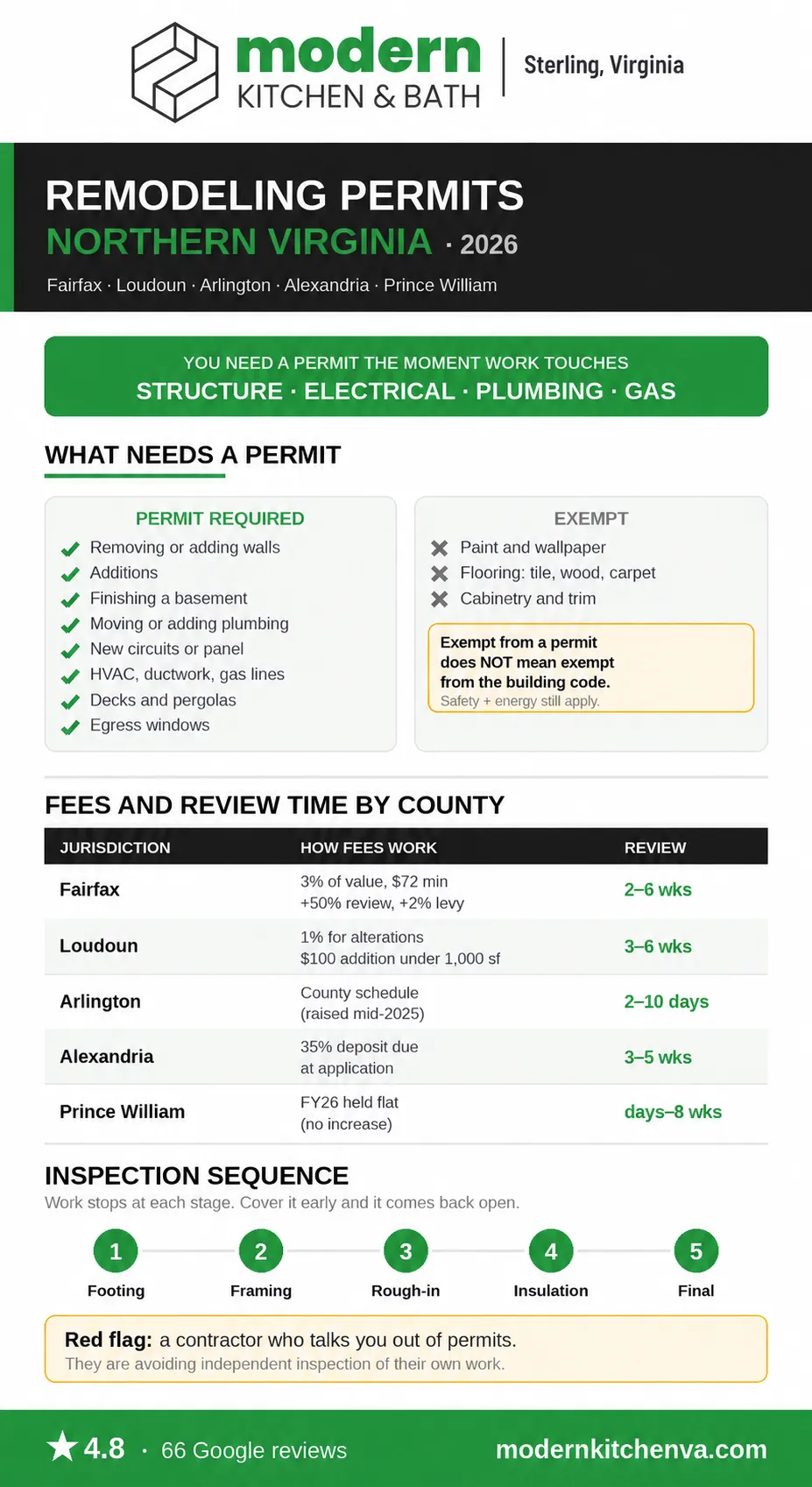
This is where the jurisdictions diverge most. Fairfax and Loudoun calculate fees from construction value, while the cities run their own schedules.
| Jurisdiction | How fees are calculated | Typical plan review time |
|---|---|---|
| Fairfax County | 3% of construction value ($72 minimum) for residential alterations, plus 50% of that as plan review, plus a 2% Virginia state levy | 2 to 6 weeks from a complete submittal |
| Loudoun County | 1% of the cost of work for alterations. Additions of 1,000 sq ft or less are a flat $100. $65 minimum permit fee, $130 plan review | Roughly 3 to 6 weeks |
| Arlington County | Own fee schedule, increased mid-2025 | Often 2 to 10 business days; 2 to 4 weeks for larger renovations |
| City of Alexandria | Own schedule. 35% non-refundable deposit due at application for permits needing plan review | Roughly 3 to 5 weeks |
| Prince William County | Own schedule, no across-the-board increase for FY26 | Days for simple scopes; 6 to 8 weeks for complex projects |
Verify before you budget. Fee schedules change on county fiscal years, usually 1 July, and the figures above reflect the schedules published as of 2026. Always confirm current rates with the jurisdiction before filing. Links to each are in the Sources at the end.
Fairfax County
Fairfax calculates the building permit fee at 3 percent of construction value, using either your stated value or the ICC Building Valuation Data table, whichever is greater, with a $72 minimum on residential alterations and repairs. Two additions to that base catch people out: plan review adds 50 percent of the base fee, and a 2 percent Virginia state levy applies to the combined total. So the effective cost is meaningfully above a flat 3 percent. On a $30,000 bathroom, the base fee is roughly $900, plan review adds about $450, and the levy adds about $27, landing near $1,375.
Plan review for a residential addition takes 2 to 6 weeks from a complete, accepted submittal. Expedited review is available for an added fee and compresses a 3 to 4 week review to roughly 5 to 7 business days. Two more things worth planning around: spring and summer are the busiest filing seasons, so an April or May submission reviews slower than a January one, and each resubmittal cycle costs 25 to 50 percent of the original plan review fee, which is a strong argument for getting drawings right the first time.
Loudoun County
Loudoun treats remodels and additions differently, which is where most confusion comes from. A remodel or alteration (repair or alteration with no addition or enlargement) is charged at 1 percent of the total cost of the work. A residential addition of 1,000 square feet or less is a flat $100, and anything larger is charged as new construction using a gross-area formula rather than a percentage. The minimum permit fee is $65, and plan review for miscellaneous building permits is $130, which includes two revisions.
Trade permits are billed separately and are modest for a one- or two-family dwelling: roughly $70 each for plumbing, gas, mechanical, and electrical fixtures or circuits, with sub-panels at $40 each. Each trade permit includes two inspections, and additional re-inspections run $30 each. So a typical Loudoun bathroom remodel is 1 percent of project cost plus $130 plan review plus a couple of $70 trade permits, not a single flat fee.
Two local specifics matter. Permit fees are invoiced at intake and must be paid before review is initiated, so the clock does not start until payment clears. And as of 1 October 2025, plan review is required for gas permits on residential alterations and additions, which adds a step to any project moving a gas range or adding a gas line.
Arlington County
Arlington is generally the fastest jurisdiction in the region for straightforward residential work, often turning permits in 2 to 10 business days, though larger renovations and anything needing zoning review run 2 to 4 weeks or longer. Permit fees increased in mid-2025.
City of Alexandria
Alexandria runs its own permit center and fee schedule, with the current version effective 1 July 2025. The detail to plan for is cash flow: any permit requiring plan review needs a non-refundable deposit of 35 percent of the total estimated permit fee at the time of application.
Prince William County
Prince William held its building development fees flat for FY26 with no across-the-board increase. Review time splits sharply by complexity: simple scopes can clear in days, while complex projects run 6 to 8 weeks. The county has also been targeting three business days for routine items such as reroofing, mechanical, gas and plumbing replacements, low-voltage work, and minor demolition.
The Inspection Sequence
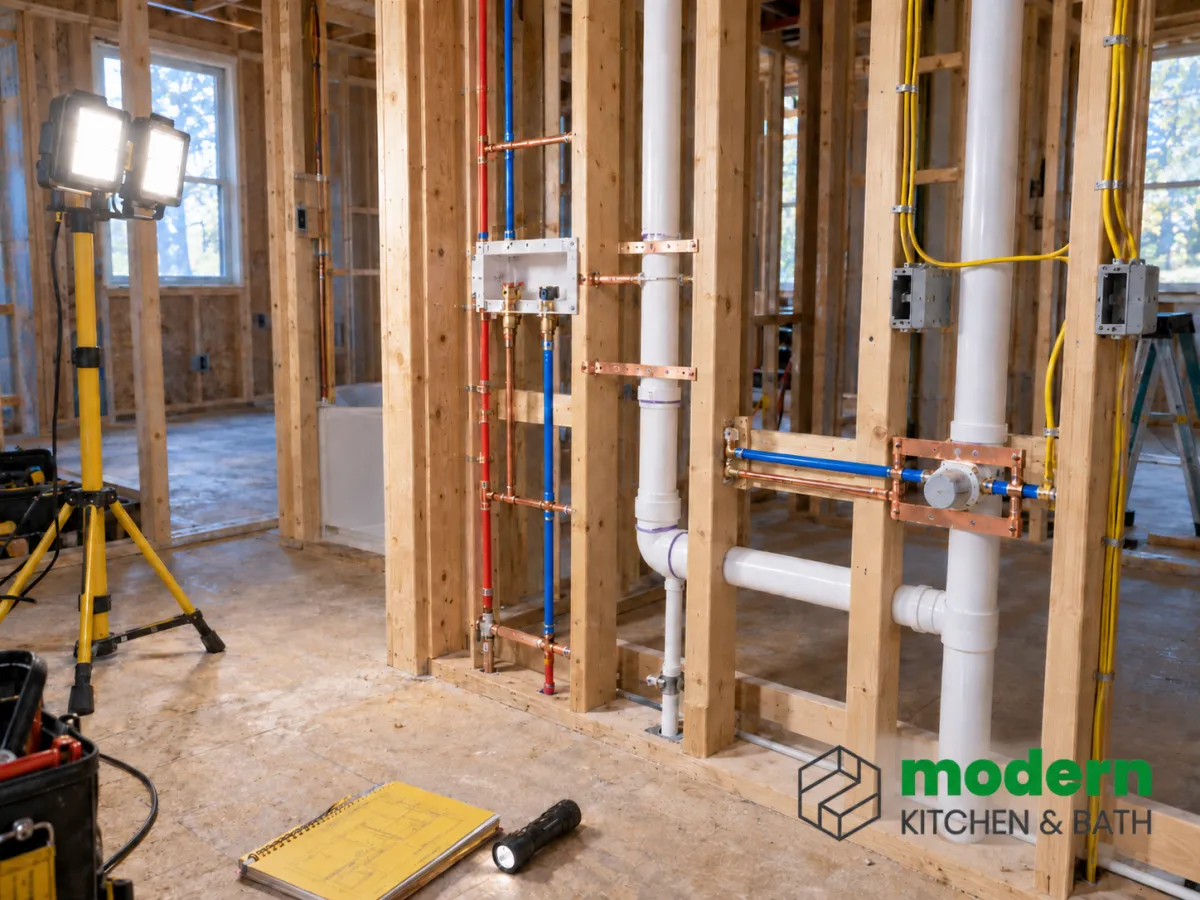
A permit is not a single event, it is a sequence. Work has to stop and be inspected at defined stages, and covering something before its inspection is the expensive mistake.
- Footing or foundation for additions and structures, before concrete is poured
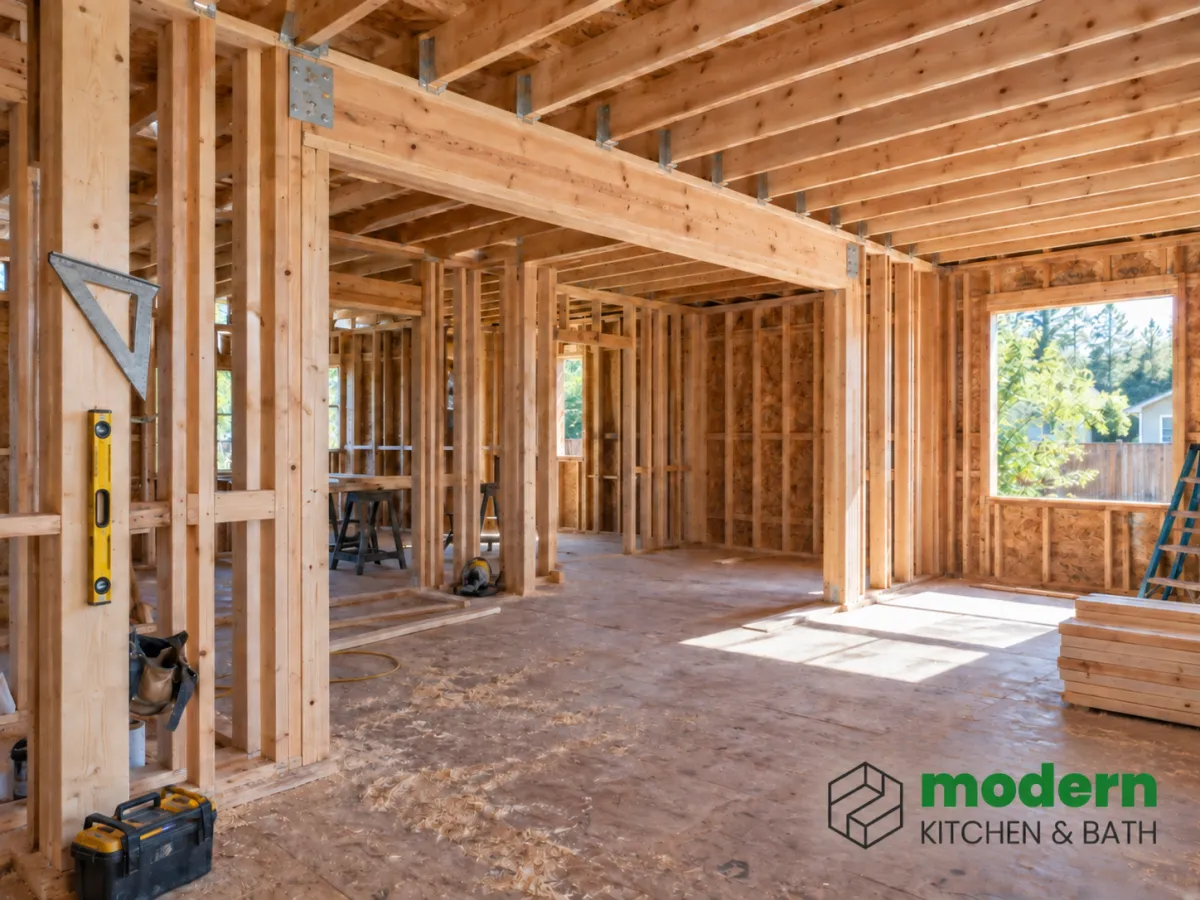
- Framing, once structural work is complete and before insulation
- Rough-in for electrical, plumbing, and mechanical, with walls still open
- Insulation, before drywall
- Final for each trade and for the building permit, once everything is finished
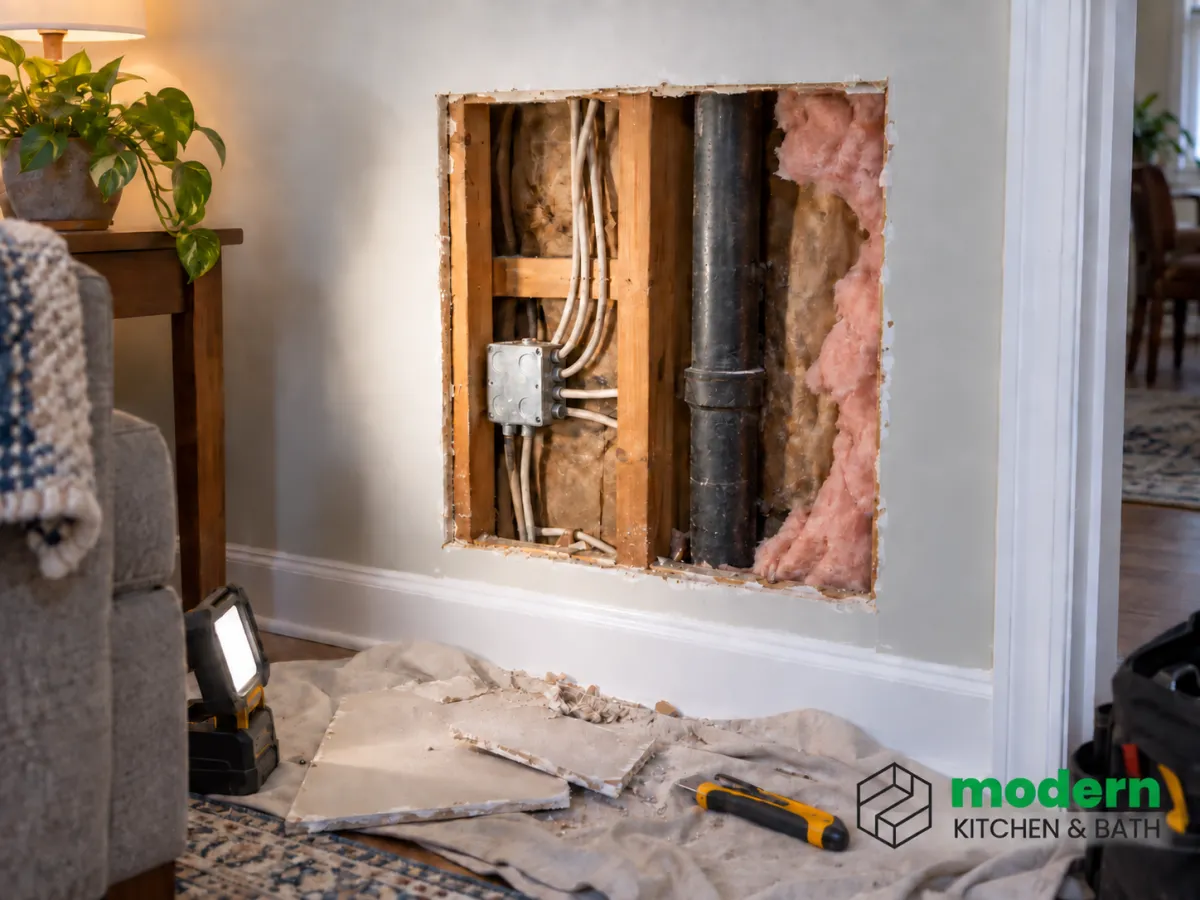
If drywall goes up before the rough-in inspection passes, the inspector can require it to be opened back up. That is the single most common source of avoidable cost and delay on a permitted job.
HOA Approval Is Separate From County Approval
This is the step most homeowners forget, and it is common across Sterling, Ashburn, Cascades, Countryside, and most planned communities in the region. If your neighborhood has an architectural review committee, its approval is independent of the county permit and neither substitutes for the other. It usually matters for anything visible from outside: additions, decks, pergolas, window and door changes, and exterior materials or colors. Review cycles often run on a monthly meeting schedule, so submitting a week after a meeting can add a month to your timeline. Start the HOA submission in parallel with design, not after the permit comes back.

Contractor Licensing in Virginia
Permits and licensing are separate systems, and the license class your contractor holds sets a hard ceiling on the size of contract they can legally sign. Virginia DPOR defines three classes:
| License class | Single contract or project | Total work in 12 months |
|---|---|---|
| Class C | Over $1,000 and under $30,000 | Under $250,000 |
| Class B | $30,000 to under $150,000 | $250,000 to under $1,000,000 |
| Class A | $150,000 or more | $1,000,000 or more |
Work valued at $1,000 or less requires no contractor license. The practical takeaway: a typical Northern Virginia kitchen or bathroom remodel sits in Class B territory, while a large primary suite, an addition, or a whole-home project crosses into Class A. Verify the class and the licence status on the DPOR licence lookup before you sign, and confirm the contractor carries liability insurance and workers compensation.
What Permits Cost by Project Type
Because most local fees track construction value, permit cost scales with project size. As a planning range for Northern Virginia:
| Project | Typical permit cost range |
|---|---|
| Bathroom remodel | $350 – $1,500 |
| Kitchen remodel | $500 – $2,000 |
| Basement finish | $600 – $2,500 |
| Adding a new bathroom | $300 – $1,500 |
| Deck or accessory structure | $200 – $800 |
| Home addition | $100 flat in Loudoun if 1,000 sq ft or less; otherwise charged as new construction, or 3% of value in Fairfax |
Budget separately for stamped drawings where required. Many jurisdictions require architect or engineer sealed plans for structural changes, which adds roughly $1,000 to $3,000 and is not part of the permit fee itself.
What Happens If You Skip Permits
Unpermitted work is a false economy, and the bill almost always arrives later rather than never.
- At resale. Home inspectors flag work that does not match county records, buyers negotiate against it, and lenders can get cautious. Unpermitted bathrooms and basements are the two most commonly caught.
- Appraisal. A finished basement or added bedroom that was never permitted may not count toward legal finished square footage, so you lose the value you paid to create.
- Insurance. A claim tied to unpermitted electrical or plumbing work can be disputed.
- Retroactive correction. Counties can require exposing completed work for inspection, which means opening finished walls, and can levy penalty fees on top.
The permit itself is rarely the expensive part of a remodel. Undoing finished work to prove it was built correctly is.
The Biggest Red Flag: a Contractor Who Talks You Out of Permits
This comes up constantly in homeowner discussions, and it is worth naming plainly. One homeowner described raising permits with a prospective contractor and getting this response:
The trade’s own verdict in that thread was blunt. A commenter identifying as a 30-year contractor wrote: “A contractor who won’t agree to permit a $200k project? Who says he doesn’t want someone to inspect his work? This is one shady individual. You dodged a bullet.” Another put the practical risk simply: if the county finds out later, it can require the work to be opened up or removed, and you have paid twice for the same room.
Some of what that contractor said is true, to be fair. Permits do add review time, and inspections do create hold points in the schedule. But those are the cost of having someone independent confirm the work is safe, and a remodeler who does not want their work inspected is telling you something important. The honest version of the conversation is a contractor explaining how permitting will affect your timeline, not one suggesting you skip it.

Buying a home with unpermitted work
The other pattern worth knowing is inheriting someone else’s shortcut. Homeowners regularly discover after purchase that a finished garage, basement, or bonus room was never permitted, and the obligation to correct it lands on the current owner, not the person who built it. In Virginia, unpermitted work is also a disclosure matter, and buyers’ attorneys routinely ask about it. If you are buying a home with finished space that looks newer than the house, ask for the permit records before closing rather than after.
How to Move Through Permitting Faster
- Submit complete drawings. Fairfax charges 25 to 50 percent of the plan review fee for every resubmittal cycle, and incomplete plans are the usual reason a review drags.
- File off-season. Spring and summer are peak filing months. A January submission typically reviews faster than an April one.
- Pay at intake where required. In Loudoun, review does not begin until the invoice is paid.
- Use expedited review when the schedule matters. Fairfax can compress a 3 to 4 week review to about a week for an added fee.
- Run HOA approval in parallel with county submission rather than in sequence.
- Let your contractor pull the permits. They know the portal, the reviewers, and what each jurisdiction wants to see.
What Our Customers Say
Permits and inspections are a large part of what a remodeler is actually managing on your behalf.
Frequently Asked Questions for Remodeling Permits in Northern Virginia
Do I need a permit to remodel a kitchen in Northern Virginia?
Usually yes. Replacing cabinets, countertops, flooring, and paint in place is exempt, but the moment you move plumbing, add or relocate electrical circuits, change ductwork, or remove a wall, a permit is required. Most full kitchen remodels involve at least one of those, so they are permitted projects.
What work does not require a permit in Virginia?
The Virginia Construction Code exempts paint and wall finishes, floor finishes including hardwood, carpet, and ceramic tile, and installing or replacing cabinetry and trim. Important caveat: exempt from a permit does not mean exempt from the building code. Health, safety, energy, and water conservation requirements still apply.
How much does a remodeling permit cost in Fairfax County?
Fairfax charges 3 percent of construction value with a $72 minimum on residential alterations, using your stated value or the ICC valuation table, whichever is greater. On top of that, plan review adds 50 percent of the base fee and a 2 percent Virginia state levy applies to the combined total, so the effective cost runs above a flat 3 percent. On a $30,000 bathroom that works out to roughly $1,375 all in.
How much are building permit fees in Loudoun County?
Loudoun charges 1 percent of the total cost of the work for a remodel or alteration, and a flat $100 for a residential addition of 1,000 square feet or less. Additions larger than that are charged as new construction on a gross-area formula. The minimum permit fee is $65, plan review for miscellaneous building permits is $130, and trade permits run about $70 each for a one- or two-family dwelling. Fees are invoiced at intake and must be paid before plan review begins.
How long does permit review take in Northern Virginia?
It varies widely by jurisdiction. Arlington often turns straightforward residential permits in 2 to 10 business days. Fairfax takes 2 to 6 weeks from a complete submittal. Loudoun runs roughly 3 to 6 weeks, Alexandria 3 to 5 weeks, and Prince William anywhere from a few days for simple scopes to 6 to 8 weeks for complex projects.
Can I pull my own permit as a homeowner?
Virginia allows homeowners to pull permits for work on their own primary residence in many cases, but you take on responsibility for code compliance and for scheduling and passing every inspection. For anything involving structure, gas, or a service panel, having a licensed contractor pull the permit is usually the better call, because the liability and the inspection relationship sit with them.
Do I need HOA approval as well as a county permit?
If your community has an architectural review committee, yes, and the two are entirely separate. County approval does not satisfy the HOA and HOA approval does not satisfy the county. HOA review often runs on a monthly meeting cycle, so start it in parallel with design rather than after the permit is issued.
What happens if I remodel without a permit?
The problems usually surface at resale, when inspectors flag work that does not match county records and buyers negotiate against it. Unpermitted finished space may not count toward legal square footage at appraisal, insurance claims tied to unpermitted electrical or plumbing can be disputed, and counties can require finished walls to be opened so completed work can be inspected, sometimes with penalty fees.
What contractor license class do I need for my project?
In Virginia, Class C covers single contracts over $1,000 and under $30,000, Class B covers $30,000 to under $150,000, and Class A is required at $150,000 or more. A typical Northern Virginia kitchen or bathroom remodel falls under Class B, while additions and whole-home projects generally require Class A. Verify the class and status on the DPOR licence lookup before signing.
How can I speed up the permit process?
Submit complete, accurate drawings, because resubmittal cycles cost both time and money, up to 50 percent of the plan review fee in Fairfax. File in the off-season if you can, since spring and summer are peak. Pay intake invoices promptly where the county requires payment before review. Use expedited review where it is offered, and run HOA approval in parallel with the county submission.
Do I need a permit to remodel my bathroom?
Almost always. Replacing a vanity, toilet, tile, and paint in the same locations is exempt, but relocating any fixture, adding circuits or an exhaust fan, or changing the shower’s plumbing requires a permit, plus separate plumbing and electrical trade permits. Because bathrooms concentrate plumbing and electrical in one small room, very few full bathroom remodels avoid permitting.
Do I need a permit to install a mini split?
Yes. A ductless mini split involves both mechanical and electrical work, so it normally requires a mechanical permit and an electrical permit for the dedicated circuit. In Loudoun, each of those runs about $70 for a one- or two-family dwelling and includes two inspections.
What if I bought a house with unpermitted work?
The obligation transfers to you as the current owner, which is the hard part. Options are usually to apply for a retroactive permit and have the work inspected, which can mean opening finished surfaces, or to correct the work to code and then permit it. Virginia treats unpermitted work as a disclosure matter on sale, so it tends to resurface when you sell even if the county never notices. If you are buying and a room looks newer than the house, ask for permit records before closing.
Should I be worried if a contractor suggests skipping permits?
Yes. It is one of the clearest warning signs in the hiring process. Permits do add review time and create inspection hold points, and an honest contractor will explain how that affects your schedule. A contractor who actively discourages permitting is avoiding independent inspection of their work, and it leaves you holding the risk at resale, at appraisal, and with your insurer.
Do pergolas and decks need permits in Northern Virginia?
Usually yes, though it depends on size, height, and whether the structure is attached to the house. Attached structures almost always require a permit because they involve a structural connection to the home. Freestanding structures may be exempt below certain size thresholds that vary by jurisdiction, so confirm with your county before building.
We Handle the Permits
Permitting is one of the main reasons homeowners hire a remodeler rather than managing trades themselves. At Modern Kitchen & Home Solutions, rated 4.8 stars across 66 Google reviews, we design and build kitchens, bathrooms, and basements across Sterling and Northern Virginia, and we pull the permits and carry the project through every inspection. If you are planning a project and want to know what it will involve in your county, we can walk you through it.
Planning a remodel and not sure what it needs?
Get a Free EstimateSources
- Virginia Uniform Statewide Building Code / 2021 Virginia Construction Code, permit exemptions
- Fairfax County Land Development Services, building permit fees and permit process
- Loudoun County, residential construction permits and fee schedules
- Arlington County Permit Arlington Center, residential plan review and fee schedules
- City of Alexandria Permit Center, FY26 fee schedule effective 1 July 2025
- Prince William County Building Development Division, FY26 fee schedule
- Virginia DPOR contractor licence classifications (Class A, B, C monetary limits)
- Google review rating verified via Google, 2026
Verification status. Loudoun County figures are taken directly from the county’s published Building and Development Application Fee Schedule (effective 1 July 2022, still the current schedule as of 2026). Fairfax County figures come from the county’s building permit fee page and Chapter 61 of the county code. Arlington, Alexandria, and Prince William review times are drawn from published county guidance and regional reporting; their detailed fee schedules were not read line by line for this guide.
Permit fees and review times change on county fiscal-year schedules, usually 1 July. Confirm current figures with the jurisdiction before filing.
Found this helpful? Make us your go-to source on Google
If our content has been useful, you can tell Google to show more of it when you search. Click below, then check the box next to Modern Kitchen and Bath on the page that opens. It takes about five seconds.

You'll need to be signed in to your Google account. One click, then tick the box next to our name.