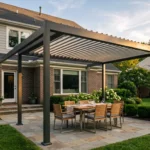
A louvered pergola is the rare backyard upgrade you can re-tune by the hour. Rotate the blades and you control how much sun, shade, and breeze reach the patio, and how much rain stays off it. The catch: most owners treat the roof like a light switch, fully open or fully closed, and miss the angles in between that do the real work. Here is how to set those angles for the sun we actually get here in Northern Virginia.
How the louvers control sunlight
The roof is built from aluminum blades that all pivot together on a hidden linkage. Turn the crank or tap the remote and every blade rotates to the same angle at once. Quality systems swing from flat and closed (a watertight position that sheds rain into gutters built into the frame) all the way open to near vertical, a range of roughly 130 to 170 degrees depending on the brand. You can stop anywhere along that arc.
That gives you four working positions:
- Full shade — blades nearly closed, blocking almost all direct sun.
- Dappled shade — a partial tilt around 30 to 60 degrees, which throws light-and-shadow patterns and keeps some sky in view.
- Open sky — blades rotated toward vertical for maximum light and air.
- Shaded but venting — blades cracked just enough to let hot air rise out while sun stays off your head.
The physics is simple once you picture it. A blade blocks the most light when its flat face turns toward the sun’s rays. Tilt the blade so its thin edge points at the sun instead, and light slips through the gaps. This is why the right angle keeps changing as the day goes on. To stop a high overhead sun you want the blades close to flat. To stop a low morning or evening sun you tilt them steeply toward that low point on the horizon. You can also redirect rather than block, bouncing soft daylight in while keeping the hard beam off the table.
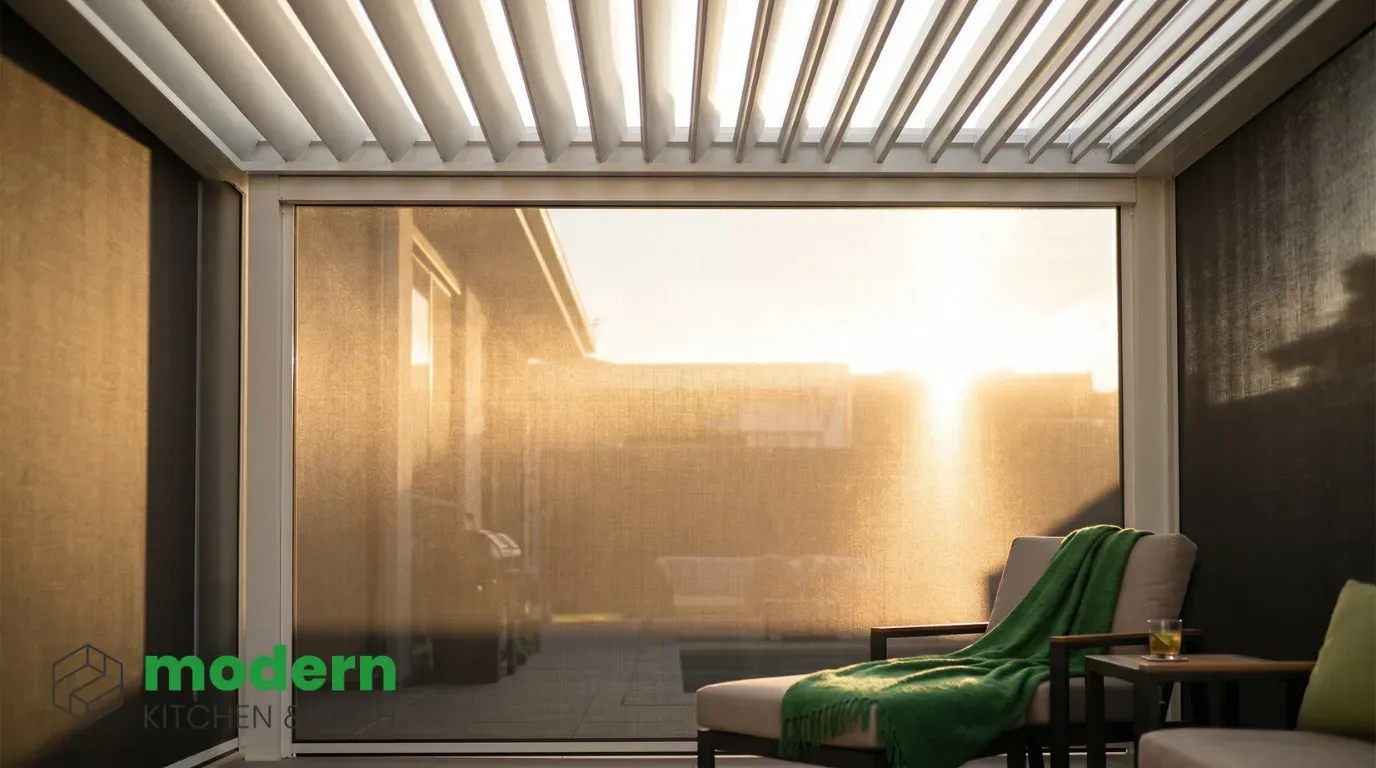
Reading the Northern Virginia sun
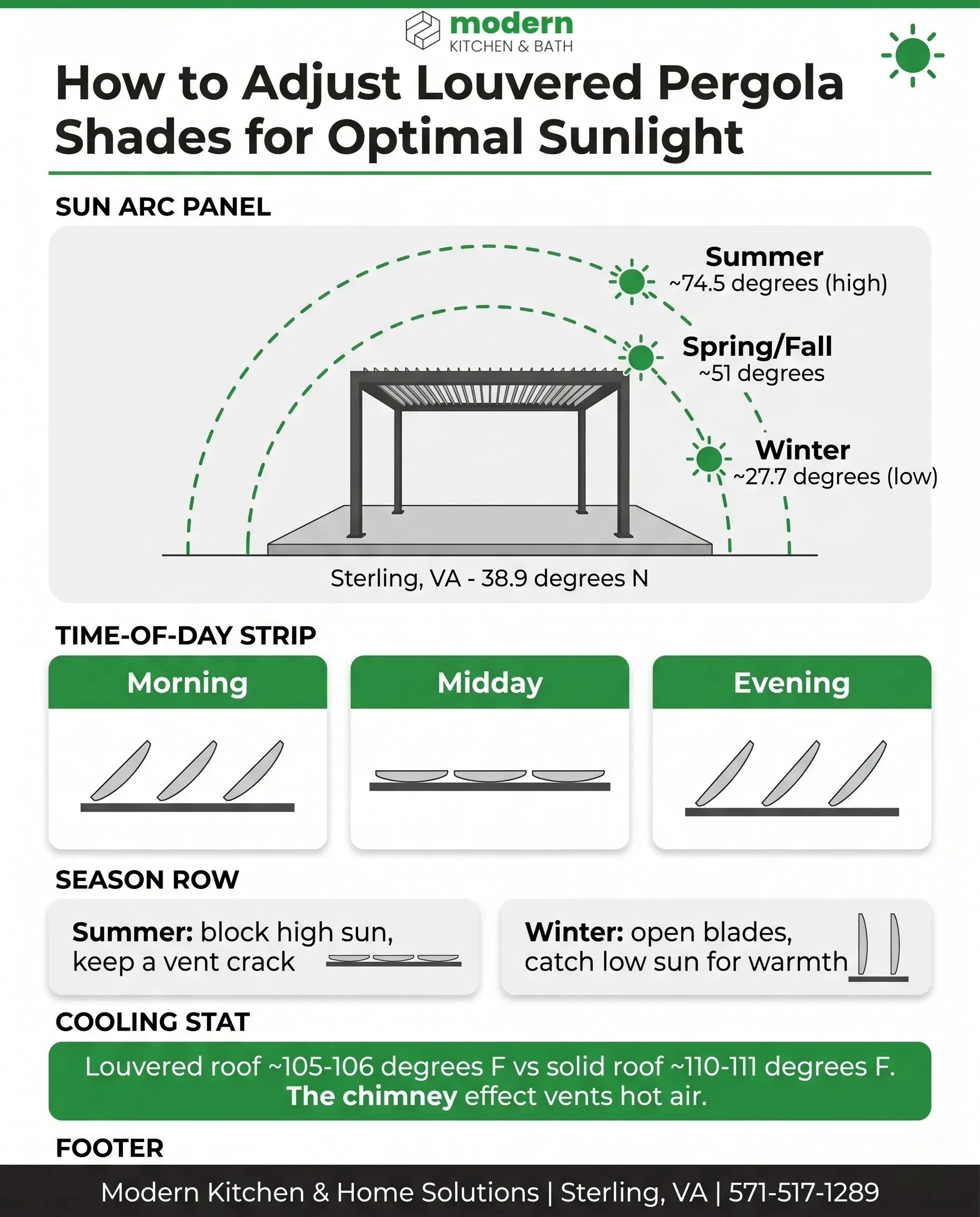
Sterling and the wider DMV sit at about 38.9 degrees north. The sun’s height at midday swings almost 47 degrees between the seasons, and that swing drives every setting you will make. At the summer solstice the noon sun climbs to roughly 74.5 degrees, nearly straight overhead. At the winter solstice it tops out at only about 27.7 degrees, low across the southern sky. The spring and fall equinoxes land in the middle, near 51 degrees.
| Season | Sunrise direction | Sunset direction | Noon sun height |
|---|---|---|---|
| Summer (late June) | Northeast (~58°) | Northwest (~302°) | ~74.5° (nearly overhead) |
| Equinox (Mar / Sep) | Due east (~90°) | Due west (~270°) | ~51° |
| Winter (late Dec) | Southeast (~120°) | Southwest (~240°) | ~27.7° (very low) |
To make that real: on a June morning around 9 a.m. the sun is still low and almost due east. By mid afternoon it has swung into the west southwest while still fairly high. That strong, low east and west sun is the hardest thing to block, which is why blade angle matters more in the early and late hours than at noon.
One note before you start adjusting. Which way your pergola faces sets the baseline for everything below. If you are still planning the build or wondering whether the structure sits in the right spot, read our companion guide on how to optimize pergola orientation for shade and airflow first, then come back here for the day-to-day settings.
A summer playbook, hour by hour
Through a hot Virginia day, the goal shifts from catching light in the cool morning to rejecting heat at midday to fighting glare in the evening. Here is the rhythm that works for most patios.
| Time | Where the sun is | Louver setting |
|---|---|---|
| Early morning | Low in the east | Open wide for soft light and cool air, or tilt toward the east if the glare bothers you. |
| Late morning | Climbing, east-southeast | Tilt blades toward the sun to cut the rising glare. Drop an east-side screen if it reaches under the roof. |
| Midday (11 to 3) | High, near overhead | Bring blades close to flat with a small crack left open. Flat blades block a high sun, and the gap lets trapped heat escape. |
| Afternoon / evening | Dropping into the west | Tilt steeply toward the west. This is the harshest glare of the day, so a west-side screen often earns its keep. |
| Night | Down | Open fully for the night sky, or close if rain is in the forecast. |
The thread running through all of it: at midday keep a vent crack rather than sealing the roof tight. A fully closed roof traps a stagnant layer of hot air underneath. A small opening keeps the air moving, which is the difference between a patio you sit on and one you abandon by 1 p.m.
Winter and shoulder seasons
Flip the strategy when the weather turns. The winter sun sits at only about 27.7 degrees and stays in the south all day, so instead of blocking it you want to catch it. Set the blades to a shallow, more open angle and let that low light pour onto the patio floor and the wall of the house. Stone and concrete soak up the warmth and radiate it back, which stretches the season you can use the space. If the pergola sits against south-facing windows, open blades even help warm the rooms behind them and take a little load off the furnace. Spring and fall are a judgment call: open for warmth on a cool morning, tilt for shade once the afternoon heats up.
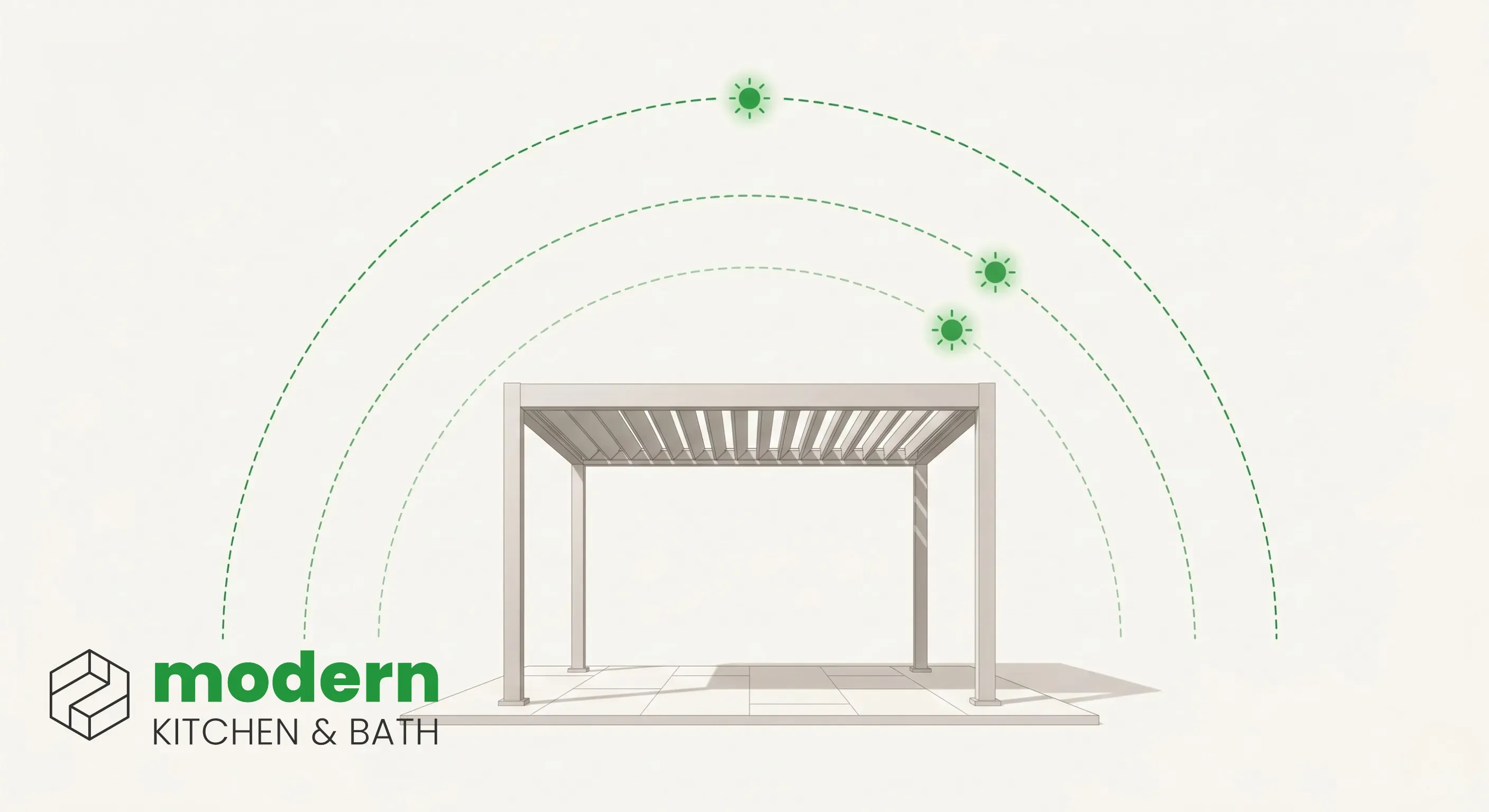
The “close toward the east” rule
Here is a heuristic that saves a lot of trial and error. In our hemisphere, set the blades to close toward the east. Because of the way a louver is shaped, when you crack it open from that closed position the wide underside of the blade turns to face the setting sun in the west. You get a built-in baffle against the worst evening glare while still keeping a gap open for the breeze. If your layout forces the blades to run and close on a north-south line instead, have them close toward the north, since the late-day sun sliding into the southwest meets the blades at a similar working angle.
Manual, motorized, or smart
How you make these adjustments depends on the control system, and the right choice tracks how often you will touch the roof.
| System | Best for | Rough cost |
|---|---|---|
| Manual crank | Smaller pergolas you adjust now and then. No wiring, very few parts to fail. | $3,000 to $10,000 |
| Motorized / smart | Larger roofs and daily use. Remote, app, scheduling, and precise angle control. | $8,000 to $25,000+ |
Motorized roofs open the door to sensors, which is where a louvered pergola starts running itself:
- Rain sensors close the blades at the first drops, which matters most when you are not home. In our pop-up thunderstorm summers, that alone protects the furniture.
- Wind sensors do the opposite. When gusts cross a set threshold they drive the blades open so the wind passes harmlessly through instead of lifting a closed roof.
- Sun and temperature sensors track the sun across the sky and hold a steady patch of shade, or close the roof during the afternoon heat without a single tap.
When louvers alone cannot do it
Overhead blades cannot stop sun that comes in sideways. Low morning and evening light slides right under the roof and hits you at eye level no matter how you angle the slats. The fix is a vertical surface, not a flatter blade. Add a retractable side screen on your worst exposure, the east end for breakfast glare or the west end for dinner. Pick a fabric around 10 to 15 percent openness, which diffuses the glare without making the space feel like a cave, and set the screen flush to the ground so winter sun does not sneak under the hem. One well-placed screen on the bad side usually beats wrapping the whole structure.
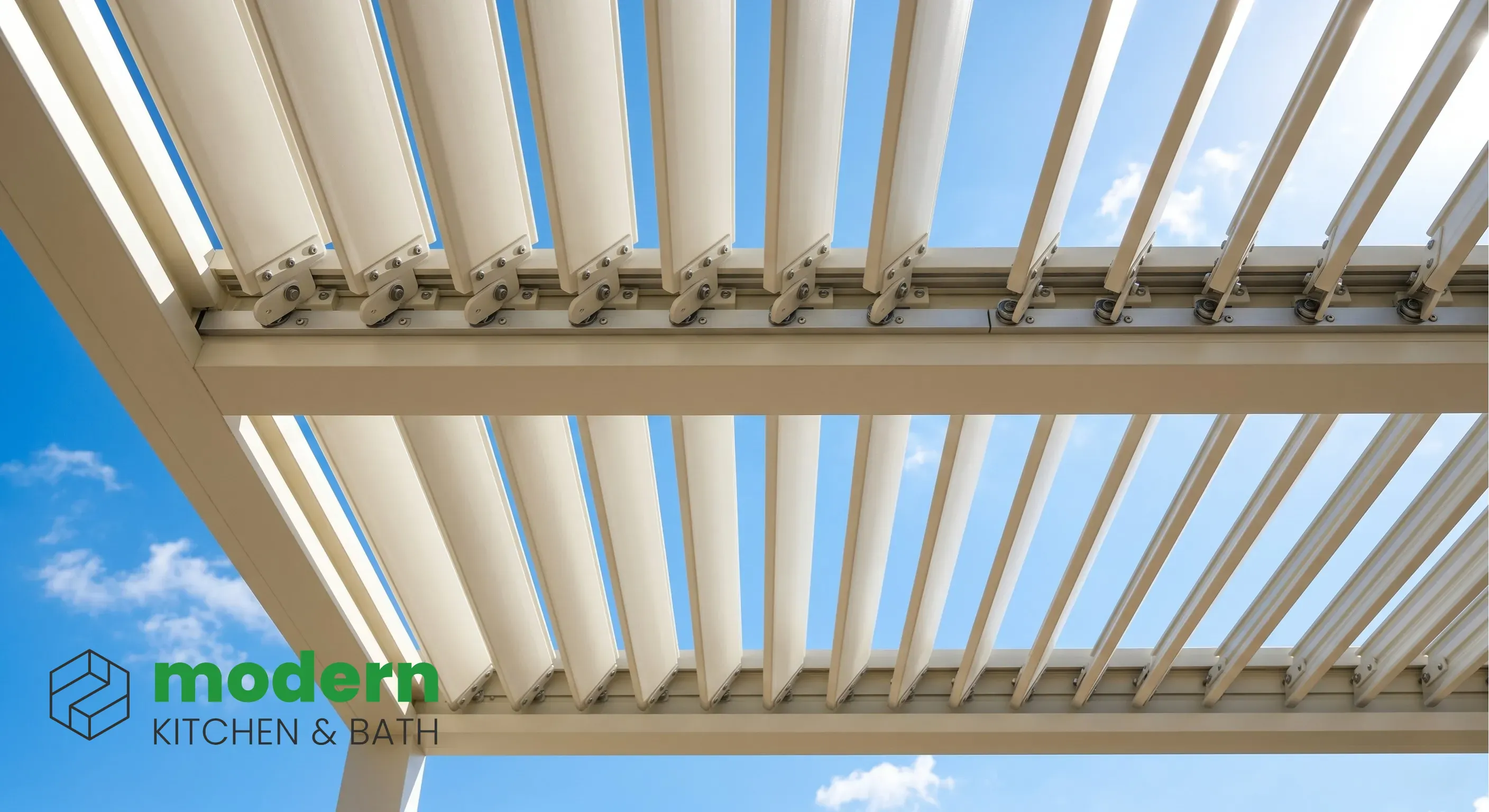
Why an angled roof runs cooler
Angling the blades does more than block light. It sets up a chimney effect. Hot air near the patio floor rises, escapes through the gaps, and pulls cooler air in from the shaded edges. That moving air is the whole point. In side-by-side heat tests, a louvered roof held a surface temperature around 105 to 106 degrees while a solid insulated roof in the same sun sat at 110 to 111, and the air beneath the louvers measured about 95.5 degrees. After sunset the thin aluminum blades shed heat fast, dropping close to 29 degrees in surface temperature and cooling the space below the surrounding yard. A solid roof simply cannot vent like that.
Blade color stacks on top of this. Dark blades (black, bronze, charcoal) soak up sun and can hit 120 to 140 degrees on the surface during a July afternoon, radiating some of that heat back down. Light blades with a matte or reflective finish run 20 to 30 degrees cooler. If summer comfort is your priority over winter warmth, lean toward a lighter color.
Keeping it working: maintenance on a DMV calendar
The blades and linkage stay smooth with very little effort, as long as you match the upkeep to our seasons.
Spring
Pollen is the enemy here. Tree pollen ramps up in March and peaks across April and May in Northern Virginia, and that yellow film is the leading reason louvers start to grind or stick. Sweep the blades and tracks, wash the frame with mild soap and water (skip bleach and ammonia, which attack the powder coating and the gaskets), and put a silicone or Teflon lubricant on the pivots. Never use an oil-based spray like WD-40 on the joints, since it grabs dust and makes the problem worse.
Summer and fall
Wipe down dust between storms and keep the gutter channels and downspouts clear, especially heading into thunderstorm season and again when the leaves drop. Cycle a motorized roof now and then so the gears stay greased and the seals stay supple.
Winter
This is the season to read your manufacturer’s manual, because the snow rule depends on how your roof was built. Lighter-duty models (rated near 10 to 15 pounds per square foot) should be opened to vertical before snow falls so it drops through the blades instead of piling on a flat roof. Heavier four-season systems (rated 30 PSF or more) are engineered to carry the load with the blades closed, keeping the space dry all winter. Whichever you own, never force frozen blades or run the motor against ice. That is how pivot pins snap and motors burn out. After a heavy snow, clear any buildup gently with a soft brush.
Five mistakes that waste the roof
- Using it as open-or-closed only. The in-between angles are the entire reason you bought an adjustable roof.
- Sealing it tight on a hot day. Closed blades trap heat. Leave a vent crack at midday.
- Expecting the roof to stop low sun. That is a job for a side screen, not a flatter blade.
- Leaving blades partly open in a hard freeze. Trapped water freezes, expands, and can crack the pivots.
- Ignoring the gutters. Clogged channels send water over the edge in a sheet and can back up under the seals.
Frequently asked questions for How to Adjust Louvered Pergola Shades for Optimal Sunlight?
What is the best angle for louvered pergola slats?
It depends on how high the sun is. To block the high midday summer sun, bring the blades close to their flat, nearly closed position and leave a small crack open so trapped heat can vent. To block the low morning or evening sun, tilt the blades steeply toward that part of the sky. Advice you see online that says 60 to 90 degrees for maximum shade usually refers to fixed-spacing slat roofs. On a pergola whose blades close flat to a watertight seal, near-closed blocks the most sun and wide-open lets the most light through.
Which way should the louvers run on a pergola?
Run the blades north to south so they can tilt to track the sun as it moves from east to west through the day. That orientation gives you working shade plus airflow from morning to evening. For the full placement and facing decision, see our guide on how to optimize pergola orientation for shade and airflow.
What are the cons of a louvered pergola?
The main drawbacks are cost, upkeep, and the limits of an overhead roof. A quality system is a real investment, the seals and gutters need cleaning to stay watertight, and motorized units add parts that can eventually need service. An overhead roof also cannot block low sun that comes in from the side, so a west or east facing patio often needs a side screen as well.
How long does a louvered pergola last?
A motorized aluminum louvered pergola generally lasts 15 to 25 years or more, and the aluminum frame itself can last even longer. Keeping the blades clean, the gutters clear, and the pivots lubricated is what gets you to the high end of that range.
Is a louvered pergola worth it?
For homeowners who want to use their patio across more of the year, most find it worth the investment. Industry estimates put the return at roughly 50 to 80 percent of the cost, and a usable outdoor space helps a home stand out to buyers. Owners often say their main regret is not adding shade sooner.
Why does my louvered pergola leak in heavy rain?
Heavy-rain leaks almost always trace back to the seals and tracks. New installs often leak until the tracks are sealed, and older roofs leak when debris blocks the gutters or downspouts built into the frame. Make sure the blades fully close to their flat position, keep the channels clear, and check the gaskets each season.
How do I block low afternoon sun on a west-facing patio?
Overhead louvers cannot stop sun that comes in sideways, which is why a west-facing patio still bakes all afternoon. The fix is a vertical surface, not a flatter blade. Add a retractable side screen on the west end, choose a fabric around 10 to 15 percent openness, and mount it to the pergola posts rather than only staking it to the ground so wind does not lift it.
Planning an outdoor living space in Northern Virginia?
Modern Kitchen & Home Solutions designs outdoor rooms that work with your kitchen, your home, and the Sterling climate, from louvered pergolas and patios to full indoor-outdoor remodels. Stop by the showroom or call to talk through your project.
Modern Kitchen & Home Solutions
47100 Community Plaza #132, Sterling, VA 20164
Consultations: 571-517-1289
Found this helpful? Make us your go-to source on Google
If our content has been useful, you can tell Google to show more of it when you search. Click below, then check the box next to Modern Kitchen and Bath on the page that opens. It takes about five seconds.

You'll need to be signed in to your Google account. One click, then tick the box next to our name.