By Isolde Carrington, Kitchen and Bath Designer · October 2026 · Modern Kitchen & Home Solutions, Sterling VA
Two pieces of national data landed this month, and read together they answer the question most homeowners ask before they call anyone: is now a good time to remodel?
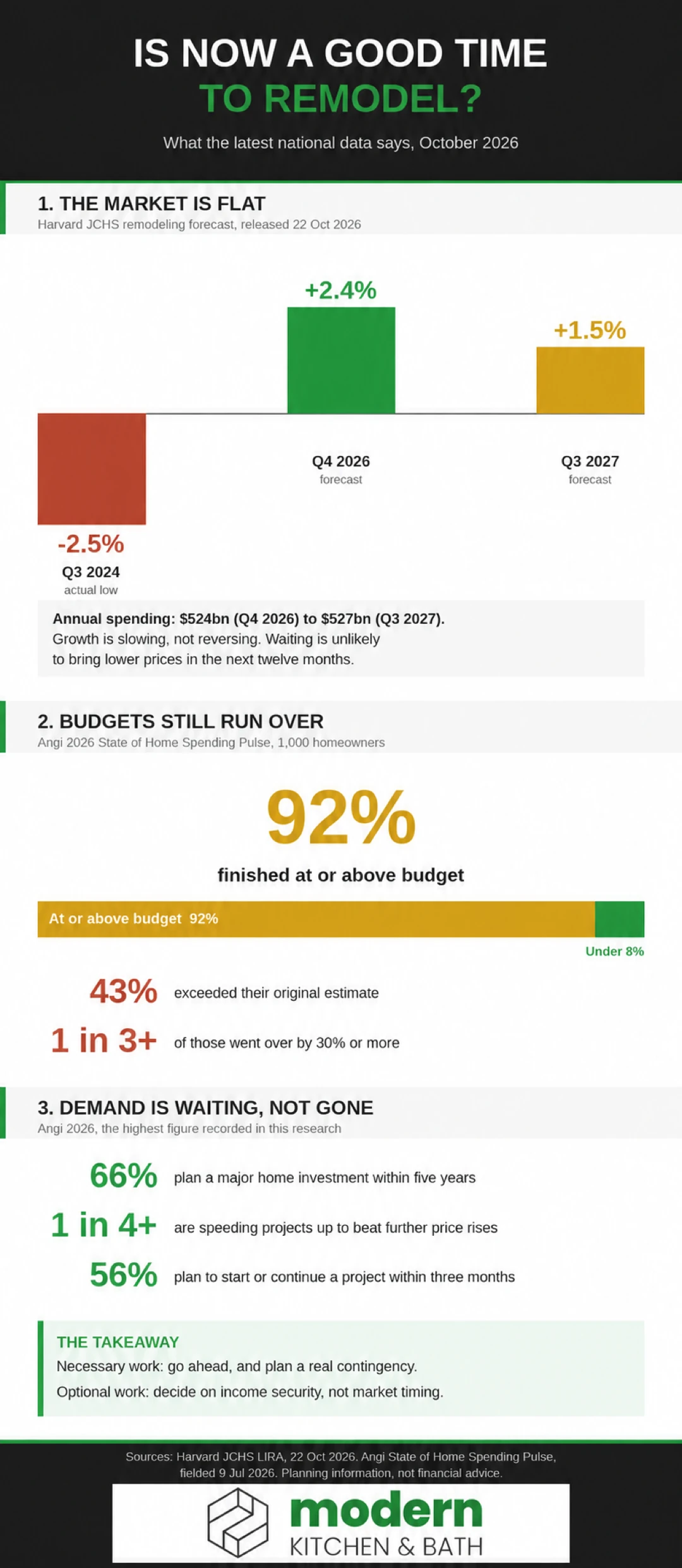
Harvard’s Joint Center for Housing Studies published its remodeling forecast on 22 October 2026. Annual spending on home improvements and repairs is expected to stay roughly flat at around $525 billion through the third quarter of 2027.
Angi surveyed 1,000 homeowners who had hired a professional in the past year. Ninety-two percent of them finished at or above budget.
Put those side by side and you get something more useful than either on its own. The market is quiet. Individual projects are still running over. The two facts fit together once you see why.
What this covers
- What the Harvard forecast says
- Why a flat market does not mean lower prices
- The budget figures every homeowner should see before getting quotes
- Why a record number of people are planning projects they have not started
- What this means specifically in Loudoun and Fairfax
- When to go ahead, and when waiting is the better call
What the Harvard Forecast Says
The Leading Indicator of Remodeling Activity is published quarterly by Harvard’s Remodeling Futures Program. It is one of the most widely cited short-term forecasts for home improvement spending in the United States, and the October 2026 release is not encouraging reading for the industry.
| Period | Annual spending | Year-over-year growth |
|---|---|---|
| Q4 2026 | $524 billion | 2.4% |
| Q3 2027 | $527 billion | 1.5% |
Growth decelerating from 2.4% to 1.5% over three quarters, on a spending base that barely moves. For context, spending contracted through late 2023 and 2024, bottoming at negative 2.5% in the third quarter of 2024, before turning positive again in mid-2025. So this is a weak recovery that is losing pace.
Two quotes from the release explain why.
Rachel Bogardus Drew, who directs the Remodeling Futures Program, pointed to the leading signals: “Retail spending on building products has been flat to negative, and remodeling permits have stagnated, which points to continued sluggish renovation activity.”
Chris Herbert, the Center’s Managing Director, was blunter about the wider picture: “Housing starts also continue to decline, and we are seeing persistent weakness in the broader housing market. These ongoing headwinds could slow growth in remodeling spending even further in the quarters ahead.”
Why a Flat Market Does Not Mean Lower Prices
Many homeowners assume the opposite, which is why the Angi data matters alongside Harvard’s.
It is reasonable to assume that a soft market means better prices. Fewer projects, contractors competing harder, costs come down. That is not what the evidence shows.
Angi’s mid-2026 survey found:
| Finding | Share of homeowners |
|---|---|
| Finished their project at or above budget | 92% |
| Exceeded their original estimate | 43% |
| Of those over budget, went over by 30% or more | more than one third |
| Said lower material prices would make them more likely to proceed | 59% |
| Said lower inflation would make them more likely to proceed | 54% |
Remember that 92%. Finishing under budget is now the exception, by a wide margin.
And the reason the market is flat is the same reason prices are not falling: high costs are what is holding activity back. Materials and labor have become more expensive, so fewer homeowners proceed. Research from the Home Improvement Research Institute, cited in the Angi report, found the same pattern: fewer homeowners taking on projects, but those who do spend more per project.
A quiet market caused by high costs does not produce low prices. It produces fewer projects at high prices.
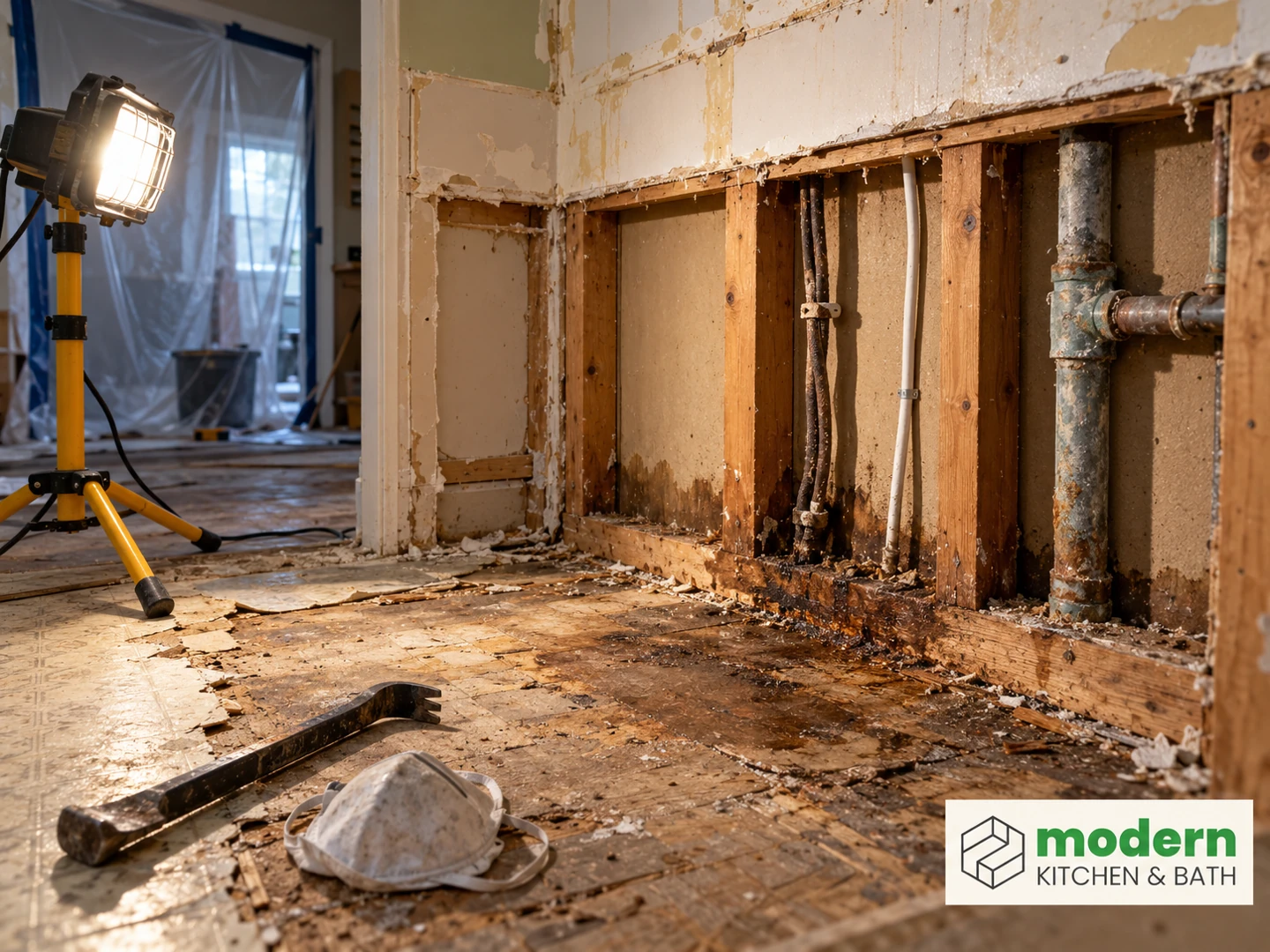
What to do with this before you get quotes. Set your budget first, then add a separate contingency on top of it. If 43% of projects exceed their estimate and a third of those exceed it by 30% or more, a 10% cushion is optimistic. Fifteen to twenty percent is realistic for a kitchen or bathroom where walls are coming open and the age of the house is uncertain. A quote with no contingency discussion in it is not a complete quote.
A Record Number of Homeowners Are Waiting to Start
The same survey contains a figure that points the other way.
Despite postponing projects, despite the cost pressure, 66% of homeowners say they plan to make a major home investment within the next five years. That is the highest figure Angi has recorded in this research.
Alongside it:
- More than one in four are accelerating projects specifically to get ahead of future price increases
- 56% plan to begin or continue a project within three months
- Recent activity skews to upkeep: 63% did maintenance and 58% did repairs, against 35% completing renovations
- 23% of those who delayed a project did so because an unplanned or emergency job jumped the queue
So most of these postponed projects are still coming. A queue is forming.
That matters for timing in a practical way. The homeowners deferring now are waiting for a signal: lower material prices, easier borrowing, more job security. When that signal arrives, they move at roughly the same time, and the constraint shifts from your budget to your contractor’s calendar.
What This Looks Like in Northern Virginia
National figures describe the whole country. Three local factors change the picture in Northern Virginia.
This region does not track the national average
Loudoun and Fairfax counties have household incomes well above the national median and a housing stock that is largely owner-occupied and aging into renovation years. The builder homes that went up across Ashburn, Brambleton and South Riding from the late 1990s are now twenty-five to thirty years old, around the age when original kitchens and bathrooms start to wear out.
Most of that is replacement work. People replace a failing kitchen whatever the national mood.
Permit timelines are part of your schedule, not an afterthought
Harvard’s forecast notes that remodeling permits have stagnated nationally. Locally, permits sit on the critical path.
Structural work, relocated plumbing, and new or moved electrical circuits all require permits and inspections in both Fairfax and Loudoun. If you are planning a spring project, the design and permit work belongs in winter. Our guide to remodeling permits in Northern Virginia covers what each county requires.
Federal employment affects confidence here more than elsewhere
Angi identified job security as a leading reason homeowners delay. In a region where a large share of households are tied to federal employment or federal contracting, that concern lands harder than the national average suggests. It is a reasonable thing to weigh, and it is the most legitimate reason to put off an optional project.
So Should You Go Ahead?
The answer depends on which kind of project you have.
If the work has to be done
Failing plumbing, water damage, an unusable layout, a bathroom that cannot be used safely. Waiting makes these worse and more expensive, and the data does not suggest prices are coming down to reward patience. Angi found that 23% of delays happened because an emergency job jumped the queue. Putting off necessary work tends to end that way.
Do it now, and budget properly.
If the work is optional
Here it comes down to three questions, and none of them is about the market.
| Question | If yes | If no |
|---|---|---|
| Is your income secure for the project duration? | Proceed | Wait. This is the one that matters most. |
| Can you fund it without stretching to the last dollar? | Proceed | Wait, or reduce the scope until the answer is yes. |
| Are you staying in the house 5 years or more? | Proceed | Reconsider the scope and spend on what sells. |
Notice what is missing from that table: any attempt to time the market. Nobody can tell you where prices go next, and anyone who says otherwise is guessing. What the Harvard data does tell you is that waiting for a better market is unlikely to be rewarded in the next twelve months, because the forecast shows spending holding steady with no decline in sight.
What a slow market does give you is attention. When contractors are less stretched, you get more of the designer’s time and more say over the start date. That is the clearest advantage a flat market offers. It also disappears quickly when the deferred demand returns.
A note on scope
If the budget is tight but the project is not optional, the useful move is usually reducing scope rather than reducing quality. A well-built smaller kitchen outlasts a large one built to a stretched budget, and phasing is a legitimate strategy. Angi’s own guidance says the same: break larger renovations into phases that fit the budget over time.
For what projects actually cost in this area, see our kitchen remodel cost guide and bathroom remodel cost guide. For where the money goes furthest, our breakdown of the NKBA 2027 kitchen trends covers which upgrades designers rank highest for return.
Rated 4.8 out of 5 from 68 Google reviews
Modern Kitchen & Home Solutions, Sterling VA · October 2026
Frequently Asked Questions for Remodeling in 2027
Is now a good time to remodel?
For necessary work, yes. Harvard’s October 2026 forecast projects remodeling spending staying roughly flat at around $525 billion through the third quarter of 2027, with growth slowing from 2.4% to 1.5%. A flat forecast means waiting is unlikely to deliver lower prices in the next twelve months. For discretionary work, the deciding factors are your income security and whether you can fund the project without stretching. Market timing comes a distant third.
Will remodeling costs go down in 2027?
There is no indication of that in the current data. Harvard projects annual spending rising slightly from $524 billion in late 2026 to $527 billion by the third quarter of 2027, which is a flat market with no forecast decline. Activity is subdued because costs are high, and a slowdown caused by high prices is not a sign that prices are about to drop. Research cited by Angi found fewer homeowners taking on projects while those who proceed spend more per project.
How much should I budget over my estimate for a remodel?
Plan for 15% to 20% above the quoted figure on a kitchen or bathroom, held as a separate contingency on top of your budget. Angi found that 92% of homeowners finished at or above budget, 43% exceeded their original estimate, and more than a third of those exceeded it by at least 30%. The risk is highest where walls are being opened in an older house, because that is where unknowns are discovered.
Why do so many remodeling projects go over budget?
Angi found 92% of projects finished at or above budget, with 43% exceeding the original estimate. Angi’s survey does not break down the causes, but the usual ones are conditions that cannot be seen until demolition, such as outdated wiring, hidden water damage, or floors that are out of level; changes made by the homeowner during the project; and material prices moving between quote and purchase. The first category is why a contingency matters more on an older house.
Are homeowners still remodeling in 2026 and 2027?
Yes, though more selectively. Angi found recent activity skewing toward upkeep, with 63% completing maintenance and 58% repairs against 35% doing renovations. But 66% say they plan a major home investment within five years, the highest figure Angi has recorded, and 56% plan to begin or continue a project within three months. Angi’s reading is that today’s postponements are not necessarily cancellations.
Should I wait for remodeling prices to drop?
The current forecast does not support waiting on price grounds. Harvard projects flat spending through late 2027. The market is slow because costs are high, and that kind of slowdown does not push prices down. More than one in four homeowners in Angi’s survey are doing the opposite, accelerating projects specifically to get ahead of further price increases. Income security is a sounder reason to wait than price.
What is the advantage of remodeling during a slow market?
Availability and attention. When contractors are less stretched, you generally get more considered quotes and more flexibility on start dates. That advantage is real but temporary, because the deferred demand in the market is substantial: 66% of homeowners plan a major investment within five years, and when conditions improve they tend to move at the same time, which tightens schedules quickly.
How far ahead should I plan a kitchen or bathroom remodel in Northern Virginia?
Allow time for design and permits before any work starts. In Fairfax and Loudoun counties, structural changes, relocated plumbing and new electrical circuits all require permits and inspections, and that approval time sits on the critical path. For a spring start, design and permitting generally belong in winter. Cosmetic work such as replacing cabinet doors or a countertop usually does not require a permit.
What is the LIRA remodeling forecast?
The Leading Indicator of Remodeling Activity is a quarterly forecast from the Remodeling Futures Program at Harvard University’s Joint Center for Housing Studies. It projects national spending on improvements and repairs to owner-occupied homes for the current quarter and the following four. It was first developed in 2007 and is published roughly three weeks after each quarter closes. The next release is 21 January 2027.
Is it better to remodel or move in the current market?
That depends on your circumstances more than on remodeling data, and a real estate agent who knows your immediate area can help you weigh it. What the current data contributes is context: Harvard notes that housing starts continue to decline with persistent weakness in the broader housing market, so the relative economics of moving are also under pressure. A useful starting point is whether your current house can be made to work. If the answer is yes, remodeling avoids the transaction costs of moving.
Thinking About a Project in Northern Virginia?
We design and build kitchens and bathrooms from our Sterling showroom for homeowners across Loudoun and Fairfax counties. If you would like a realistic read on cost, scope and timing for your house, bring us your floor plan.
Sources
- Joint Center for Housing Studies of Harvard University, “Remodeling Spending Continues to Stagnate”, Leading Indicator of Remodeling Activity, published 22 October 2026. Quotes from Rachel Bogardus Drew, Director of the Remodeling Futures Program, and Chris Herbert, Managing Director. Next release 21 January 2027.
- Angi, “2026 State of Home Spending Pulse”. Survey of 1,000 US homeowners aged 18 and over who hired a professional for a home improvement, repair or maintenance project within the previous 12 months, fielded 9 July 2026 with age, gender and regional quotas.
- Home Improvement Research Institute, Quarterly Homeowner Project Activity Tracker Q2 2026, as cited in the Angi report.
- Google review rating for Modern Kitchen & Home Solutions verified October 2026.
This article summarizes published industry research to help with project planning. It is not financial advice, and it does not attempt to forecast prices beyond what the cited sources state.
Related Reading
- How Much Does It Cost to Remodel a Kitchen
- How Much Does a Bathroom Remodel Cost
- Kitchen Trends in Northern Virginia: The 2027 Report
- Remodeling Permits in Northern Virginia
- Basement Remodeling Cost in Northern Virginia
- Home Addition Cost in Northern Virginia
- Kitchen Countertop Cost in Northern Virginia
Found this helpful? Make us your go-to source on Google
If our content has been useful, you can tell Google to show more of it when you search. Click below, then check the box next to Modern Kitchen and Bath on the page that opens. It takes about five seconds.

You'll need to be signed in to your Google account. One click, then tick the box next to our name.