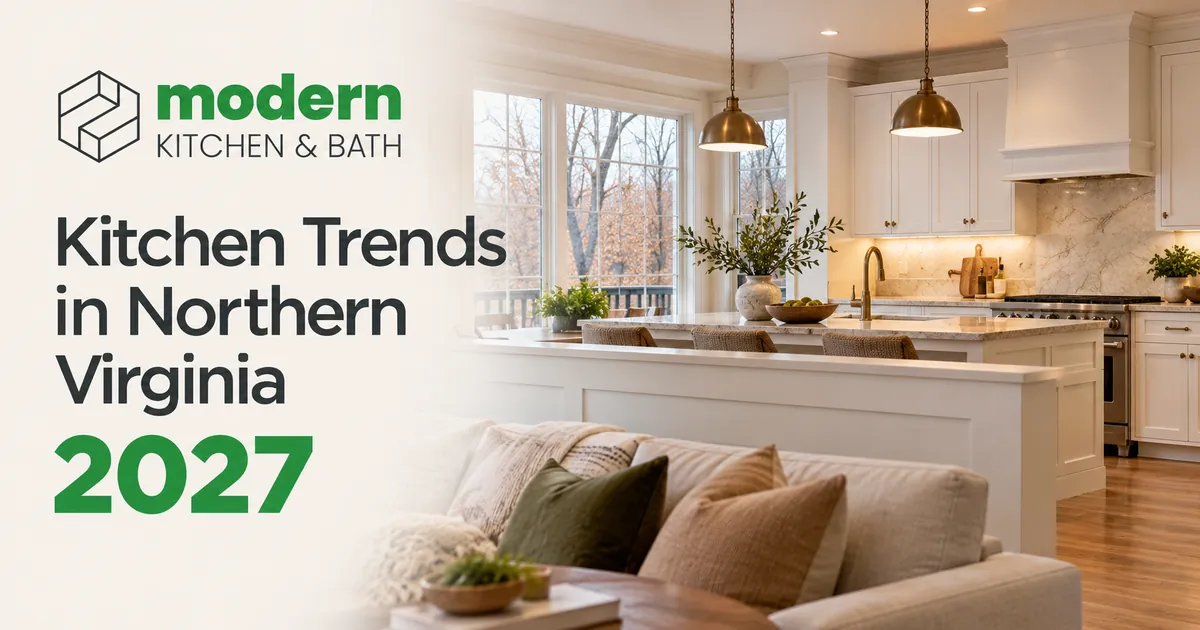
The National Kitchen & Bath Association released its 2027 Kitchen Trends Report on 14 October 2026, and the headline is one I did not expect to write: the walls are coming back.
After fifteen years of knocking them down, designers are putting them back up. Not solid walls, and not a return to the closed galley kitchens of the 1980s, but partial walls, operable partitions and deliberately defined zones. Eighty-one percent of the 830 industry professionals NKBA surveyed rate intentional zoning as “here to stay.” That is a reversal of the 2026 report, which still listed open layouts as a trend in its growth phase.
I have spent more than a decade designing kitchens, and the last several of them here in Northern Virginia. What follows is the 2027 data, and then the part the national reports never cover: what it actually means for a house in Sterling, Ashburn, Vienna or Fairfax, where the housing stock, the weather and the permit offices all have opinions of their own.
What this guide covers
- The return of walls and zoned layouts
- Why layout is now the second-highest-ROI upgrade
- Quartzite overtaking quartz on countertops
- Cabinets: natural wood, concealment, and the end of open shelving
- Lighting treated as design rather than utility
- Wellness and climate resilience, which matter more here than most places
- Mudrooms, pantries and the hardest-working rooms in a Virginia house
- A measured verdict on AI in the kitchen
- What all of this costs and permits locally
The Headline for 2027: Walls Make a Comeback
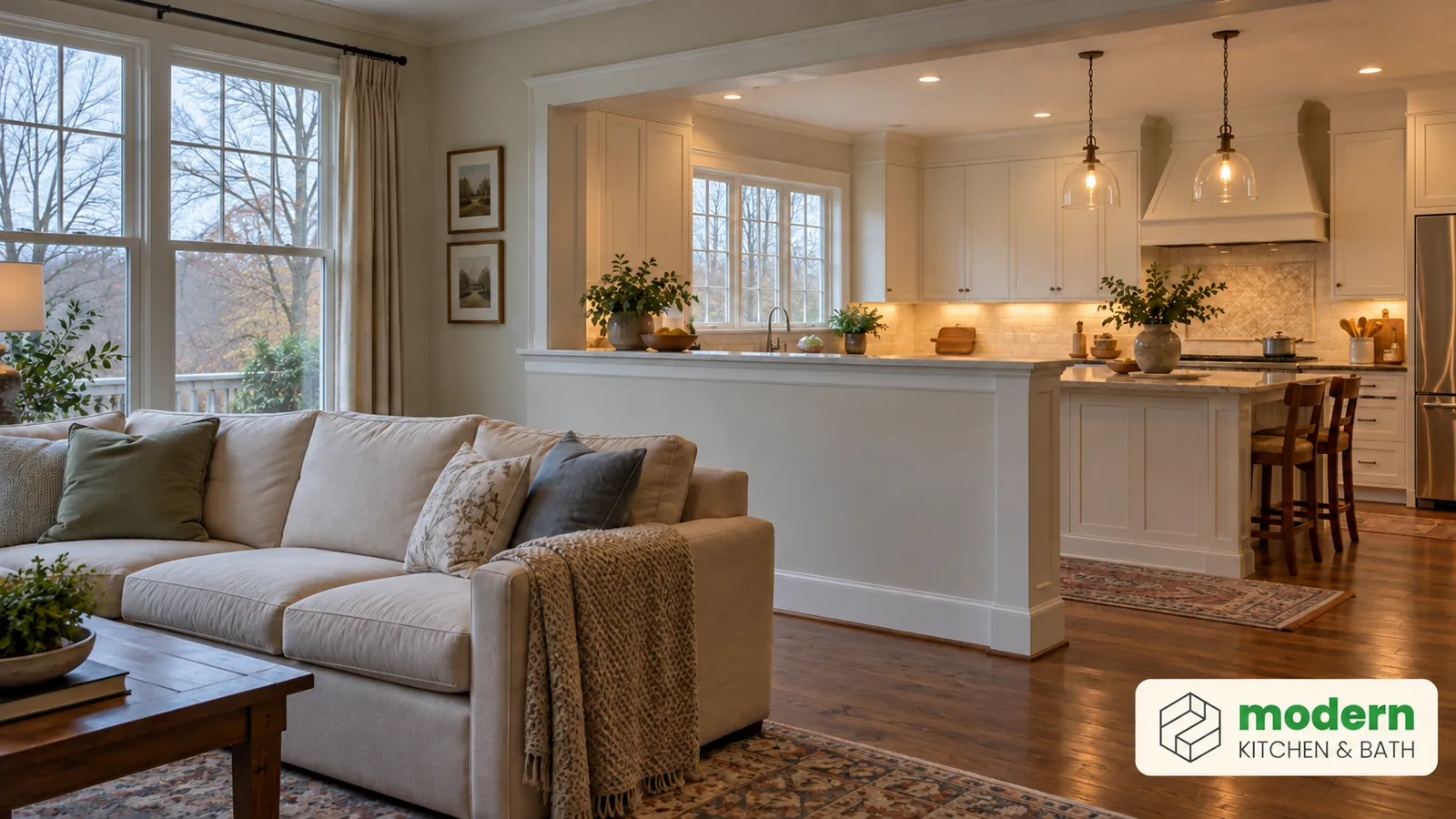
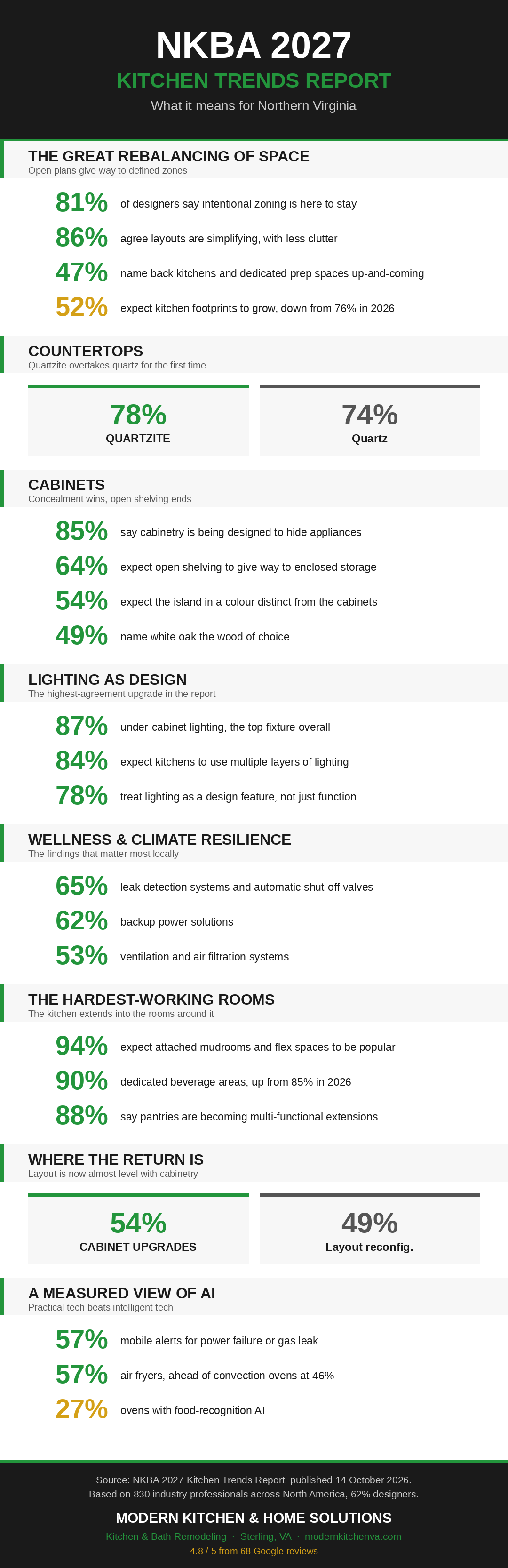
The single clearest finding in the NKBA 2027 report is a rebalancing of space. Fully open floor plans are giving way to something more considered.
| Layout feature | Designers who agree | Status |
|---|---|---|
| Intentional zoning | 81% | Here to stay |
| Dedicated prep spaces and back kitchens | 47% | Up and coming |
| Semi-enclosed layouts | 46% | Up and coming |
| Partially concealed kitchens | 41% | Up and coming |
| Layout is simplifying, less clutter | 86% | Current direction |
The kitchen is still growing, but more slowly. Fifty-two percent of designers expect kitchen footprints to increase over the next three years. In the 2026 report that figure was seventy-six percent. The square footage that is being added is going into defined zones and enclosed storage rather than into more open space for its own sake.
What this means for a Northern Virginia house
This is where the national data meets local reality, and the fit is better than you might expect.
A great deal of the housing stock in Loudoun and Fairfax counties, particularly the builder homes that went up across Ashburn, Brambleton and South Riding from the late 1990s onward, was designed around exactly the great-room concept that 2027 is now walking back. Two-storey family room open to the kitchen, no separation, every pan clatter and dishwasher cycle broadcast into the living space.
Homeowners here have been telling me for years that they love the light and hate the noise. The 2027 data says the industry has finally caught up to that complaint.
The practical version in a NoVA house is rarely a new wall. More often it is:
- A peninsula or a taller island back panel that screens the working side of the kitchen from the family room
- A cased opening with a partial return instead of a fully open span
- Converting an underused formal dining room or a butler’s pantry into a back kitchen
- Glass or slatted partitions that divide sound without dividing light
Before you plan to move or remove anything: in a two-storey Northern Virginia colonial, the wall between the kitchen and family room is frequently load-bearing, and the beam required to remove it drives both cost and schedule. Zoning work that adds partitions is usually simpler and less expensive than the open-plan conversions of the last decade. Either way, check our guide to remodeling permits in Northern Virginia before you commit to a layout, because structural changes and relocated plumbing or electrical both trigger permits in Fairfax and Loudoun.
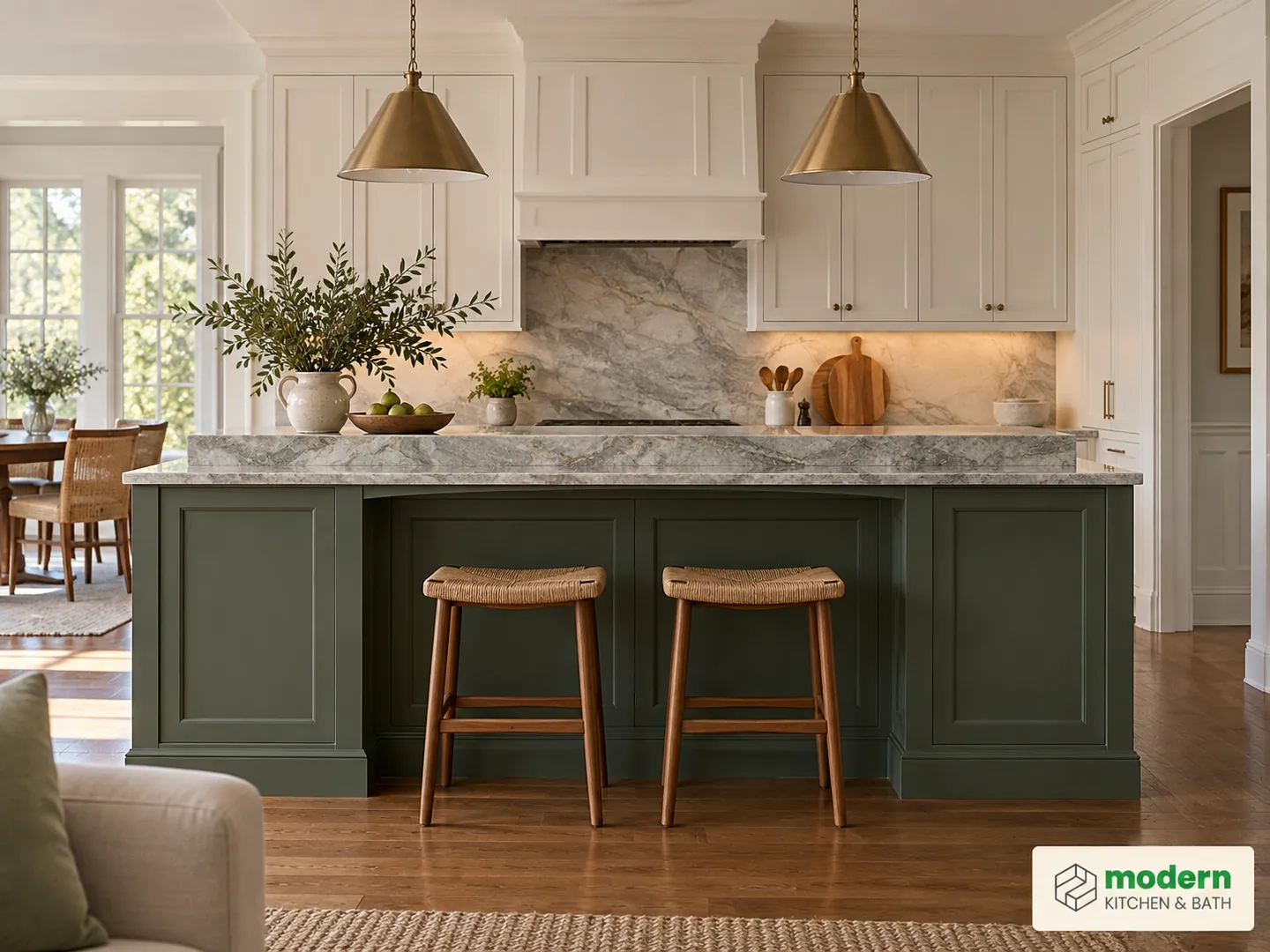
Layout Reconfiguration Is Now the Second-Best Investment You Can Make
This finding deserves more attention than it will probably get. When NKBA asked designers which kitchen investments deliver the highest return, the ranking was:
| Investment | Designers naming it highest-ROI |
|---|---|
| Cabinet upgrades | 54% |
| Layout reconfiguration | 49% |
Layout is now essentially neck and neck with cabinetry as the thing worth spending money on. For years the standard advice was that cabinets and countertops carried the return and layout was a luxury. That has shifted.
It matches what I see on local projects. A kitchen with dated cabinets and a good working layout feels better to live in than a kitchen with beautiful new cabinets and a bad one. If your budget will not stretch to both, the 2027 data gives you permission to fix the layout first.
If you are weighing where the money goes, our kitchen remodel cost guide breaks down the tiers, and the kitchen island cost guide covers the single element most often involved in a zoning change.
Countertops: Quartzite Overtakes Quartz for 2027
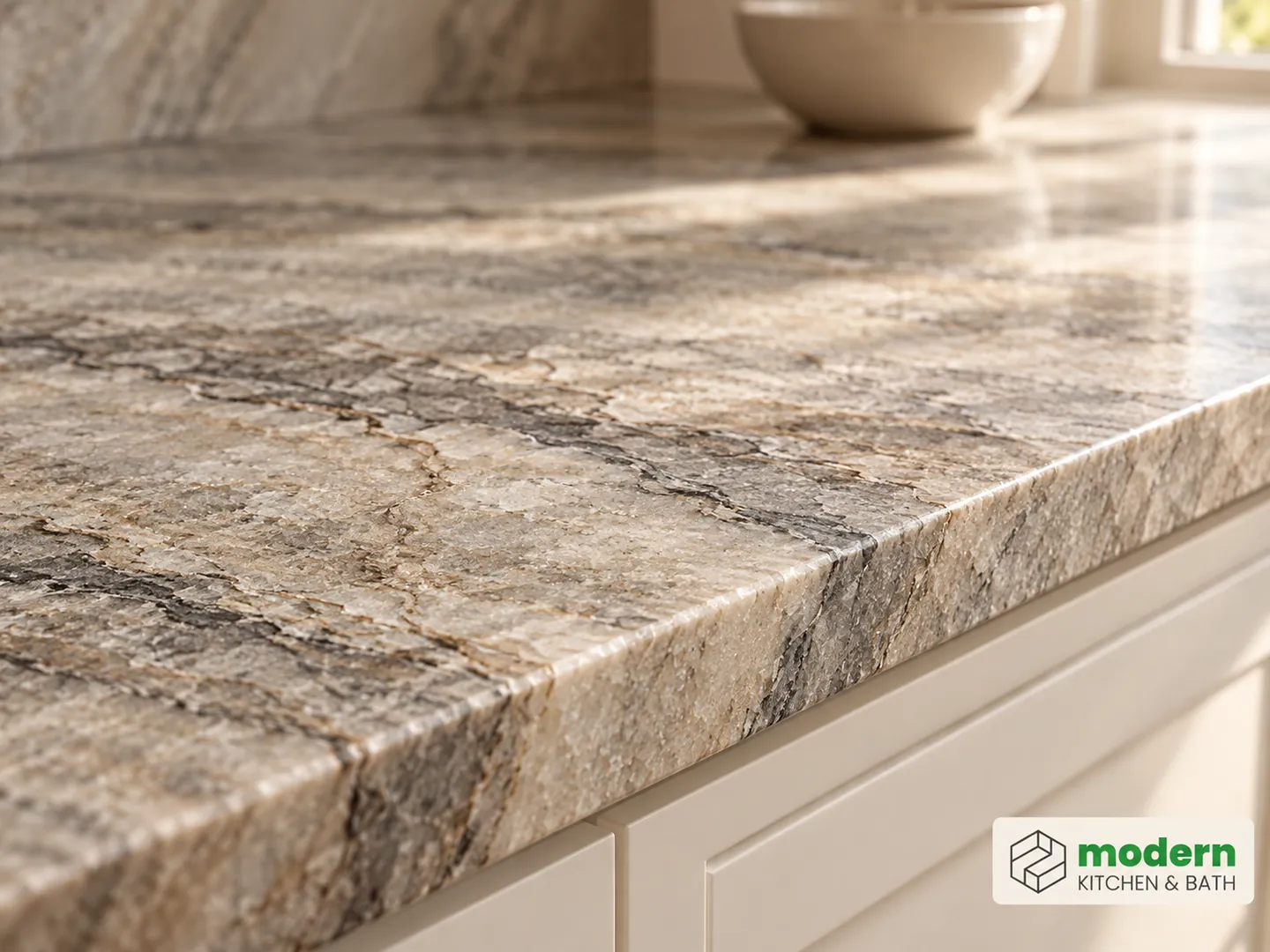
For the first time in several years, engineered quartz is not the top countertop pick in the NKBA forecast.
| Countertop material | Designers expecting it to be popular |
|---|---|
| Quartzite | 78% |
| Quartz | 74% |
Four points is a narrow margin, and I would not declare quartz finished on the strength of it. But the direction is consistent with the wider move toward natural materials running through the whole 2027 report.
It is worth being clear about what the two actually are, because the names are close enough to cause genuine confusion and the practical differences matter.
- Quartzite is a natural stone, quarried and cut. Each slab is unique, it handles heat well, and it needs periodic sealing. Harder than granite.
- Quartz is engineered, roughly ninety percent ground mineral bound with resin. Consistent pattern slab to slab, non-porous, no sealing, but the resin is vulnerable to heat.
Homeowners frequently assume quartzite is the low-maintenance one because the name sounds like quartz. It is the opposite. If you want a surface you never think about, quartz is still the better answer, and the 2027 numbers do not change that.
Local pricing for both, plus the other materials in the mix, is in our kitchen countertop cost guide for Northern Virginia. If you are specifically weighing natural stone against engineered, see quartz vs granite and our overview of countertop types.
Cabinets: Natural Wood Wins, and Open Shelving Is Over
Two findings stand out, and they point the same direction.
| Cabinet trend | Designers who agree |
|---|---|
| Cabinetry designed to conceal appliances and functional elements | 85% |
| Open shelving on its way out, replaced by enclosed storage | 64% |
| Island in a colour distinct from the rest of the cabinetry | 54% |
| White oak as the wood of choice | 49% |
| Natural material cabinets with no finish | 34% |
| Light-toned cabinetry | 32% |
| Medium-toned cabinetry | 32% |
Concealment at eighty-five percent is the story here. It is the cabinetry expression of the same instinct driving zoned layouts: homeowners want the working parts of the kitchen to be available but not on display. Appliance garages, hidden pantry doors, panelled refrigerators and integrated dishwashers all follow from it.
Open shelving, meanwhile, has had a long run and is ending. Sixty-four percent of designers expect enclosed storage to replace it. Anyone who has actually lived with open shelves in a house that cooks regularly will not be surprised.
On colour, the 2027 report puts neutrals at ninety-six percent, with greens at eighty-three percent and blues at seventy-five percent, both down slightly from 2026. Reds and burgundies held steady at forty-seven percent.
Cabinets are a deep subject and we cover them properly elsewhere. For the full colour and style picture see our modern kitchen cabinet ideas, and for the darker end of the spectrum, which has been the most-read piece on this site, see black kitchen cabinet trends. When it comes to fitting them, our cabinet installation guide explains what the work involves.
Lighting Is Being Treated as Design, Not Utility
Lighting is one of the strongest sections in the 2027 report, and in my experience it is the single most underspecified part of a kitchen remodel.
| Lighting finding | Designers who agree |
|---|---|
| Under-cabinet lighting will be popular | 87% |
| Kitchens incorporating multiple layers of lighting | 84% |
| Lighting used as a key design feature, not purely functional | 78% |
| Interior-cabinet lighting | 76% |
| Recessed lighting | 57% |
| Floor and path lighting for nighttime | 52% |
| Lighting controls connected to a mobile device | 50% |
| Sconces and wall lights | 48% |
| Pendant lights | 46% |
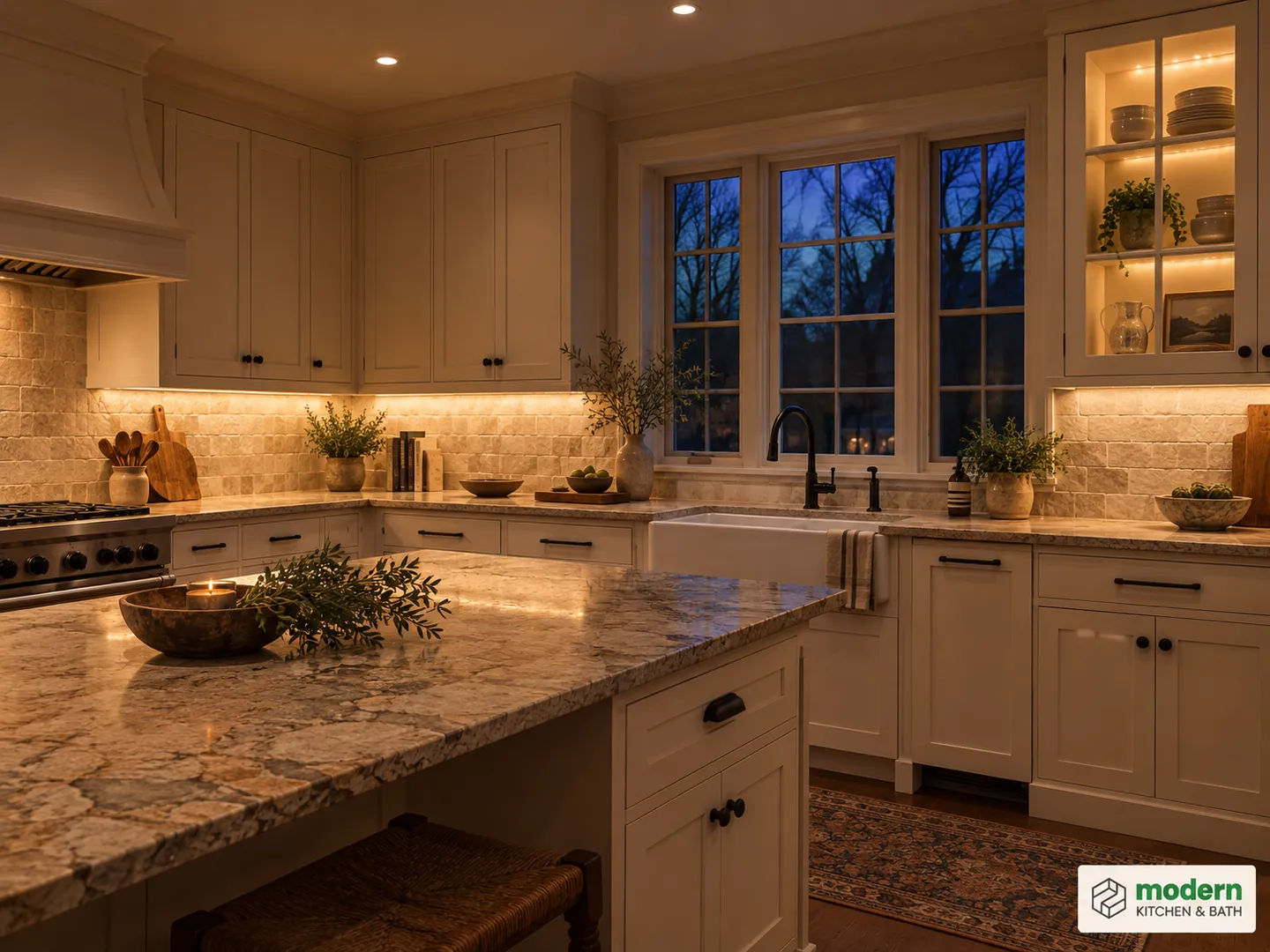
The phrase to hold onto is multiple layers. A single bank of recessed cans in the ceiling is what most Northern Virginia builder kitchens shipped with, and it is why so many of them feel flat. Layering means ambient light overhead, task light on the work surfaces, and accent light that gives the room depth after dark.
Under-cabinet lighting at eighty-seven percent is the highest-agreement individual fixture in the report, and it is also the lowest-cost meaningful upgrade on this entire page. If you do nothing else from the 2027 list, do that one.
Adding or relocating lighting circuits is electrical work, and in both Fairfax and Loudoun counties it requires a permit and inspection. Plan it into the project rather than treating it as a finishing touch, because the wiring has to happen before the drywall closes.
Wellness and Climate Resilience Move to the Front
This is the section of the NKBA 2027 report that is most relevant to Northern Virginia, and it is the one I would have ranked first if I were writing the report myself.
| Climate resilience feature | Designers who agree |
|---|---|
| Leak detection systems and automatic shut-off valves | 65% |
| Backup power solutions | 62% |
| Ventilation and air filtration systems | 53% |
Leak detection at sixty-five percent is the top climate-resilience finding, and if you own a house in this region you already know why it matters. A supply line failure behind a dishwasher or under a sink is one of the most common and most expensive forms of damage in local homes, and in a house with a finished basement the water does not stop at the kitchen floor.
An automatic shut-off valve is a comparatively small line item inside a kitchen remodel. It is one of the few things on this list that can pay for itself outright.
Backup power at sixty-two percent reads differently here than it would in a milder region. Northern Virginia loses power to summer thunderstorms, to the occasional derecho, and to winter ice. If you are already opening walls and touching the panel during a kitchen remodel, it is the natural moment to think about what stays running when the street goes dark, even if that is only the refrigerator and a few circuits.
On the wellness side, ventilation is being reframed as a health feature rather than a code box to tick, cited alongside water filtration, touchless faucets and sound-absorbing materials. Given how many local kitchens are open to living space, cooking odours and particulate travel through the whole ground floor. Proper ventilation is genuinely a quality-of-life question here, not a technicality.
If your kitchen remodel touches a finished lower level, our basement remodeling cost guide covers the moisture and drainage considerations that go with it. For broader material choices, see sustainable kitchen remodeling.
The Hardest-Working Rooms: Mudrooms, Pantries and Flex Space
The 2027 report describes the kitchen extending outward into the rooms around it, and the agreement levels here are among the highest in the whole study.
| Feature | Designers expecting it to be popular |
|---|---|
| Attached mudrooms and flex spaces | 94% |
| Dedicated beverage areas | 90% (up from 85% in 2026) |
| Pantries evolving into multi-functional extensions | 88% |
| Dedicated small-appliance stations | 73% |
| Walk-in pantries | 67% |
| Pet feeding stations | 64% |
| Eat-in kitchens | 63% |
| Mudroom space growing | 45% |
| Laundry space growing | 43% |
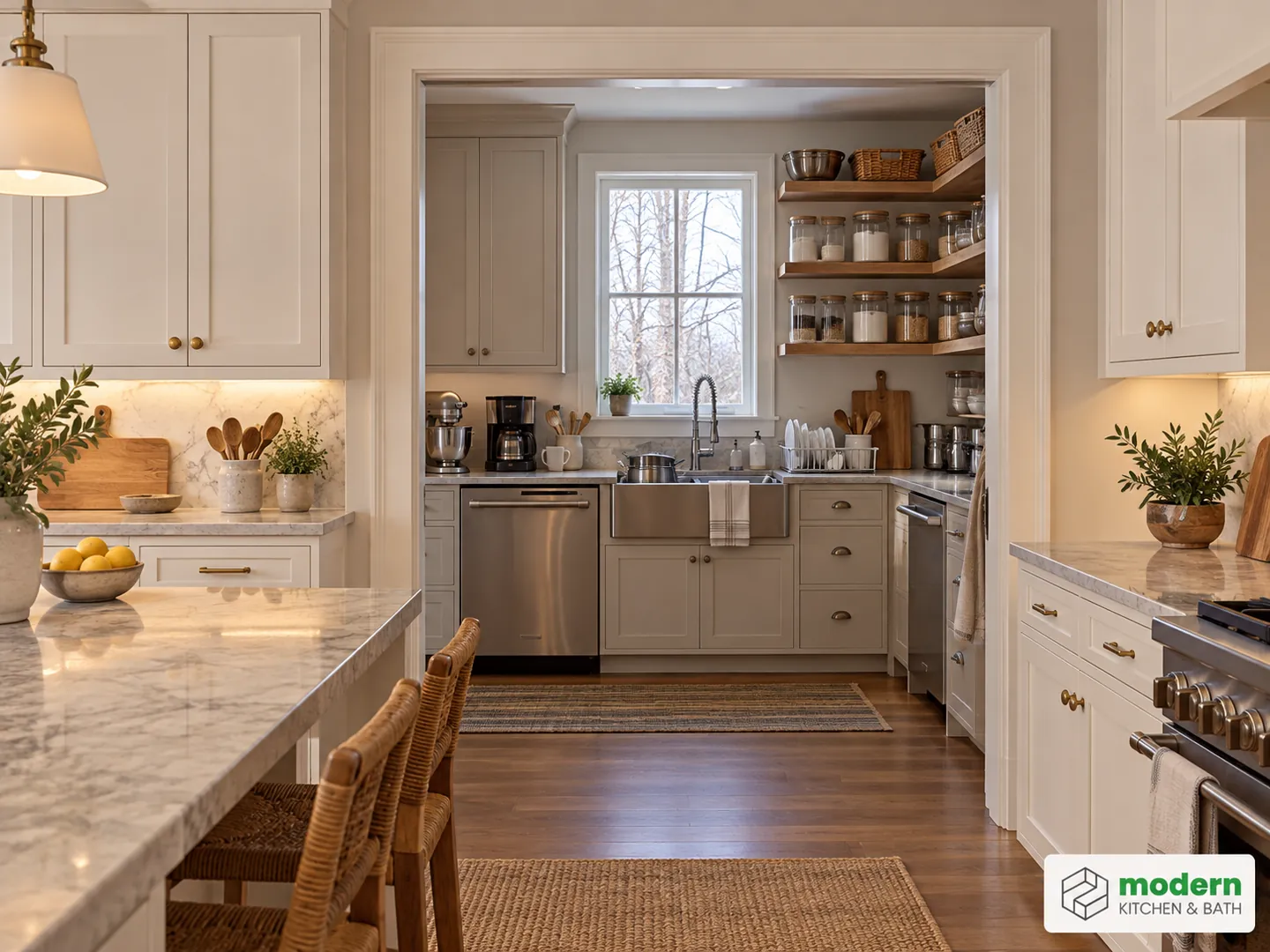
Ninety-four percent on mudrooms is close to unanimous, and it lands well in this region. Northern Virginia has four real seasons, including a muddy spring and a salted, slushy winter. A proper transition space between the garage or back door and the kitchen is not a lifestyle flourish here, it is how you keep the rest of the house clean from February to April.
The pantry finding is the one I would flag for anyone planning a project. Eighty-eight percent of designers see pantries becoming multi-functional extensions of the kitchen rather than shelves behind a door. Combined with the back-kitchen trend at forty-seven percent, this is the same idea arriving from two directions: the work of a kitchen is being moved out of the show kitchen and into an adjacent space.
The island keeps getting more specific
Eighty-two percent of designers say island size and configuration are becoming more tailored to the individual space. When asked where islands will change most, technology led at seventy-four percent, ahead of storage at sixty percent and functional zones at fifty-eight percent.
The practical read: the standard rectangle with a pair of pendants over it is giving way to islands shaped around what the household actually does at them.
A Measured Verdict on AI in the Kitchen
Given how much noise surrounds AI everywhere else, the 2027 numbers are strikingly restrained.
| Technology | Designers expecting demand in 2027 |
|---|---|
| Mobile alerts for power failure or gas leak | 57% |
| Air fryers | 57% |
| Convection ovens | 46% |
| App-controlled appliances | 40% |
| WiFi-connected refrigerators | 37% |
| WiFi-connected dishwashers | 36% |
| Ovens with food-recognition AI | 27% |
| AI that learns and adjusts to cooking preferences | 24% |
Note the shape of that list. The technology designers expect homeowners to want is the practical, problem-solving kind. A phone alert telling you the power failed while you were away ranks at fifty-seven percent. An oven that recognises your food ranks at twenty-seven.
Air fryers outranking convection ovens, fifty-seven to forty-six, is the most honest line in the entire report.
My advice to local clients has not changed: buy connected appliances if the connection solves a problem you actually have, and do not pay a premium for intelligence you will configure once and never touch again.
For more on which systems are worth the investment, see our guide to smart kitchen technology.
What the 2027 Trends Mean for Your Northern Virginia Remodel
Pulling the report together into something you can act on, here is how I would rank the 2027 findings for a homeowner in Loudoun or Fairfax County, weighted for what the housing stock and the climate here actually call for.
| Priority | What to do | Why it matters here |
|---|---|---|
| 1 | Fix the layout before the finishes | Second-highest ROI at 49%, and most local builder kitchens were laid out for a trend now reversing |
| 2 | Add leak detection and an automatic shut-off valve | 65% of designers agree, and finished basements make water damage costly in this region |
| 3 | Layer the lighting, starting under the cabinets | 87% agreement, lowest cost per unit of improvement on the list |
| 4 | Zone the kitchen from the family room | 81% rate zoning here to stay, and it addresses the noise complaint in open-plan NoVA homes |
| 5 | Treat the mudroom as part of the kitchen project | 94% agreement, and four-season weather makes it functional rather than decorative |
| 6 | Choose the countertop on maintenance, not the trend line | Quartzite leads at 78%, but quartz at 74% is still the lower-maintenance surface |
Permits and timing in Fairfax and Loudoun
Most of the 2027 priorities above touch something a county inspector cares about. Structural changes for zoning, relocated plumbing for a back kitchen or beverage area, and new electrical circuits for layered lighting all require permits in both counties. Cosmetic work such as replacing cabinet doors or swapping a countertop generally does not.
Build the permit timeline into your schedule rather than discovering it midway. Our guide to remodeling permits in Northern Virginia sets out what each county requires and roughly how long approvals take.
Rated 4.8 out of 5 from 68 Google reviews
Modern Kitchen & Home Solutions, Sterling VA · October 2026
Frequently Asked Questions for Kitchen Trends in Northern Virginia
What are the kitchen trends for 2027?
The NKBA 2027 Kitchen Trends Report identifies a move away from fully open floor plans toward defined zones, partial walls and operable partitions, with 81% of designers rating intentional zoning as here to stay. Other leading findings include quartzite overtaking quartz for countertops at 78% versus 74%, cabinetry designed to conceal appliances at 85%, layered lighting at 84%, and climate resilience features such as leak detection at 65%. Kitchen footprints are still growing but more slowly, with 52% of designers expecting an increase over the next three years, down from 76% in the 2026 report.
Are open floor plan kitchens going out of style?
They are being rebalanced rather than abandoned. The NKBA 2027 report marks a reversal from 2026, which still listed open layouts as a growing trend. Designers now favour semi-enclosed layouts at 46% and partially concealed kitchens at 41%, with 81% saying intentional zoning is here to stay. In practice this rarely means rebuilding solid walls. It means screening the working side of the kitchen with partial walls, taller island backs, cased openings or slatted partitions that separate sound without blocking light.
What are the kitchen cabinet trends for 2027?
Concealment leads at 85%, with cabinetry increasingly designed to hide appliances and functional elements behind panels and appliance garages. Open shelving is declining, with 64% of designers expecting enclosed storage to replace it. On materials, white oak is the wood of choice for 49% of designers, 34% expect natural cabinets with no finish, and light and medium tones each sit at 32%. A distinct island colour is expected by 54%.
What are the kitchen cabinet colour trends for 2027?
Neutrals remain dominant at 96%, followed by greens at 83% and blues at 75%. Both greens and blues ticked down slightly from the 2026 figures of 86% and 78%. Reds, including burgundies, held steady at 47%, while yellow eased from 47% to 43%. The broader direction is toward natural wood rather than painted finishes, with white oak the single most favoured wood.
What are the kitchen countertop trends for 2027?
Quartzite has edged ahead of engineered quartz for the first time in several years, with 78% of designers expecting quartzite to be popular against 74% for quartz. The four-point gap is narrow, so quartz is far from finished, but the shift is consistent with the wider preference for natural materials running through the 2027 report.
Is quartzite better than quartz for kitchen countertops?
Neither is better outright, and the names cause genuine confusion. Quartzite is a natural quarried stone, harder than granite, excellent with heat, and it needs periodic sealing because it is porous. Quartz is engineered from roughly 90% ground mineral bound with resin, so it is non-porous and never needs sealing, but the resin can be damaged by heat. If you want the lower-maintenance surface, that is quartz, despite quartzite leading the 2027 trend data.
Is open shelving still in style for 2027?
No. The NKBA 2027 report found 64% of designers expect open shelving to give way to enclosed storage. It fits the broader concealment trend, where 85% of designers see cabinetry being designed to hide appliances and functional elements. Open shelving has had a long run, and households that cook regularly tend to find it impractical to keep looking the way it does in photographs.
What are the kitchen lighting trends for 2027?
Layering is the central idea, with 84% of designers expecting kitchens to use multiple layers of lighting and 78% treating lighting as a design feature rather than a purely functional one. Under-cabinet lighting is the highest-agreement individual fixture in the entire report at 87%, followed by interior-cabinet lighting at 76%, recessed at 57%, floor and path lighting at 52%, sconces at 48% and pendants at 46%. Half of designers expect lighting controls to be connected to a mobile device.
What are the kitchen island trends for 2027?
Islands are becoming more specific to the household rather than following a standard format, with 82% of designers saying size and configuration are increasingly tailored to the space. Asked where islands will change most, designers named technology first at 74%, ahead of storage at 60% and functional zones at 58%. A distinct island colour, different from the surrounding cabinetry, is expected by 54%.
What is a back kitchen?
A back kitchen is a secondary preparation space adjacent to the main kitchen, used for the messier work of cooking and for small-appliance storage, so the primary kitchen stays presentable. The NKBA 2027 report names dedicated prep spaces and back kitchens as up-and-coming features, cited by 47% of designers. In a Northern Virginia home this is most often created by converting an underused formal dining room, a butler’s pantry or an oversized pantry rather than by building an addition.
What are the small kitchen trends for 2027?
The findings that translate best to a smaller kitchen are concealment at 85%, enclosed storage replacing open shelving at 64%, and layered lighting at 84%, all of which make a compact room feel calmer and larger. The report also found 86% of designers agree layouts are simplifying with less clutter, which matters more in a small kitchen than in a large one. Pantry reorganisation is relevant too, with 73% expecting dedicated small-appliance stations that clear the counters.
What are the kitchen backsplash trends for 2027?
The 2027 report does not break out backsplash separately, but the direction follows from its material findings. With quartzite leading countertops at 78% and natural, unfinished materials gaining in cabinetry at 34%, full-height stone backsplashes that continue the countertop material are consistent with the wider move toward natural surfaces and visual calm. We cover the options in detail in our kitchen backsplash ideas guide.
Which kitchen upgrade has the best return on investment?
Cabinet upgrades rank first, named highest-ROI by 54% of designers, with layout reconfiguration a close second at 49%. The notable change is how close those two now are. Layout has historically been treated as a luxury rather than a return-generating investment, and the 2027 data suggests that if your budget will not cover both, fixing a poor layout is defensible before replacing finishes.
Do I need a permit to change my kitchen layout in Northern Virginia?
Usually yes. In both Fairfax and Loudoun counties, structural changes such as removing or altering a wall, relocating plumbing for a sink or beverage area, and adding or moving electrical circuits for new lighting all require permits and inspections. Cosmetic work such as replacing cabinet doors, refacing, or swapping a countertop generally does not. Because several of the 2027 priorities involve layout and lighting, build permit time into the schedule rather than treating it as an afterthought. Our guide to remodeling permits in Northern Virginia covers each county’s requirements.
Planning a Kitchen Remodel in Northern Virginia?
We have been designing and building kitchens from our Sterling showroom for homeowners across Loudoun and Fairfax counties. If you would like to talk through what the 2027 trends mean for your house specifically, bring us your floor plan.
Sources
- National Kitchen & Bath Association, 2027 Kitchen Trends Report, published 14 October 2026. Findings drawn from 830 industry professionals across North America, 67% of them NKBA members. Of respondents, 62% were designers, the remainder showroom professionals, dealers, kitchen and bath remodelers, contractors and architects. NKBA represents nearly 55,000 North American kitchen and bath professionals.
- PHCP Pros, “NKBA 2027 Kitchen Trends Report Signals Shifts in Kitchen Design”, 15 October 2026, including comment from Bill Darcy, Global President & CEO of NKBA.
- USA Cabinet Store, “NKBA 2027 Kitchen Trends Report: 10 Shifts and What They Mean for Your Remodel”, by Emin Halac, CEO, 16 October 2026. Consulted as a second industry reading of the same report; its figures agree with the primary source throughout.
- USA Cabinet Store, “2026 Kitchen and Bathroom Remodel Trends”, 3 November 2025, referenced for year-over-year comparison against the 2026 NKBA findings.
- Google review rating for Modern Kitchen & Home Solutions verified October 2026.
Related Reading
- How Much Does It Cost to Remodel a Kitchen
- Kitchen Countertop Cost in Northern Virginia
- Modern Kitchen Cabinet Ideas
- Black Kitchen Cabinet Trends
- Kitchen Cabinet Installation in Northern Virginia
- Kitchen Island Cost
- Remodeling Permits in Northern Virginia
- Smart Kitchen Technology
- Sustainable Kitchen Remodeling
- 15 Beautiful Design Trends
Found this helpful? Make us your go-to source on Google
If our content has been useful, you can tell Google to show more of it when you search. Click below, then check the box next to Modern Kitchen and Bath on the page that opens. It takes about five seconds.

You'll need to be signed in to your Google account. One click, then tick the box next to our name.