Quick answer: as a planning range for Northern Virginia in 2026, installed kitchen countertops run about \$70 to \$160 per square foot for quartz and \$60 to \$140 for granite, putting a standard 40 to 55 square foot kitchen around \$3,000 to \$8,000. A large kitchen with an island and premium stone passes \$15,000. The only reliable number comes after a fabricator templates your finished cabinets and confirms the slab layout, because material grade, slab yield, seams, edge work, cutouts and tear-out move the total more than measured area does.
Countertops are the one line in a kitchen budget where the quote almost never matches the calculator. You measure 42 square feet, multiply by a number you found online, and the estimate comes back thousands higher. That gap is not a markup. It is how slabs are actually bought and cut, and once you understand it the rest of the pricing makes sense.
This guide covers what countertops really cost here, why per square foot is a misleading unit, the quality levels that set the price, what the 2026 import tariff changed, and the question everybody is quietly asking: whether an expensive new surface will survive normal cooking.
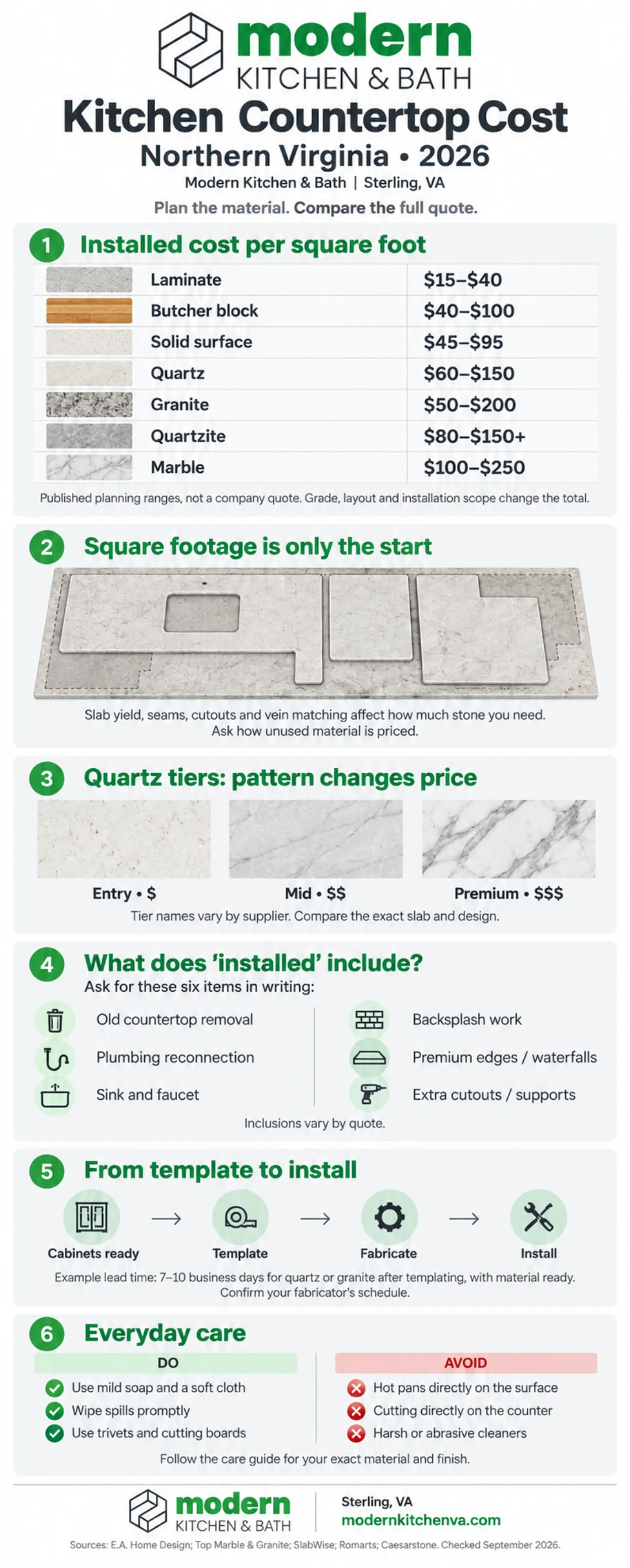
Kitchen Countertop Cost in Northern Virginia (2026)
Material is the starting point, but not the whole number. These are planning ranges for this market as of September 2026, not quotes.
How to read these figures. They come primarily from our own supply and installation work in Northern Virginia, cross-checked against homeowner-reported quotes in local discussions and published national cost data. They are not a survey of competitor bids. Use them to set a budget, then get a measured quote.
The ranges assume templating, fabrication, a standard eased or straight edge, sink and cooktop cutouts, and standard installation. They exclude tear-out and disposal of existing tops, plumbing disconnect and reconnect, the sink itself, backsplash tile, electrical work, difficult access such as stairs or restricted parking, and tax.
| Material | Installed per sq ft | Typical 45 sq ft kitchen | Worth knowing |
|---|---|---|---|
| Laminate | $30 – $60 | $1,400 – $2,700 | Modern laminate looks far better than its reputation, but seams and edges give it away |
| Butcher block | $60 – $120 | $2,700 – $5,400 | Warm and repairable, needs oiling, poor choice around a sink |
| Granite | $60 – $140 | $2,700 – $6,300 | Natural stone, every slab different, needs periodic sealing |
| Quartz (engineered) | $70 – $160 | $3,200 – $7,200 | Consistent pattern, no routine sealing, widely selected here |
| Porcelain | $90 – $180 | $4,000 – $8,100 | Very heat and UV resistant, fewer local fabricators handle it well |
| Quartzite | $90 – $200 | $4,000 – $9,000 | True quartzite is typically harder than granite, but trade names are inconsistent. Confirm the actual stone |
| Marble | $100 – $250+ | $4,500 – $11,000+ | Beautiful and soft. It will etch. Accept that before buying it |
For scale, a standard kitchen in popular quartz or granite commonly lands between \$2,500 and \$5,000, while a large or luxury kitchen with premium stone runs \$7,000 to \$15,000 or more, reaching \$100 to \$250 per square foot at the top end. Homeowners comparing notes in local forums report figures in the same territory, from around $1,800 for a small granite job to $3,500 for 3cm quartz and roughly $94 per square foot for stone on larger projects.
Why Per Square Foot Is a Misleading Number
This is the single most useful thing to understand before you read a quote, and almost nobody explains it.
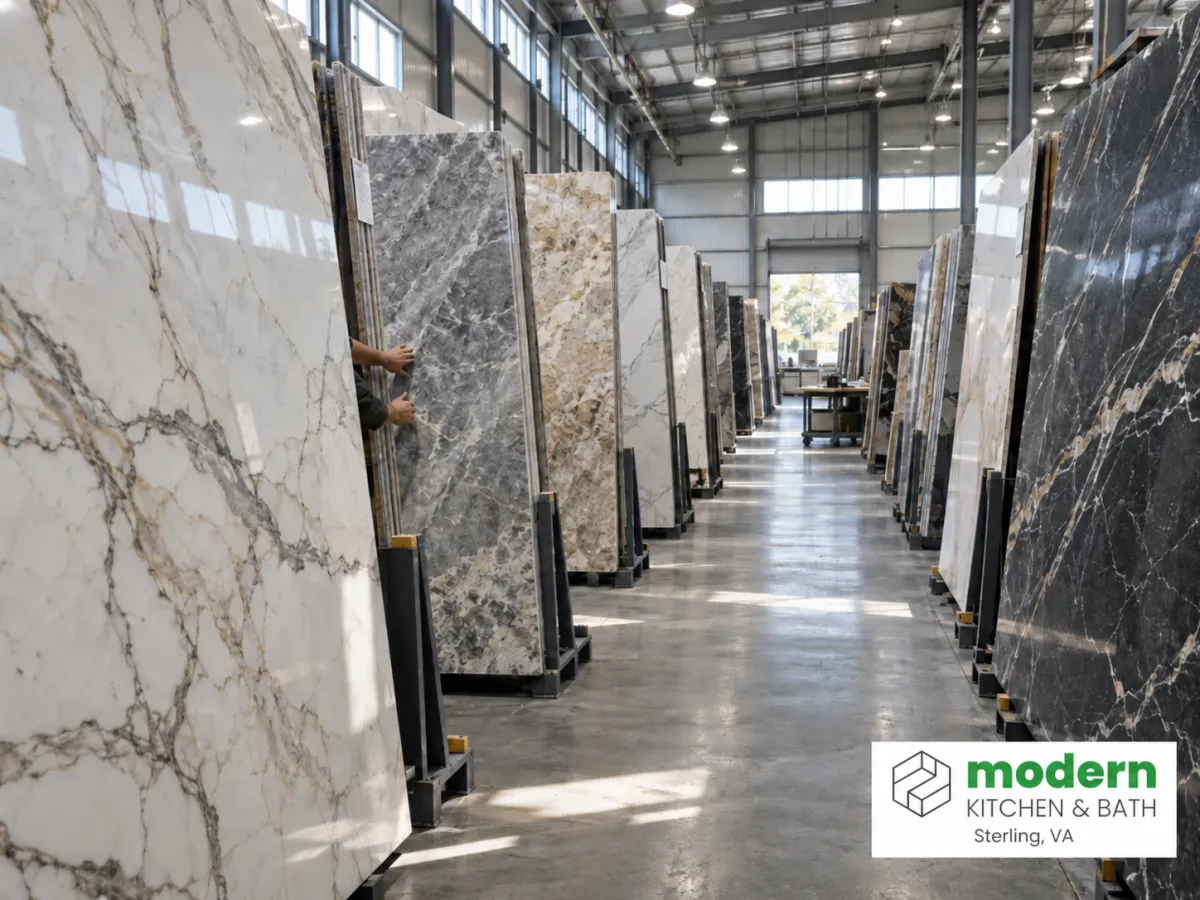
Stone is supplied in slabs, so slab yield often drives the quote more than your measured area does. Slabs commonly run around 55 to 65 square feet depending on material and supplier. If your kitchen needs 42 square feet, the fabricator still has to buy and cut a whole slab, and the offcuts go somewhere.
Billing practice varies. Some fabricators price by usable square foot, some by slab, some by linear foot, and many apply a minimum charge or a fabrication allowance on top. Ask which method your quote uses.
The practical consequence is that a modestly larger kitchen can cost disproportionately more, because crossing onto a second slab adds close to a slab rather than a few percent. Where that line falls depends on slab dimensions, cutout positions, edge layout, vein direction and island geometry, so there is no fixed square-footage threshold. A large island is the usual trigger, since islands need long uninterrupted pieces and generate the most waste.
Ask this question: how many slabs does my job take, and what happens to the remainder? If you are paying for a second slab, ask whether there is enough left for a bathroom vanity or a small bar top. Sometimes there is, and it costs far less to fabricate it in the same run than as a separate job later.
Per square foot or per linear foot?
Fabricators quote both, and the two are not interchangeable. Linear foot pricing measures the run along the front edge and assumes a standard depth of about 25 inches. Square foot pricing measures actual area. A quote in linear feet can look cheaper while describing the same job, so when you compare bids, convert everything to one unit or ask each fabricator to quote the same way.
Quartz Levels: the Price Driver Nobody Explains
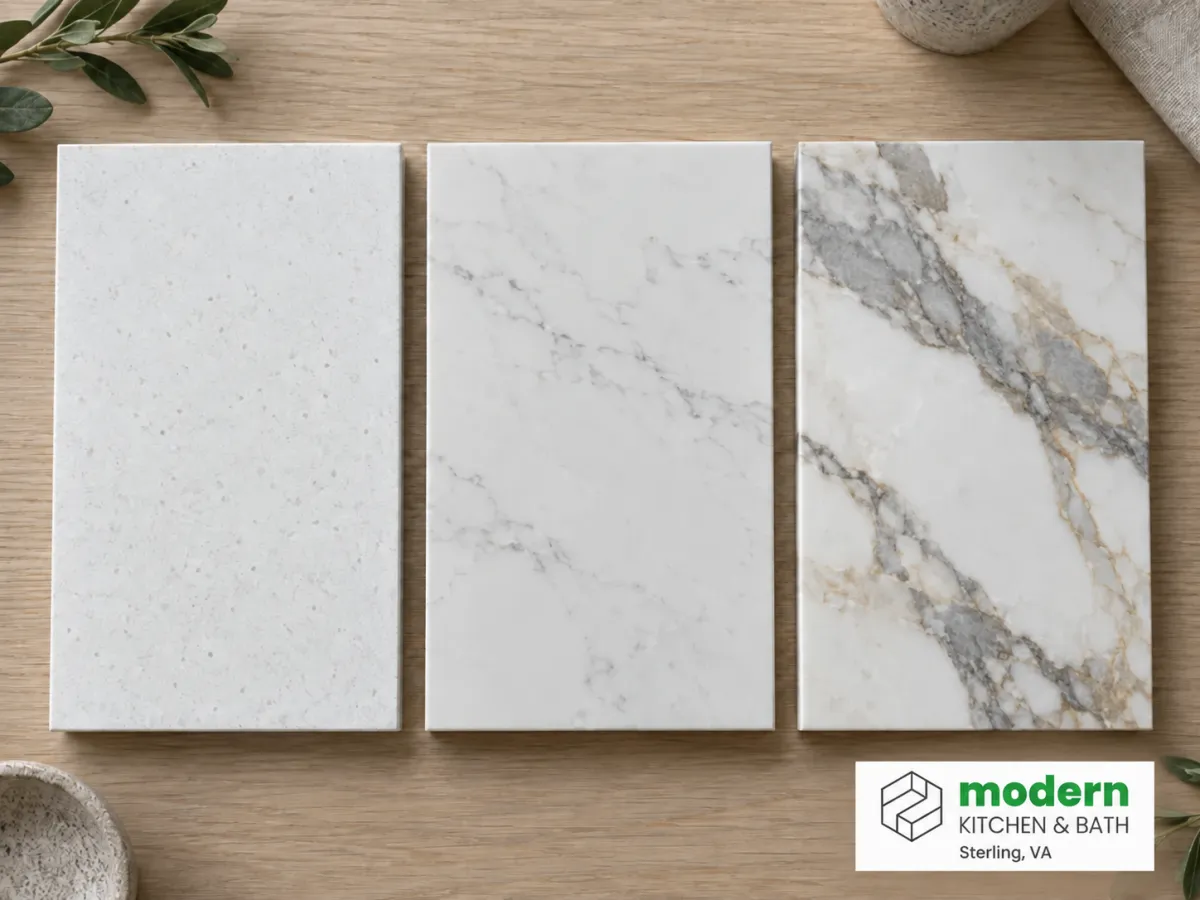
Quartz is not sold as one product. Manufacturers group their colours into levels, usually numbered 1 through 5 or labelled as standard, premium and designer. The level, far more than the brand, is what moves your price.
| Level | What it looks like | Relative cost |
|---|---|---|
| Level 1 (standard) | Simple consistent speckle, few colourways, no dramatic veining | Lowest |
| Level 2 (mid) | Light movement, some veining, a commonly specified tier | Moderate |
| Level 3 to 5 (premium and designer) | Bold marble-look veining, full-slab patterns, book-matched pairs | Substantially higher |
Two kitchens with identical square footage and the same fabricator can differ by several thousand dollars purely on level. If a quote seems high, the first question is not “can you discount it” but “what level is this colour, and what does the next level down look like in my kitchen”.
The marble-look patterns everyone saves to Pinterest are almost always level 4 or 5. That is not a reason to avoid them, but it is worth knowing you are choosing a price tier, not just a colour.
Quartz vs Granite: Cost and Reality
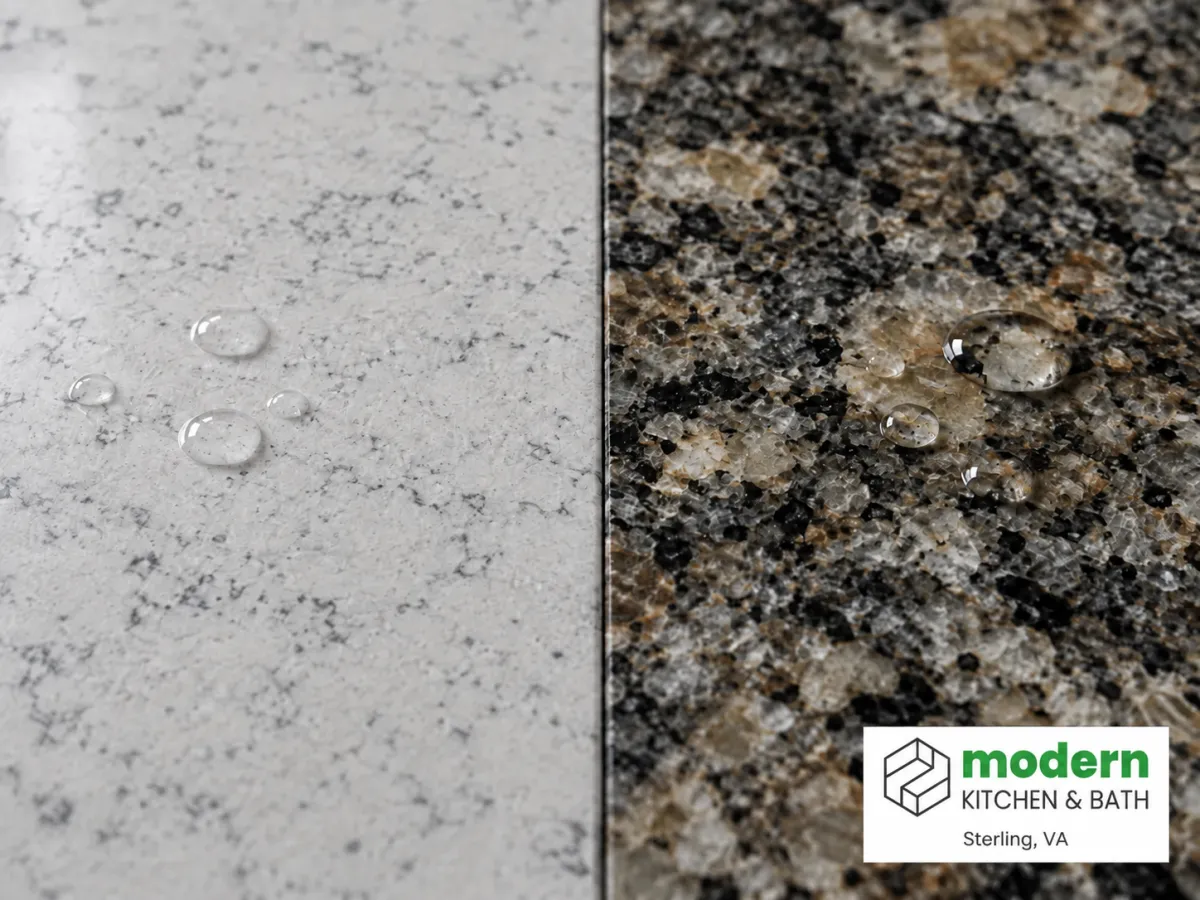
This is the most searched countertop comparison, and the honest answer is that the price gap is smaller than people expect and the practical differences matter more.
| Consideration | Quartz | Granite |
|---|---|---|
| Installed cost | $70 – $160 per sq ft | $60 – $140 per sq ft |
| Sealing | Manufacturers generally state no routine sealing is needed | Many benefit from periodic sealing; interval depends on the stone and sealer |
| Heat | Resin can be marked by hot cookware; use trivets | More heat tolerant, though trivets are still sensible |
| Staining | Highly resistant | Can stain if sealing lapses |
| Consistency | What you see in the sample is what arrives | Every slab differs, view your actual slab |
| Repair | Difficult, resin does not blend | Chips can often be filled |
Granite is frequently the less expensive of the two in this market, which surprises people who assume natural stone costs more. Entry-level granite is genuinely affordable, while exotic granite runs well past premium quartz.
The real decision is behavioural. If nobody in your house will ever maintain a sealant, quartz largely removes that chore. If somebody habitually puts a pan straight from the burner onto the counter, granite is more forgiving. Our quartz vs granite comparison covers the material differences in more depth.
What Actually Drives Your Quote
Beyond material and level, these are the lines that move the number:
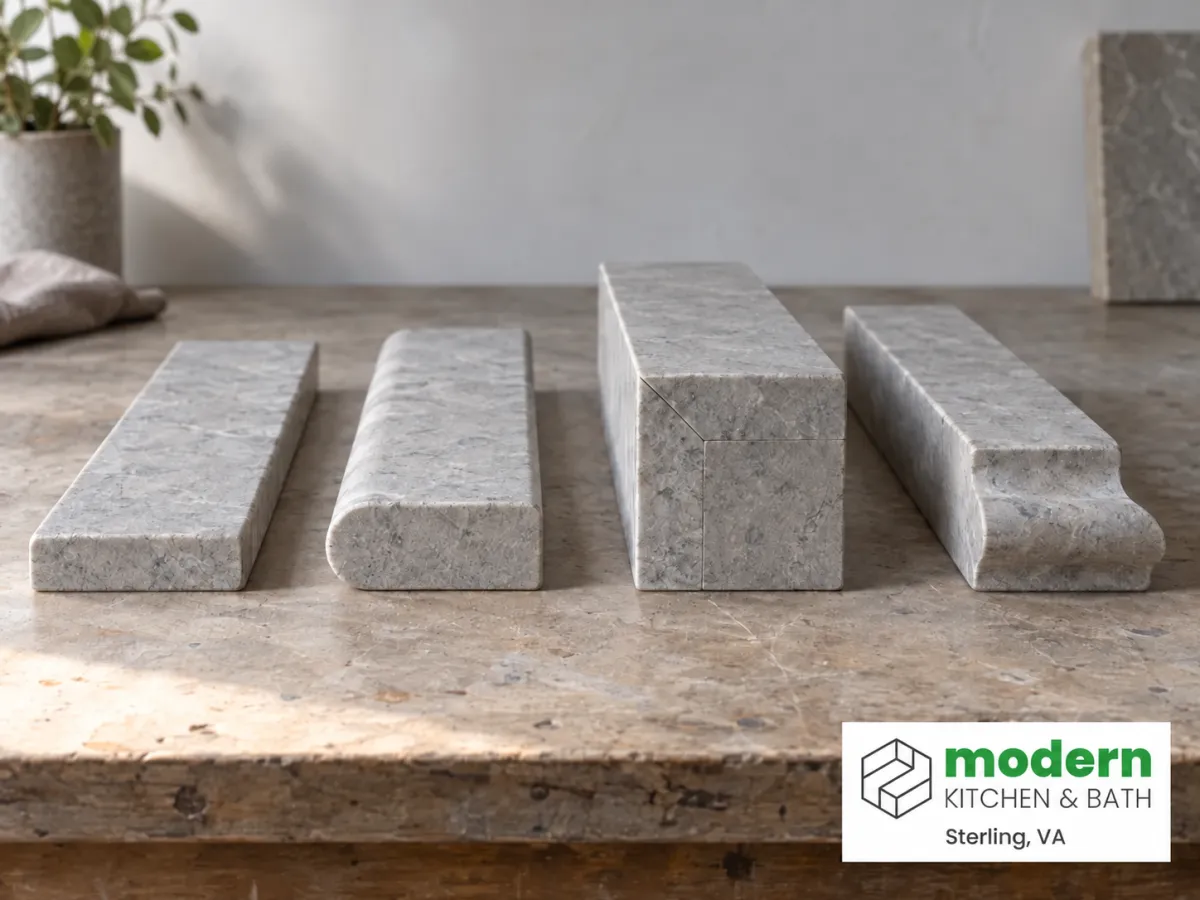
- Edge profile. Eased, straight and bullnose edges are usually included. Mitered, ogee, waterfall and any built-up edge are extra, sometimes substantially. A waterfall island edge can add a meaningful fraction of the job because it consumes extra slab.
- Thickness. 3cm is standard for kitchens here. 2cm costs less but usually needs a built-up edge to look substantial, which adds labour and can erase the saving.
- Cutouts. Sink, cooktop, faucet and soap dispenser holes are each priced. An undermount sink costs more to cut and polish than a drop-in because the exposed edge has to be finished.
- Seams. Where a seam lands is a design decision. Fewer seams means larger pieces, more waste and more slab. Ask to see the slab layout before fabrication.
- Backsplash. A 4 inch stone backsplash from the same slab is priced separately. A full-height slab backsplash behind the range is a significant addition.
- Removal and disposal. Taking out the old tops is labour, and on tile or concrete it is heavy labour.
- Cabinet condition. Stone needs a level base. If cabinets have settled, shimming and levelling comes first.
What “Installed” Usually Does Not Include
The word installed does a lot of work in countertop advertising. Check whether these are in your number or outside it:
- Plumbing disconnect and reconnect. Many fabricators do not touch plumbing. Someone has to disconnect the sink before template and reconnect after install, and it may not be them.
- The sink itself. Often supplied separately.
- Removal of the existing countertop.
- Backsplash tile, as distinct from a stone backsplash.
- Electrical work where outlets sit in an island or a full-height backsplash.
One Northern Virginia homeowner comparing quotes online found removal of the old countertops priced at over ten thousand dollars on a multi-slab job. That is unusual, but it demonstrates why removal should never be assumed.
The 2026 Tariff, and What It Actually Costs You
If you have been told quartz prices are rising, this is part of why. Following an affirmative injury finding by the US International Trade Commission in May 2026, a presidential proclamation issued on 31 July 2026 imposed a Section 201 safeguard measure on imports of quartz surface products, structured as a four-year tariff-rate quota effective 15 August 2026 and running to 14 August 2030. In the first period, covered imports within the quarterly quota carry an additional 25 percent duty and above-quota entries carry 50 percent. It can stack on top of existing antidumping and countervailing duties, including those applied to quartz from India and Türkiye.
Whether a particular slab is covered, and at what rate, depends on its tariff classification and country of origin, so this is not a flat duty on all quartz.
The important detail for a homeowner: the duty applies to the imported value of the slab, not to fabrication or installation, which make up the larger part of your bill. Reported estimates put the added border cost on a typical 50 square foot kitchen’s worth of covered imported quartz in the low hundreds of dollars before markup, which is a single-digit percentage of an installed price rather than a doubling.
Two practical consequences. First, ask where a slab is made, because material may be treated differently depending on origin and classification, and the difference between two similar colours can now come down to that. Your supplier or a customs professional can confirm the status of a specific product. Second, ask how long a quote is honoured. Pricing in this category has been moving, and a quote with no stated validity period is worth less than one that commits to a date.
This also speaks to a question people are now searching directly, which is whether quartz is falling out of favour. We would not claim local demand has dropped, and quartz remains a widely chosen surface here. What is fair to say is that some designers and fabricators report renewed interest in natural stone and porcelain, while import costs and the worker-safety story below have both become more prominent. Availability and preference vary by supplier.
Will It Survive My Kitchen?
Ask Google about countertop cost and a striking share of the related questions are not about money at all. They are about damage: hot coffee cups, crockpots, Clorox wipes, Windex, vinegar. People are not only asking what it costs, they are asking whether an expensive surface will survive normal life.
Heat is quartz’s real weakness
Engineered quartz is stone particles bound with resin, and the resin is the vulnerable part. A hot mug of coffee is not a realistic concern. Cookware straight off a burner or out of an oven is, and a slow cooker or air fryer running for hours in one spot can mark the surface through sustained heat. How much heat a given slab tolerates depends on the product, its thickness, the resin system and how long the heat is applied, so treat trivets as standard practice rather than optional. Granite, porcelain and quartzite are generally more tolerant.
Cleaning: simpler than the internet suggests
For everyday cleaning, warm water and mild dish soap, or the cleaner your manufacturer recommends, handles almost everything. Avoid abrasive pads, oven cleaner, drain cleaner and paint remover entirely. For bleach-based wipes, ammonia glass cleaners and vinegar, follow the care sheet for your specific brand and finish, because guidance differs between manufacturers and repeated use of the wrong product can dull a surface over time.
Ask your installer to identify the exact product and give you the manufacturer’s written care instructions. It is a reasonable thing to expect and it settles these questions for your actual countertop rather than countertops in general.
Marble is the opposite problem. It etches on contact with anything acidic, including lemon juice, wine and tomato. That is not staining and it is not a defect, it is a chemical reaction with the stone.
Do quartz countertops need sealing?
Most engineered-quartz manufacturers state that their surfaces are non-porous and require no routine sealing, which makes this one of the most persistent countertop myths. Granite, marble and most natural stone do benefit from periodic sealing, though the interval depends on the specific stone, finish and sealer. Before paying for any protection or maintenance service, ask which product you have and check the manufacturer’s written care guidance.
The Silicosis Question, Answered Honestly
A growing number of people are searching whether quartz countertops are dangerous, banned, or linked to lung disease. The answer requires a distinction that most coverage blurs, so here it is plainly.
The established hazard arises when the material is cut, ground, drilled or polished, and it falls on the workers doing that, not on homeowners living with a finished countertop. Engineered quartz typically contains over 90 percent crystalline silica by mass, against less than about 45 percent for granite. Working it dry releases respirable silica dust, and inhaling that dust causes silicosis, an irreversible lung disease.
The scale is why this is now a live issue. A study published in NEJM Evidence in August 2026 reported that the California Department of Public Health identified 592 cases of silicosis among engineered stone fabrication workers between January 2019 and June 2026. Of those, 65 underwent lung transplantation and 31 died. Many were men in their thirties. NIOSH has issued guidance on the hazard.
On the regulatory side, accuracy matters here because the situation is often reported loosely. In May 2026 California’s Occupational Safety and Health Standards Board granted a petition and directed Cal/OSHA to begin emergency rulemaking toward prohibiting fabrication and installation of engineered stone containing more than one percent crystalline silica. That started a regulatory process. It was not itself an operative ban, and it applies to California, not Virginia.
For a homeowner, the practical point is this: in normal household use, an intact installed countertop does not ordinarily generate respirable silica dust, so it is not an everyday exposure concern for your family. Dust control does matter during fabrication, installation, and later on if the countertop is ever drilled, cut or removed.
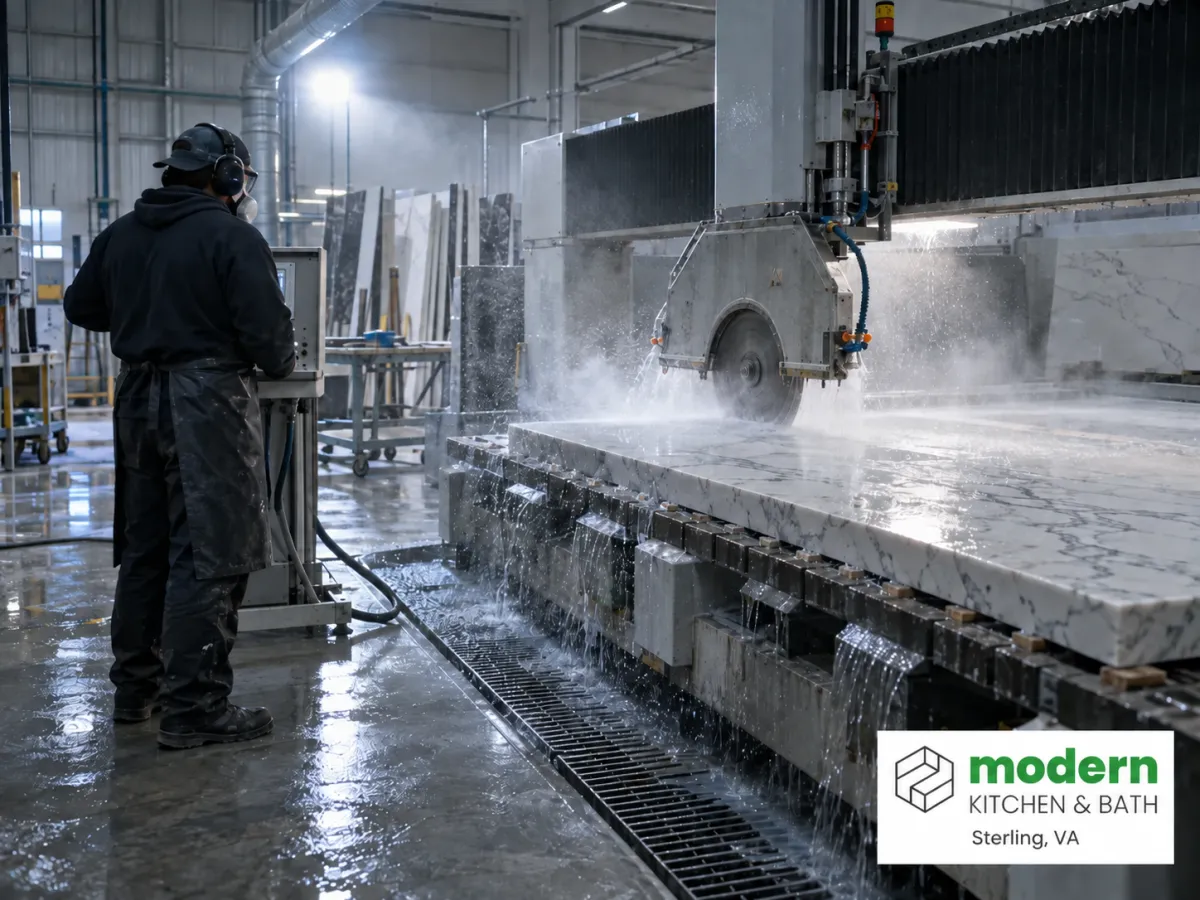
What it means for choosing a fabricator. The controls are well established: wet cutting rather than dry, local exhaust ventilation, respiratory protection and air monitoring. It is entirely reasonable to ask a fabricator how they control silica dust, and a good one will answer without hesitation. If any cutting happens on site, it should be wet cut. The same applies if you ever have a countertop drilled or removed later.
Lower Cost Routes That Are Not a Compromise
If replacement does not fit the budget, there are legitimate options short of it.
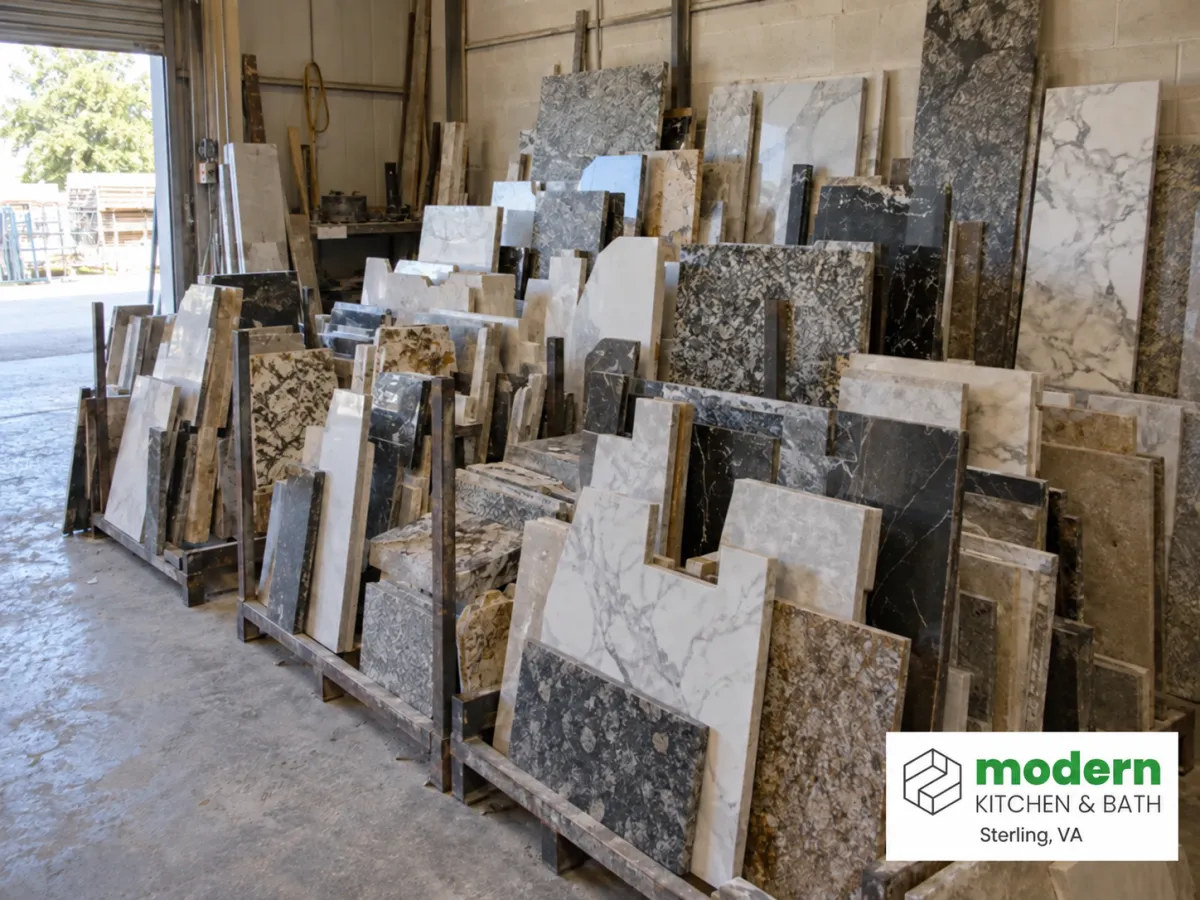
- Remnants. Fabricators hold offcuts from previous jobs. For a bathroom vanity, a small bar or a compact galley kitchen, a remnant can cost a fraction of a new slab in the same material. The trade-off is that you choose from what exists today.
- Lower level, same material. Dropping from a level 4 marble-look quartz to a level 2 with light veining often saves more than switching material entirely.
- Prefabricated tops. Pre-cut stone in standard sizes with the edge already finished. Much less expensive, but limited colours and sizes, and it rarely suits an island or an unusual layout.
- Modern laminate. Genuinely improved, with convincing patterns and better edge options than the laminate people remember.
- Keep the layout. The largest saving available is not moving the sink. Relocating plumbing turns a countertop job into a plumbing job.
Overlay and resurfacing products also exist. They can look acceptable initially, but they add thickness, complicate the sink edge and rarely last like stone. We would rather sell you a remnant than an overlay.
Big Box or Local Fabricator?
Home Depot, Lowe’s and IKEA all sell countertops, and the headline price is often attractive. What differs is not usually the stone, it is everything around it.
A big box order is typically subcontracted to a regional fabricator, which means you are buying the same work with an extra layer between you and the person cutting your stone. Selection is limited to stocked colours, you generally cannot walk the slab yard and choose your actual piece, and when something needs resolving you are coordinating between a retailer and a subcontractor.
Working directly with a local fabricator or a remodeler who holds the relationship means you can see your slab, discuss where the seams fall, and talk to the person responsible. For a straightforward galley kitchen in a standard colour, the big box route is perfectly reasonable. For anything with an island, unusual angles or a dramatic slab, the ability to stand in front of your actual stone matters more than people expect.
How Long It Takes
Countertops are fast compared with the rest of a kitchen, but there is a gap in the middle that surprises people.
| Stage | Timing | What happens |
|---|---|---|
| Slab selection | Before anything | Choose material and level, ideally viewing the actual slab |
| Template | After cabinets are set and level | Digital measurement of the real cabinets, not the drawings |
| Fabrication | 1 to 3 weeks | Cutting, edge profiling, cutouts and polishing |
| Installation | Usually one day | Set, seam, secure and seal if natural stone |
| Plumbing reconnect | Same day or next | Often a separate trade |
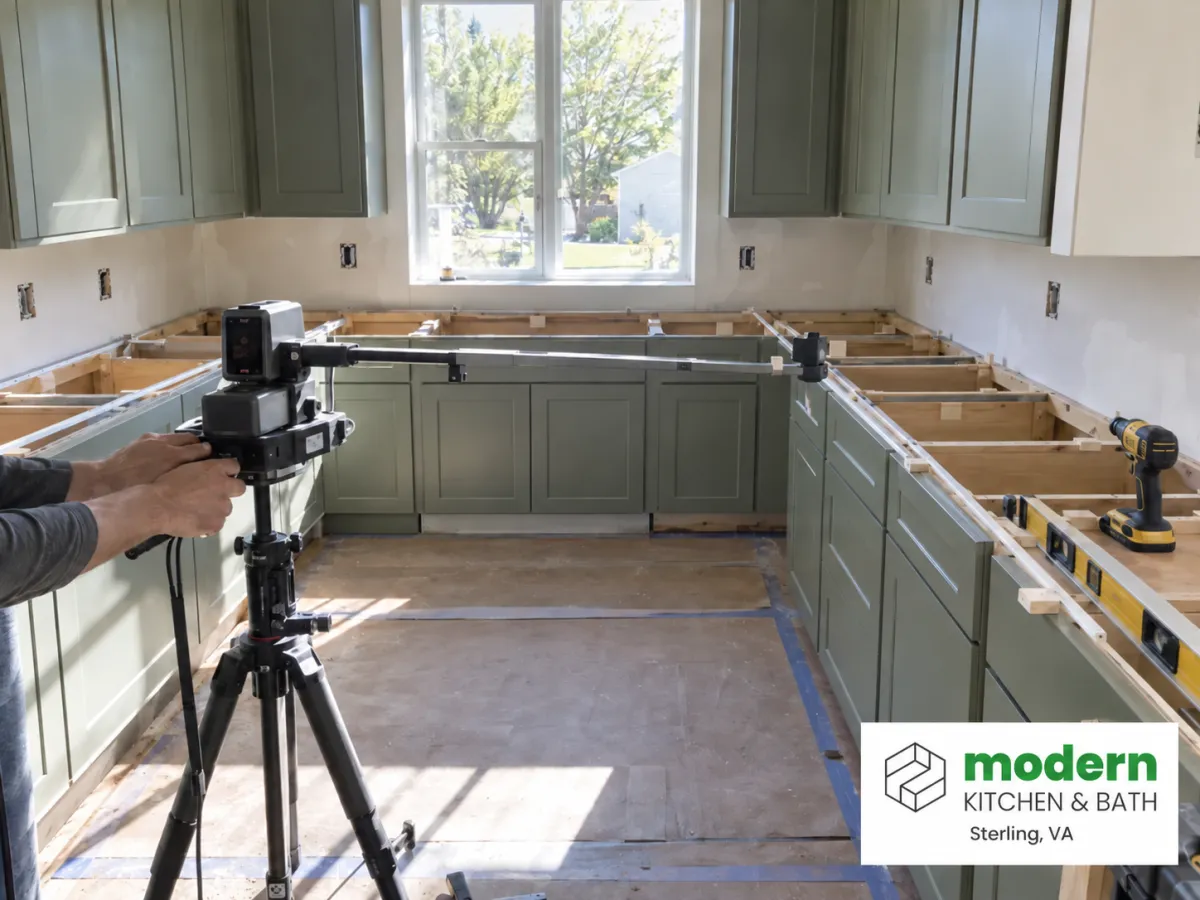
Plan for the gap. Between template and installation you have no countertops and no kitchen sink, typically for one to three weeks. Templating cannot happen before cabinets are installed and level, so this gap cannot be compressed by ordering earlier. Set up a temporary sink and plan meals around it.
A like-for-like countertop replacement that does not move plumbing, alter electrical work or touch walls is generally treated as cosmetic work rather than a permit-triggering project in Fairfax County. Permit rules are set locally, however, and differ between Fairfax, Loudoun, Prince William, Arlington, Alexandria and the incorporated towns, so confirm the current requirement with the relevant building department before work starts. If the project grows to include relocating the sink or adding circuits for an island, permits come back into play. Our Northern Virginia permits guide covers where the line sits.
What Catches Homeowners Off Guard
The quote and the calculator disagree
Online calculators price area. Fabricators price slabs, edges, cutouts, seams and removal. The two will never match, and the calculator is not the honest one.
Nobody looked at the actual slab
Natural stone varies enormously within a single colour name. A sample the size of a postcard tells you very little about a slab with dramatic movement. Where possible, go and see the piece being cut for you.
The seam landed somewhere visible
Seams are unavoidable on most kitchens. Where they go is negotiable, and it is far easier to discuss before fabrication than after.
The island needed a second slab
This is the most common reason a countertop quote exceeds expectations. Islands need long continuous pieces and generate the most waste.
What Our Customers Say
Countertops are the part of a kitchen people touch every day, and the part they notice if the seam is wrong or the edge is not what they pictured. We would rather spend an extra hour on slab layout than have you live with a compromise for fifteen years.
Frequently Asked Questions for Kitchen Countertop Cost
How much do kitchen countertops cost in Northern Virginia in 2026?
Installed, expect about $70 to $160 per square foot for quartz and $60 to $140 for granite. A standard kitchen of 40 to 55 square feet typically lands between $3,000 and $8,000, while a large kitchen with an island and premium stone can pass $15,000. Laminate starts far lower at roughly $30 to $60 per square foot installed.
How much should I budget for quartz countertops?
As a planning figure for a typical Northern Virginia kitchen, budget \$3,200 to \$7,200 installed for a mid-level quartz, current as of September 2026. The slab material is only part of that. Fabrication, edge profiling, cutouts, seaming and installation make up a large share, which is why the installed price is well above an advertised slab price. Tear-out, plumbing reconnection and the sink are often separate.
Is quartz cheaper than granite?
Usually not. In this market entry-level granite is often the less expensive option, and quartz sits slightly above it. The ranges overlap heavily, so the comparison depends far more on the level of quartz and the grade of granite than on the material category. Exotic granite costs more than most quartz.
Is it better to get granite or quartz countertops?
Neither is better outright. Quartz never needs sealing and is highly stain resistant, which suits busy households. Granite tolerates heat better and chips can often be repaired. Choose quartz if nobody will maintain a sealant, and granite if hot pans regularly land on the counter.
What is the best countertop for your money?
For most Northern Virginia kitchens, a level 2 quartz or a mid-grade granite gives the best balance of durability, appearance and cost. Both survive family use, both look current, and neither commits you to the premium tier. The most reliable way to save money is dropping a level within the same material rather than changing material.
How much is a 10 ft piece of quartz countertop?
A 10 foot run at standard 25 inch depth is roughly 21 square feet, so about $1,500 to $3,400 installed depending on level and edge. Be careful comparing this to slab pricing, because you are charged for the slab the piece is cut from, not only the area you use.
What is the downside to a quartz countertop?
Heat is the main one. The resin binding engineered quartz can be marked by hot cookware or by sustained heat from an appliance such as a slow cooker, with tolerance varying by product. Quartz is also difficult to repair invisibly, and prolonged direct sunlight can discolour some colours, which matters for a sunroom or a south facing window.
What can ruin a quartz countertop?
Heat and harsh chemicals. Oven cleaner, drain cleaner, paint remover and abrasive scouring pads can all damage the surface permanently. Sustained heat from cookware or appliances can mark the resin. Cutting directly on it will dull knives before it marks the stone, but a chopping board is still sensible. Check your manufacturer’s care sheet for the specifics of your product.
Can I put a hot cup of coffee on quartz?
Yes. A hot mug is not a realistic concern on quartz. The issue is cookware straight off a burner or out of an oven, and appliances that run hot for long periods in one spot. Use trivets for those as a matter of habit.
Can I put my crockpot on my quartz countertop?
Use a heat resistant mat under it. A slow cooker running for hours delivers sustained heat to one area, which is exactly the condition that can mark the resin. The same applies to air fryers and electric griddles.
Can I use Clorox wipes on quartz countertops?
Guidance differs by manufacturer, so check the care sheet for your specific product. Several manufacturers advise against bleach-based cleaners, and repeated use can dull a finish over time. Warm water with a little dish soap cleans quartz perfectly well for everyday purposes.
Can you use Windex on quartz countertops?
Many manufacturers advise against ammonia based glass cleaners on quartz. Occasional use is unlikely to ruin a countertop, but a pH neutral cleaner or mild soap and water is the safer daily habit. Follow the care sheet for your brand.
Can I use vinegar to clean quartz?
Better not to. Vinegar is acidic and manufacturers commonly advise against it on quartz, as repeated use can dull the finish. On marble, acid causes etching on contact. Keep vinegar, lemon juice and acidic cleaners off stone countertops unless your manufacturer explicitly permits them.
Do quartz countertops need to be sealed?
Generally no. Engineered quartz manufacturers state that their surfaces are non-porous and need no routine sealing. Granite, marble and most natural stone do benefit from periodic sealing, though the interval depends on the specific stone, finish and sealer rather than a fixed annual rule. Before paying for any sealing or protection service, confirm which product you have and what its manufacturer recommends.
Are quartz countertops dangerous?
In normal household use, an intact installed countertop does not ordinarily generate respirable silica dust, so it is not an everyday exposure concern. The documented danger is occupational, affecting workers who cut, grind and polish engineered stone, which typically contains over 90 percent crystalline silica. A study in NEJM Evidence in August 2026 reported 592 silicosis cases among California fabrication workers from 2019 to mid-2026, including 65 lung transplants and 31 deaths. That is why wet cutting, ventilation and respiratory protection matter, and why it is fair to ask a fabricator how they handle it. Dust control also applies if a countertop is later drilled, cut or removed.
Why is quartz on the decline?
This is a question people are asking rather than a measured drop in local demand. Three things are behind it: the Section 201 safeguard tariff on covered imported quartz effective August 2026, the silicosis story changing how some buyers and regulators view engineered stone, and designers reporting renewed interest in natural stone and marble-look porcelain. Quartz remains widely chosen in Northern Virginia, but it is no longer the automatic default it was a few years ago.
What is the 2026 trend for kitchen countertops?
Natural stone is returning, particularly quartzite and honed finishes rather than high polish. Marble-look porcelain is gaining ground for its heat and UV resistance. Full-height slab backsplashes and waterfall island edges remain popular, and warmer tones are displacing the cool greys that dominated the last decade.
Do I need a permit to replace kitchen countertops?
Usually not. A like-for-like replacement that does not move plumbing, change electrical work or alter walls is generally treated as cosmetic in Fairfax County. Permit rules are local and vary across Northern Virginia jurisdictions, so confirm with your building department before starting. If the work expands to relocating the sink or adding circuits for an island, permits come back into play.
Get a Real Countertop Quote
No countertop can be priced accurately from square footage alone, because the number depends on how many slabs your layout consumes, where the seams fall, which level you choose and what is underneath. At Modern Kitchen & Home Solutions, rated 4.8 out of 5 across 66 Google reviews as of September 2026, we supply and install kitchen countertops across Sterling and Northern Virginia, and we will tell you honestly when a remnant or a lower level gets you most of the look for meaningfully less.
Want a real number for your kitchen, not a calculator estimate?
Get a Free EstimateRelated Reading
Choosing your surface
- Quartz vs granite explained: the material comparison in depth, without the pricing
- Kitchen countertops in Sterling VA: what we stock, supply and install
The rest of the kitchen
- Kitchen remodel cost guide: where countertops sit in the whole budget
- Kitchen cabinets and cabinet refacing: new countertops on tired cabinets rarely satisfies
- Kitchen remodeling: if the layout itself is the problem
Planning and paying
- Remodeling permits in Northern Virginia: what needs one and what does not
- Financing options: including renovation loans with no equity required
- Our completed projects
Sources
- Our own Northern Virginia countertop supply and installation pricing, September 2026
- National installed-cost data for quartz and natural stone, 2026
- Presidential proclamation of 31 July 2026 imposing a Section 201 safeguard tariff-rate quota on quartz surface products, effective 15 August 2026, following the US International Trade Commission injury determination of May 2026; plus existing antidumping and countervailing duty orders
- NIOSH and CDC guidance on engineered stone and silicosis; California Department of Public Health case data reported in NEJM Evidence, August 2026 (592 cases, 65 lung transplants, 31 deaths, January 2019 to June 2026)
- California Occupational Safety and Health Standards Board action of May 2026 directing Cal/OSHA to begin emergency rulemaking
- Homeowner cost reports and voice-of-customer discussions (r/nova, r/Carpentry, Houzz)
- Google review rating verified via Google, 2026
Prices are planning figures as of September 2026, not quotes, and they exclude tear-out, plumbing work, the sink, backsplash tile and difficult access. Countertop pricing varies with slab yield, grade and layout more than with square footage, so confirm with a measured quote. Tariff coverage and rates depend on tariff classification and country of origin and can change; confirm the status of a specific product with your supplier or a customs professional. Care guidance varies by manufacturer; follow the written care instructions for your actual product.
Found this helpful? Make us your go-to source on Google
If our content has been useful, you can tell Google to show more of it when you search. Click below, then check the box next to Modern Kitchen and Bath on the page that opens. It takes about five seconds.

You'll need to be signed in to your Google account. One click, then tick the box next to our name.