
Most homeowners pay for their remodels out of savings. That is the main finding of new analysis from Harvard’s Joint Center for Housing Studies, published on November 4, and it holds even after years of rising home values.
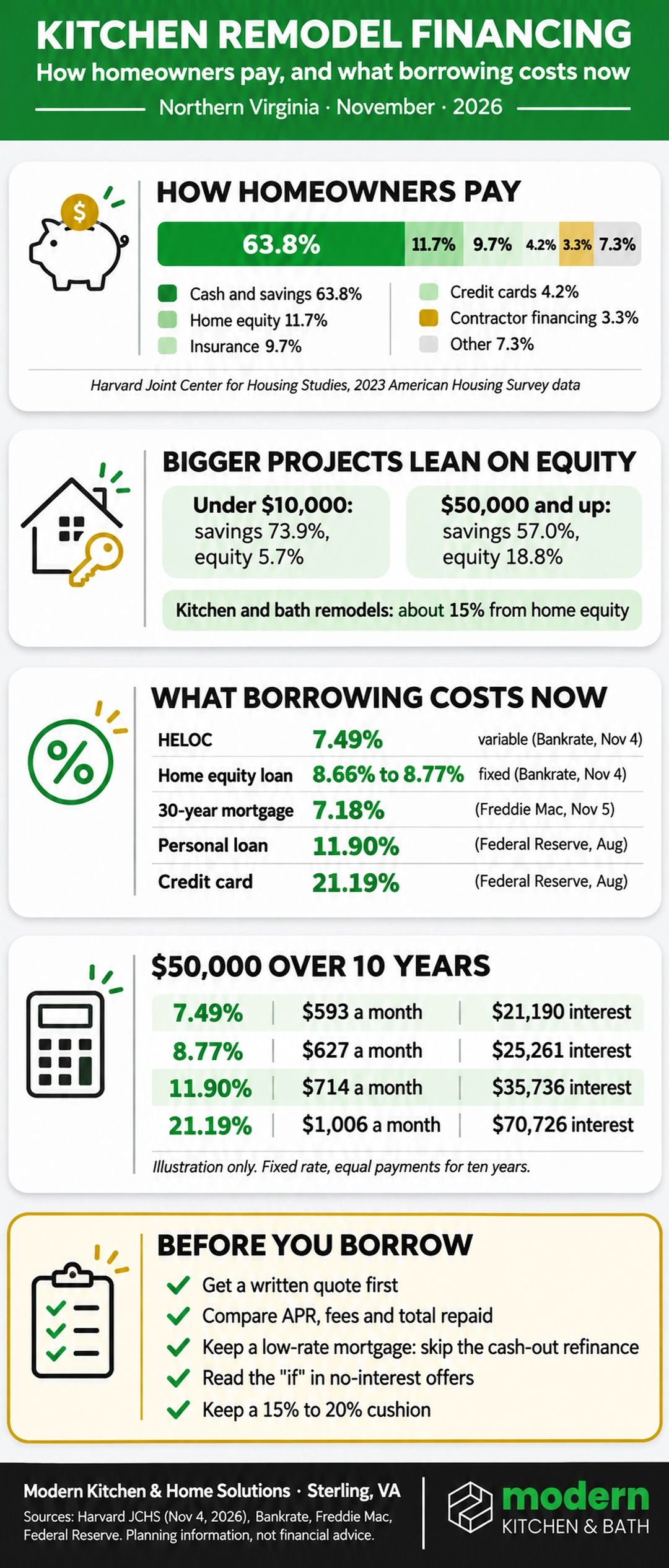
Cash paid for 63.8% of homeowner improvement spending in 2023. Home equity loans, home equity lines of credit and cash-out refinancing together paid for 11.7%. That is despite the average homeowner gaining about $143,000 in equity between 2019 and 2023.
Borrowing has also become more expensive this fall. The Federal Reserve raised its benchmark rate in September and held it on October 28, and the average HELOC rate reached 7.49% in Bankrate’s November 4 survey. On a $50,000 project repaid over ten years, the way you pay can change the interest bill by more than $14,000.
What this covers
- How homeowners pay for remodels, according to Harvard
- What each way of paying costs right now
- Why a cash-out refinance is hard to justify this year
- Contractor financing and “no interest” offers
- When the interest is tax-deductible
- What this means in Loudoun and Fairfax
- How to choose, situation by situation
How Homeowners Pay for Remodels
Harvard’s analysis uses the federal government’s 2023 American Housing Survey and assigns each project to its main source of money.
| Main source of funds | Share of 2023 improvement spending |
|---|---|
| Cash and savings | 63.8% |
| Home equity (HELOC, home equity loan, cash-out refinance) | 11.7% |
| Homeowners insurance settlements | 9.7% |
| Credit cards, including store cards | 4.2% |
| Financing arranged by the contractor | 3.3% |
| Other (personal loans, family help, repair programs, unreported) | 7.3% |
Bigger projects lean more on equity. Savings covered 73.9% of spending on projects under $10,000 and 57.0% on projects of $50,000 or more. Across the same range, the equity share rose from 5.7% to 18.8%.
By project type, equity paid for about 15% of spending on kitchen and bath remodels, against 24.3% for room additions and 7.5% for replacing systems such as plumbing, HVAC and electrical. Harvard’s reading is that large, planned projects give owners both the reason and the time to arrange a loan, while urgent repairs get paid from whatever money is on hand.
The equity share has barely moved. It was 11.2% in 2019 and 11.7% in 2023, even though total homeowner equity grew 74.9% to $31.7 trillion over those years.
What Each Way of Paying Costs Right Now
The Fed raised its target range to 3.75% to 4% on September 16 and left it there on October 28. That keeps the prime rate, the base for most HELOCs and credit cards, at 7%.
| Option | Recent national average | Borrows against your home | Usual fit |
|---|---|---|---|
| Savings | No interest | No | Projects you can cover and still keep a cushion |
| HELOC | 7.49%, variable (Bankrate, Nov 4, 2026) | Yes | Phased work, or a final cost you can’t pin down yet |
| Home equity loan | 8.66% to 8.77%, fixed, by term (Bankrate, Nov 4, 2026) | Yes | A fixed scope and a fixed monthly payment |
| Cash-out refinance | 7.18%, 30-year fixed (Freddie Mac, Nov 5, 2026) | Yes, and it replaces your mortgage | Owners whose current rate is close to today’s |
| Personal loan | 11.90%, 24-month (Federal Reserve, Aug 2026) | No | Less equity, smaller jobs, or a need for speed |
| Credit card | 21.19% on all accounts, 22.36% on accounts paying interest (Federal Reserve, Aug 2026) | No | Small purchases you pay off within months |
These are national averages. The rate you are offered depends on your credit score, how much equity you have and the lender. In Bankrate’s survey this week, fixed home equity loans averaged more than HELOCs. A HELOC’s rate follows prime, though, so it can rise after you borrow.
What the rate difference costs
| Borrowing $50,000 over 10 years at | Monthly payment | Total interest |
|---|---|---|
| 7.49% (HELOC average) | $593 | $21,190 |
| 8.77% (10-year home equity loan average) | $627 | $25,261 |
| 11.90% (personal loan average) | $714 | $35,736 |
| 21.19% (credit card average) | $1,006 | $70,726 |
How to read this table. It is an illustration with a fixed rate and equal payments for ten years. Real HELOCs are variable and often interest-only during the draw period, personal loans usually run for fewer years, and credit cards are not built for a ten-year balance. Use it to see the spread between options. Your own quote will differ.
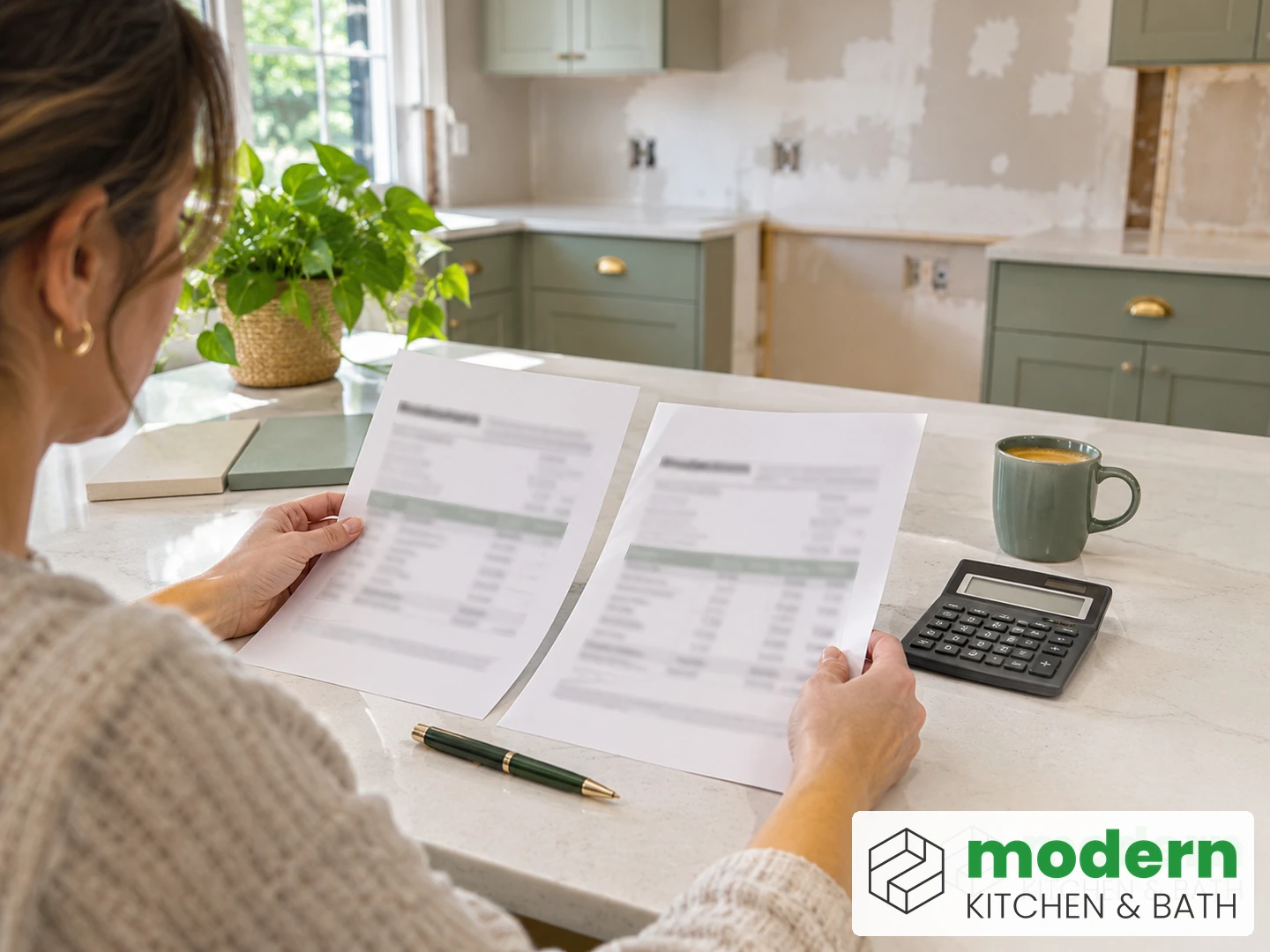
Compare the total cost. A longer term lowers the monthly payment and raises the interest you pay overall. Ask each lender in writing for the APR, every fee and the total you will repay over the full term, and line the offers up side by side.
How much equity lenders will let you use
Lenders take a percentage of the home’s appraised value and subtract what you still owe. The CFPB’s guide to home equity lines uses 75% in its example, and M&T Bank puts the usual cap at 70% to 85% of value for everything secured by the house.
Take a home at Loudoun County’s median value of $743,800 with a $400,000 mortgage balance. At 80%, the lender’s ceiling is $595,040, which leaves about $195,000 of room. That is well beyond what an average Northern Virginia kitchen costs. For most owners here, the real decision is whether borrowing is worth it.
Why a Cash-Out Refinance Is Hard to Justify Right Now
A cash-out refinance replaces your mortgage with a larger one and pays you the difference. The new rate applies to the whole balance, including the old mortgage.
Freddie Mac’s 30-year average was 7.18% on November 5, up from 6.22% a year earlier. If your current mortgage is at 3%, moving a $400,000 balance to 7.18% adds about $16,700 of interest in the first year, roughly $1,390 a month, before you borrow anything for the kitchen.
The National Kitchen & Bath Association’s latest market survey found that a significant share of today’s remodeling money comes from owners who planned and saved, and from owners staying put because of their low existing mortgage rates. A HELOC or home equity loan leaves that first mortgage alone.
A cash-out refinance can still make sense when your current rate is already close to today’s, or when the house is paid off. Compare it with a home equity loan on total cost before you decide.
What about FHA 203(k) loans?
FHA’s 203(k) program rolls renovation costs into a purchase or refinance mortgage. The Limited 203(k) covers up to $75,000 of non-structural work, and the Standard 203(k) handles larger renovations. For an existing owner it means refinancing the mortgage, so it runs into the same rate problem. It is more useful when you are buying a house that needs a new kitchen.
Contractor Financing and “No Interest” Offers
Harvard counted financing arranged by the contractor as the main source for 3.3% of improvement spending.
We work with HFS Financial, so here is how that arrangement works. HFS is not a lender. It matches homeowners with lenders in its network that offer personal loans, it checks your options with a soft credit inquiry that does not affect your score, and the money is paid to you directly. No home equity or appraisal is needed. Rates depend on your credit and income, and HFS does not guarantee any rate. Our financing page has the application link.
The trade-off is straightforward. A personal loan is quick and puts no lien on your house, but its rate is usually higher than equity borrowing, as the table above shows.
Read the “if” in no-interest offers
Store cards and some financing plans advertise no interest if the balance is paid in full within a set period. That is deferred interest. The CFPB explains that if the full balance is not paid off by the end of the period, you could owe all the interest that was deferred, counted from the date of purchase. A true 0% APR offer charges interest only on what remains after the promotion.
If you use one of these offers, divide the balance by the number of months and pay that amount, which is often more than the minimum payment.
When the Interest Is Tax-Deductible
IRS Publication 936 allows a deduction for interest on a home equity loan or HELOC only when the money is used to buy, build or substantially improve the home that secures the loan. A kitchen or bathroom remodel can qualify. Paying off a car with the same line of credit does not.
You also have to itemize, and the loan counts toward the $750,000 limit on mortgage debt taken out after December 15, 2017. Interest on a personal loan or credit card used for the same kitchen is not deductible as mortgage interest. Ask a tax professional how this works on your return.
What This Means in Northern Virginia
The national numbers shift once you apply them to this market.
High home values and high incomes
Census estimates for 2020 to 2024 put the median owner-occupied home at $743,800 in Loudoun County and $732,800 in Fairfax County. Median household income is $181,765 in Loudoun and $153,637 in Fairfax. In Harvard’s analysis, the top income fifth of homeowners starts at $172,000, and that group paid for 15.2% of its improvement spending with home equity, against 4.9% for the lowest-income fifth.
Kitchens here land in the biggest project bracket
Our kitchen remodel cost guide puts the average Northern Virginia kitchen at about $75,000. That sits in Harvard’s largest bracket, $50,000 and up, where savings paid for 57.0% of spending and equity for 18.8%. A primary bathroom here commonly runs $60,000 to $120,000, according to our bathroom remodel cost guide, so the same choices apply.
Prices are still moving
In NKBA’s October report, kitchen and bath firms said their prices rose 5.1% over the past year on average, and the association tied the increase to tariffs. The tariff on imported cabinets and vanities is also scheduled to rise from 25% to 50% on January 1, which our cabinet tariff guide covers. Arrange financing against a written quote, and leave room in it for changes.
So How Should You Pay?
It depends on the size of the job, how much equity you have and how much uncertainty you can live with in the monthly payment.
| Your situation | What usually fits |
|---|---|
| Project under about $15,000, and savings cover it with a cushion left over | Pay cash. There is no interest and no paperwork. |
| Full kitchen with a fixed scope and a signed quote | Home equity loan. Fixed rate, fixed payment, and your first mortgage stays as it is. |
| Work done in phases, or a final cost you can’t pin down yet | HELOC. Draw only what you spend, and expect the rate to follow prime. |
| Little equity, a recent purchase, or you would rather not borrow against the house | Personal loan, through your bank or our financing partner. It is faster, with a higher rate. |
| First mortgage at a rate well below today’s | Avoid a cash-out refinance, which reprices the whole balance. |
| Small purchases you can clear within a few months | A card can work. Check whether a “no interest” offer is deferred interest. |
Keep a cushion whichever way you pay. Our look at whether now is a good time to remodel suggests holding 15% to 20% of the budget as a contingency on kitchens and bathrooms where walls come open. Plan your borrowing with that in mind, so a surprise behind the drywall doesn’t end up on a credit card.

A note on timing
Line up the money before you sign the contract. Home equity loans and HELOCs involve an appraisal and underwriting, which can take several weeks. Personal loans usually move faster. Custom cabinets can take up to twelve weeks to arrive, as our cabinet installation guide explains, so the funding date and the order date need to line up.
For what projects cost in this area, see our kitchen remodel cost guide and bathroom remodel cost guide. For the cabinet portion of the budget, our guide to the cost of kitchen cabinets breaks down the options.
Rated 4.8 out of 5 from 68 Google reviews
Modern Kitchen & Home Solutions, Sterling VA · October 2026
Frequently Asked Questions About Kitchen Remodel Financing
What is the best way to finance a kitchen remodel?
It depends on the size of the project, how much equity you have and how fixed the scope is. For a full kitchen with a signed quote, a fixed-rate home equity loan gives you a predictable payment and leaves your first mortgage alone. A HELOC suits work done in phases. A personal loan fits when equity is thin or you need the money quickly. Harvard’s November 2026 analysis found that most homeowners pay mainly from savings, especially on projects under $10,000.
How do most homeowners pay for a remodel?
Mostly with cash. Harvard’s Joint Center for Housing Studies found that savings paid for 63.8% of homeowner improvement spending in 2023. Home equity paid for 11.7%, insurance settlements 9.7%, credit cards 4.2% and contractor-arranged financing 3.3%. Equity’s share rises with project size, to 18.8% on projects of $50,000 or more, and it paid for about 15% of kitchen and bath remodel spending.
Is a HELOC or a home equity loan better for a kitchen remodel?
A home equity loan pays a lump sum at a fixed rate, which suits a kitchen with a fixed scope and quote. A HELOC lets you draw money as you need it, which suits phased work, but its rate is variable and follows the prime rate. In Bankrate’s November 4, 2026 survey, HELOCs averaged 7.49% and home equity loans 8.66% to 8.77% depending on the term.
What are HELOC rates right now?
Bankrate’s national average for a $30,000 HELOC was 7.49% as of November 4, 2026. The Federal Reserve held its target range at 3.75% to 4% on October 28, which keeps the prime rate at 7%. Your own rate depends on your credit score, your equity and the lender, so compare at least three offers.
Should I use a cash-out refinance to pay for a kitchen?
Usually not if your current mortgage rate is low. A cash-out refinance replaces your whole mortgage at today’s rate, and Freddie Mac’s 30-year average was 7.18% on November 5, 2026. Moving a $400,000 balance from 3% to 7.18% adds about $16,700 of interest in the first year. A HELOC or home equity loan leaves the first mortgage untouched.
Is home equity loan interest tax-deductible for a kitchen remodel?
It can be. IRS Publication 936 allows the deduction only when the money is used to buy, build or substantially improve the home that secures the loan, and only if you itemize. The debt also counts toward the $750,000 limit on mortgage debt taken out after December 15, 2017. Interest on a personal loan or credit card is not deductible as mortgage interest. Check with a tax professional.
Can I finance a kitchen remodel without home equity?
Yes. A personal loan needs no equity or appraisal and puts no lien on your house. The trade-off is the rate: the Federal Reserve’s average for a 24-month personal loan from a commercial bank was 11.90% in August 2026, well above the average for home equity products.
Does Modern Kitchen & Home Solutions offer financing?
Yes, through HFS Financial. HFS is not a lender. It connects homeowners with lenders that offer personal loans, checks options with a soft credit inquiry that does not affect your score, and pays approved funds to you directly. Rates depend on your credit and income. Our financing page has the details and the application link.
Can I finance a bathroom remodel the same way?
Yes. The same options apply, and the same rules about rates, equity and taxes. A primary bathroom in Northern Virginia commonly costs $60,000 to $120,000, which puts it in the project size where home equity plays its biggest role. For the plans we offer, see our page on bathroom remodel financing.
What does “no interest if paid in full” mean on remodel financing?
It usually means deferred interest. The CFPB explains that if the full balance is not paid off by the end of the promotional period, you could owe all the interest that was deferred, counted from the date of purchase. A true 0% APR promotion charges interest only on the balance left after it ends. Read the terms for the word “if” before you sign.
Planning a Kitchen or Bathroom for 2027?
We design and build kitchens and bathrooms from our Sterling showroom for homeowners across Loudoun and Fairfax counties. Bring us your floor plan, and we will give you a written quote you can take to any lender, along with our financing options if you want them.
Sources
- Joint Center for Housing Studies of Harvard University, “Homeowners Use Savings, Equity, and Insurance to Fund Remodeling”, November 4, 2026. JCHS tabulations of the 2023 American Housing Survey.
- National Kitchen & Bath Association, “K&B Industry Pros Report Modestly Improving Market Conditions”, October 27, 2026, on the 3Q26 NKBA/John Burns Kitchen & Bath Market Index.
- Board of Governors of the Federal Reserve System, Federal Open Market Committee statement, October 28, 2026.
- Board of Governors of the Federal Reserve System, H.15 Selected Interest Rates, bank prime loan rate.
- Board of Governors of the Federal Reserve System, G.19 Consumer Credit, Terms of Credit, August 2026 values (preliminary): 24-month personal loan rate and credit card plan rates.
- Bankrate, HELOC rates and home equity loan rates, national averages for a $30,000 line or loan, as of November 4, 2026.
- Freddie Mac, Primary Mortgage Market Survey, November 5, 2026.
- Consumer Financial Protection Bureau and Federal Reserve Board, “What You Should Know About Home Equity Lines of Credit”.
- M&T Bank, “What Is Home Equity and How Can You Use It?”, on combined loan-to-value limits.
- Consumer Financial Protection Bureau, “What is a deferred interest promotion?”, and the CFPB’s letter to retail card issuers on deferred-interest promotions.
- Internal Revenue Service, Publication 936, Home Mortgage Interest Deduction.
- U.S. Department of Housing and Urban Development, Mortgagee Letter 2024-13, revisions to the 203(k) Rehabilitation Mortgage Insurance Program.
- U.S. Census Bureau, QuickFacts: Fairfax County and Loudoun County, Virginia, American Community Survey 2020 to 2024 estimates.
- HFS Financial, hfsfinancial.net, on how its lender network and credit check work.
- Northern Virginia kitchen and bathroom cost figures from our own kitchen remodel cost guide and bathroom remodel cost guide.
- Google review rating for Modern Kitchen & Home Solutions verified October 2026.
This article summarizes published research and rate surveys to help with project planning. It is not financial, tax or legal advice. Rates change daily, so confirm current terms with each lender before you borrow. Loan payment figures are illustrations, not offers.
Related Reading
Found this helpful? Make us your go-to source on Google
If our content has been useful, you can tell Google to show more of it when you search. Click below, then check the box next to Modern Kitchen and Bath on the page that opens. It takes about five seconds.

You'll need to be signed in to your Google account. One click, then tick the box next to our name.