A backsplash is the smallest line item in a kitchen remodel and the one that gets stared at the most. Cabinets define the room. Countertops set the tone. But the four-foot strip between them is where homeowners in Sterling, Reston, and Vienna decide whether their kitchen feels current, dated, or genuinely theirs.
The shift for 2026 is real. White subway tile no longer wins by default. Handmade zellige, fluted ceramic, full-height stone slabs, and warm earth tones are reshaping what a kitchen wall is supposed to do. Costs are also moving. Loudoun County labor rates have climbed alongside the data center boom, and a 25% tariff on imported tile and cabinets is still in effect through the year.
This guide pulls together 23 backsplash ideas worth your attention this year, with real 2026 pricing for Northern Virginia, material comparisons, installation realities, and the mistakes we keep watching homeowners repeat. If you’re planning a remodel in the DMV, this is the only backsplash article you need to read.
Quick Take
12 things to know before you pick a backsplash
How Much Does a Kitchen Backsplash Cost in Northern Virginia? (2026 Pricing)
The average kitchen backsplash in the U.S. costs $1,000 nationally for a 30-square-foot run. In Northern Virginia, the same project realistically lands between $1,400 and $2,800. The gap comes down to three things: Loudoun County labor rates, material logistics, and the type of tile you choose.
Most kitchens in Sterling, Ashburn, Herndon, and Reston have 25 to 40 square feet of backsplash area between the countertop and the upper cabinets. A small galley kitchen runs closer to 18 square feet. A larger primary kitchen with a long island wall can hit 60 square feet or more. Square footage is your starting calculation, but it’s the material decision that swings the budget the most.
Material costs (2026, installed, Northern Virginia)
The table below shows what each backsplash material costs installed in our market, including standard prep, thinset, grout, and labor. Premium patterns (herringbone, chevron, mosaic) add 15% to 30% on top of these ranges.
| Material | Material/sf | Installed/sf (NoVA) | Best Use |
|---|---|---|---|
| Peel-and-stick vinyl | $5–$15 | $10–$35 | Rentals, refresh |
| Ceramic subway tile | $1–$8 | $14–$75 | Budget, classic |
| Porcelain tile | $3–$15 | $20–$65 | Mid-range, durable |
| Glass mosaic | $5–$25 | $25–$75 | Color, light reflection |
| Natural stone (marble, slate) | $8–$40 | $20–$85 | Luxury, character |
| Authentic zellige | $15–$45 | $45–$100 | Handcrafted statement |
| Stainless steel | $10–$30 | $25–$65 | Behind ranges |
| Beadboard | $3–$10 | $13–$40 | Cottage, farmhouse |
| Slab (quartz, porcelain, marble) | $40–$150 | $45–$250 | Full-height, no grout |
Labor rates in Loudoun and Fairfax counties
Tile labor in our region runs $9 to $22 per square foot for standard installs and $30 to $45 per square foot for complex work like herringbone, chevron, or hand-cut zellige. Hourly rates for tile setters land at $65 to $110 in 2026, up from $55 to $90 in 2024. The data center build-out across eastern Loudoun has pulled experienced tradespeople into commercial work, which is the single biggest reason residential rates keep climbing.
For a 30-square-foot kitchen backsplash with mid-range porcelain in a horizontal subway pattern, expect $1,500 to $2,200 installed in Sterling, Ashburn, or Herndon. Drop in a herringbone pattern and that climbs to $1,900 to $2,800. Switch to a marble slab and you’re looking at $2,400 to $4,500.
Hidden costs to budget
- Removal of existing backsplash: $3 to $6 per square foot
- Drywall repair or backer board prep: $200 to $500 typical
- Outlet relocation (electrician trip charge): $150 to $400
- Tile waste factor: order 10% to 15% extra (more for diagonal or herringbone patterns)
- Tile delivery surcharge for slab or oversized formats: $100 to $300
- Sealing for natural stone or zellige: $1 to $3 per square foot
23 Kitchen Backsplash Ideas for 2026
These 23 ideas reflect what designers are actually specifying right now in NoVA kitchens, what manufacturers are producing in volume, and what pairs cleanly with the cabinet and countertop choices most homeowners are landing on this year. We’ve grouped them into six categories so you can navigate by aesthetic instead of scrolling through 23 unrelated photos.
Handmade & Artisanal Tile
5 ideas1. Authentic Moroccan Zellige
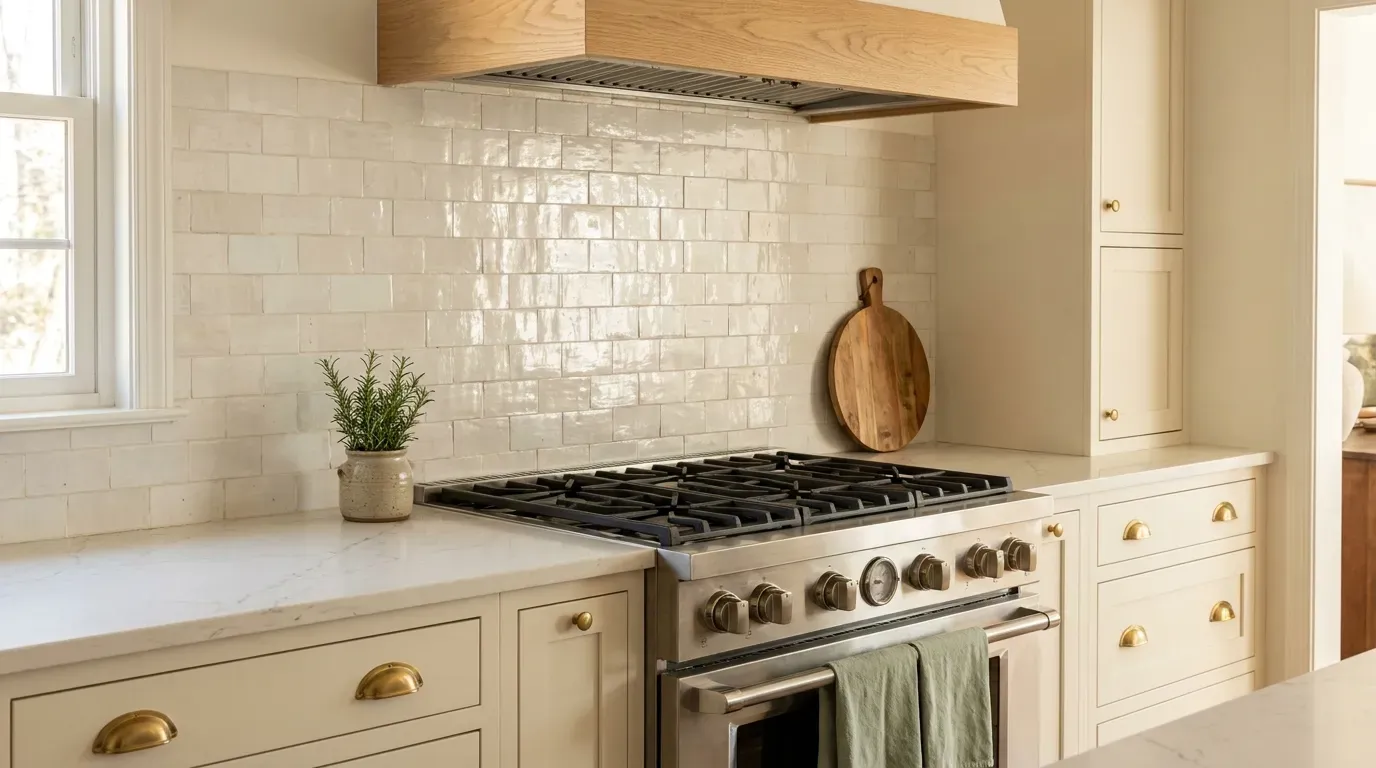
Hand-shaped clay tiles fired in Fez kilns, glazed by hand, and never identical from one piece to the next. The slight tonal variation, irregular edges, and uneven surface are the point. Light hits zellige differently throughout the day, which is something machine-made tile simply can’t replicate. Pair with warm white or off-white shaker cabinets, brass hardware, and a wood range hood.
2. Zellige-Inspired Porcelain
Manufactured porcelain that mimics the handmade Moroccan look at half the price and with consistent sizing. Easier for installers to set, easier to keep clean, and a strong choice if you love the zellige aesthetic but want fewer maintenance tradeoffs. The look reads almost identical from three feet away.
3. Hand-Pressed Ceramic in Muted Greens
Sage green, sea glass, and pale celadon glazes are dominating 2026 kitchens. Hand-pressed tile carries enough imperfection to feel artisanal without going full zellige. Works beautifully against cream or oat-toned cabinets with unlacquered brass hardware.
4. Terracotta Clay Tile
Earthy, warm, and increasingly popular in transitional kitchens that want a Mediterranean note without committing to a full theme. Terracotta needs sealing. The patina it develops over five to ten years is the reason designers keep specifying it.
5. Hand-Glazed Art Tile
Smaller-batch tile from makers like Fireclay Tile, Heath Ceramics, and Cle Tile. Color choices, shapes, and textures that mass-produced tile can’t match. Lead times can run 8 to 14 weeks. Plan accordingly if your remodel timeline is tight.
Textured & Sculpted Tile
4 ideas6. Vertical Fluted Tile
Tall, narrow tile with vertical grooves that catch light and throw shadow lines across the wall. Fluted tile is the texture trend that defined 2025 and is carrying directly into 2026. Particularly effective in kitchens with limited natural light because the surface plays with whatever light reaches it.
7. Horizontal Ribbed Tile
Same dimensional energy as fluted but laid horizontally, which visually widens a galley kitchen. We’ve installed this format in several Cascades and Countryside homes where the kitchen needed to feel less narrow.
8. Beaded Ceramic
Small, raised dot patterns across each tile. Quietly textural, and a strong fit for transitional kitchens that want depth without going modern.
9. Sculpted Geometric Relief
Tile with deeply cast geometric forms (diamonds, scallops, half-circles). Bolder than fluted, and best used as a feature wall behind a range rather than wrapping the entire kitchen.
Slab & Full-Height Backsplashes
4 ideas10. Calacatta Marble Slab
A single piece of bookmatched marble running from countertop to upper cabinet. Dramatic veining, no grout lines, no maintenance ritual. Calacatta and Calacatta Gold remain the two most-requested marbles in NoVA kitchens. Sealing every 12 to 18 months is required.
11. Quartzite Waterfall Match
Same quartzite slab as the countertop, continued up the wall as a backsplash and over the island edge. The unbroken effect makes the kitchen feel architectural. Quartzite is harder than marble and far more forgiving of acid (lemon, wine, vinegar).
12. Floor-to-Ceiling Porcelain
Large-format porcelain panels (often 60 inches by 120 inches) installed from countertop all the way to the ceiling. The look reads modern and high-end without the price of natural stone. Particularly strong with flat-panel cabinets in newer Ashburn and Lansdowne builds.
13. Soapstone Full-Height
Quietly trending again. Soft to the touch, naturally matte, and develops a warm patina over years. Honed soapstone slabs work for homeowners who want depth and character without the cold reflectivity of polished marble.
Subway Tile, Reinvented
3 ideas14. Vertical-Stacked 4×12 Subway
Subway tile in elongated 4×12 format, stacked vertically rather than the traditional offset brick pattern. The vertical lines visually raise ceiling height, which helps in 1980s Sterling Park and Sugarland Run homes where ceilings often max out at 8 feet.
15. Beveled Subway in Dusty Blue or Sage
Beveled edges add subtle shadow lines while the muted color softens the kitchen. Two of the most-requested colors in our 2026 projects. Pair with white oak shaker cabinets and brass hardware for a contemporary farmhouse read.
16. Herringbone in Warm Neutrals
Classic 3×6 or 2×8 subway tile laid in a herringbone pattern. Adds movement without color. Greige, taupe, and warm white versions read more current than bright white in 2026.
Pattern, Mosaic & Color
4 ideas17. Penny Round in Matte Finish
Small circular tile in matte glaze. Quietly modern, slightly retro, and a fresh take on mosaic that doesn’t read busy. Strong choice in cottage-style kitchens or transitional homes.
18. Geometric Hexagon
Hexagonal tile in two- or three-color patterns. Visually busy if used on a full wall, so better as a focal area behind the range or above the sink. Black-and-white hexagon is a classic that’s coming back.
19. Terrazzo Backsplash
Speckled terrazzo, either in cement or porcelain. Each chip catches light differently, so the wall has movement built in. Particularly fresh as a contrast to plain shaker cabinets in newer Lowes Island builds.
20. Back-Painted Glass
Smooth, single-sheet glass with paint applied to the back. Easiest backsplash material to clean (one wipe handles everything). Reads modern, especially in flat-panel cabinet kitchens. Color choices range from muted neutrals to rich saturated tones.
Unconventional & Material Mixes
3 ideas21. Beadboard for Cottage Kitchens
Painted beadboard running from countertop to upper cabinets. Cheap, charming, and a strong fit for older Vienna and Reston cottages where shaker cabinets and a farmhouse sink already live. Best painted in soft white, sage, or warm cream.
22. No-Backsplash with Limewash or Plaster
Skip tile entirely. Use a durable limewash, Roman clay, or microcement finish instead. Reads quietly luxurious, requires excellent ventilation behind the range, and isn’t right for every cook. We’re seeing it in design-forward kitchens in Great Falls and Vienna.
23. Mixed Material Zoning
Different backsplash materials in different zones of the kitchen. A marble slab behind the range, simple subway tile elsewhere. Or zellige on the cooking wall and back-painted glass behind the sink. Effective when the kitchen is large enough for the zones to read intentional rather than disconnected.
Need help picking?
Schedule a Free In-Home Consultation
We’ll come to your kitchen, measure the backsplash area, walk through tile against your existing cabinets and countertop, and give you a real number to plan around.
Book a Free Consultation →How to Choose the Right Backsplash for Your Northern Virginia Kitchen
Three questions decide your backsplash before any color or material question matters: what’s the rest of the kitchen doing, how long do you plan to stay in the home, and what does your daily cooking look like? Get those right, and the tile choice gets dramatically easier.
Match cabinet color and countertop together
The single most common backsplash regret is choosing tile after the cabinets and countertops are already locked in. Picking the order matters. Our standard sequence: cabinet color first (sets the tone), countertop second (sets the contrast level), backsplash third (resolves both). Fighting that order means your backsplash is always compromising.
If you have white shaker cabinets and Calacatta-look quartz, almost any backsplash works because the kitchen is reading neutral. If you have walnut cabinets and a warm-toned quartzite, you need a backsplash that supports the warmth (zellige, terracotta, hand-glazed ceramic) rather than competing with it (bright glass mosaic, cool-toned stone).
Consider the home’s age and style
Sterling and Herndon homes built in the 1980s carry a transitional architecture that handles handcrafted tile, beadboard, and warm subway tile easily. Reston’s mid-century moderns from the 1970s lean toward clean lines like back-painted glass, slab, and minimal grout. Vienna and Great Falls colonials accept the broadest range, from marble slab to Moroccan zellige. Newer Lansdowne, Cascades, and Brambleton builds usually fit large-format porcelain or full-height stone better than they fit busy mosaic.
ROI and resale in NoVA
Cost vs. Value Report data for the South Atlantic region puts mid-range minor kitchen remodels at roughly 78% recouped at resale in 2025–2026. The backsplash itself isn’t the line item buyers see on a Zillow listing, but a dated tile choice can absolutely move pricing. In our market, what reads as dated to buyers in 2026: 4-inch granite stub backsplashes (the 2005 standard), busy 1-inch glass-and-stone mosaics, and high-contrast white-with-dark-grout subway tile. What reads current: tonal grout, warm color palettes, and dimensional tile.
Backsplash Materials Compared at a Glance
Use this table to narrow your shortlist before you visit a tile showroom. Durability, maintenance, and DIY-friendliness are weighted by how the material actually behaves in a working kitchen, not in a marketing photo.
| Material | Durability | Maintenance | DIY-Friendly | Lifespan |
|---|---|---|---|---|
| Ceramic | High | Low | Yes (basic patterns) | 20+ years |
| Porcelain | Very high | Low | Moderate | 25+ years |
| Glass mosaic | Moderate | Low | Hard (cuts) | 15–20 years |
| Natural stone | Moderate | High (sealing) | No | 30+ years |
| Zellige | Moderate | Moderate | No | 30+ years |
| Stainless steel | Very high | Moderate (smudges) | Moderate | 20+ years |
| Beadboard | Low–Moderate | Moderate (paint) | Yes | 10–15 years |
| Slab stone | Very high | Moderate | No | 30+ years |
| Peel-and-stick | Low | Low | Yes | 3–7 years |
Installation: DIY vs. Professional (and What to Expect)
About a third of homeowners ask us upfront whether they can install their own backsplash. The honest answer depends entirely on the material and the pattern. Some installs are reasonable weekend projects. Others end with someone calling us to redo work that’s already been paid for once.
When DIY makes sense
Peel-and-stick vinyl, simple beadboard, and basic 3×6 subway tile in a horizontal pattern are reasonable DIY targets if you have prior tile experience. A 25-square-foot subway install takes a careful homeowner one full weekend. Save 30% to 50% versus professional pricing if you handle prep, set, grout, and seal yourself.
When you need a pro
Zellige, slab, herringbone, chevron, large-format porcelain, and any natural stone should go to an experienced installer. Zellige tile especially. Every piece is irregular, the grout joints are intentionally tight (1/16 inch), and a poor install ruins the look that justified the cost in the first place. Slab installs require equipment most homeowners don’t own (suction lifters, wet saw, leveling systems). Hire a tile setter who can show you 10+ recent jobs in the same material.
Permits in Loudoun and Fairfax counties
Tile-only backsplash work doesn’t require a permit in either county. You’re putting decorative material on an existing wall surface. Permits enter the picture when the project involves electrical (relocating outlets, adding under-cabinet lighting circuits), plumbing (moving the sink), or structural work (cutting the wall, adding a hood vent). Budget $50 to $150 for an electrical permit if your remodel includes outlet relocation.
Typical install timeline
A standard 30-square-foot tile backsplash takes 2 to 3 days of on-site work: day one for prep and dry layout, day two for setting tile, day three for grouting and finishing. Slab installs are usually one full day plus templating earlier in the week. Zellige and complex patterns can stretch to 4 to 5 days. Build in dry-time buffers. Most thinset systems need 24 hours before grouting, and grout needs 72 hours before sealing.
7 Backsplash Mistakes We Watch Homeowners Repeat in 2026
Choosing the backsplash before the cabinets and countertop are decided.
The reverse-order pick is the #1 source of backsplash regret. Lock cabinet color and countertop first.
Using bright white grout with white tile.
Reads dated in 2026. Use warm white or off-white grout, or go tonal (matched to tile).
Skipping the 4-inch return on a stub backsplash.
If you’re keeping a 4-inch stub, at minimum extend it behind the range. The half-and-half look (stub elsewhere, full behind range) is the cleanest budget compromise.
Picking trendy color in the wrong room.
Sage green tile reads beautifully in a Reston colonial. The same tile in a 1990s Sterling builder kitchen with oak cabinets fights everything. Trendy colors need a kitchen ready to support them.
Underordering tile.
Order 10% extra minimum. 15% for diagonal or herringbone. 20% for natural stone where slab variation matters. Running short mid-install means waiting weeks for a matching dye lot, and sometimes you don’t get one.
Ignoring the outlet plan.
Where outlets land on the backsplash matters visually. We re-plan outlet locations on most projects to avoid awkward tile cuts or to align outlets with grout lines.
Sealing zellige or natural stone with the wrong product.
Penetrating sealers are correct. Topical sealers ruin the look of zellige especially. Confirm the product before applying.
Frequently Asked Questions
What is the most popular kitchen backsplash for 2026?+
Subway tile is still the most-installed backsplash nationally, but the format has shifted. Vertical-stacked 4×12 subway in warm whites, sage green, or dusty blue is replacing the standard 3×6 horizontal layout. Zellige tile and slab backsplashes are the two trends gaining the fastest share in mid-range and high-end kitchens.
How much does a kitchen backsplash cost in Northern Virginia?+
Most Northern Virginia kitchen backsplash projects cost $1,400 to $2,800 for 30 square feet of standard tile work, $2,400 to $4,500 for marble slab or zellige, and $4,000 to $7,500 for full-height stone or large-format porcelain. Loudoun and Fairfax county labor runs 25% to 35% above national averages.
Can I install a kitchen backsplash myself?+
DIY works for peel-and-stick, beadboard, and simple subway tile in horizontal patterns. It does not work well for zellige, slab, herringbone, chevron, or large-format porcelain. Professional install is worth paying for any time the material is irregular, expensive, or requires specialized equipment.
How long does a kitchen backsplash installation take?+
Standard tile work takes 2 to 3 days on-site. Slab installs run 1 to 2 days plus a templating visit earlier in the week. Zellige and complex patterns take 4 to 5 days. Plan for an additional 24 hours before grouting and 72 hours before sealing.
Do I need a permit for a backsplash project in Loudoun or Fairfax County?+
No, tile-only backsplash work does not require a permit in either county. Permits are required if the project involves outlet relocation, plumbing changes, or structural modifications such as cutting the wall for a vent hood. Budget $50 to $150 for an electrical permit if outlet work is part of the scope.
What backsplash material is easiest to clean?+
Back-painted glass, large-format porcelain, and slab stone are the easiest to maintain because they have minimal or no grout lines. Stainless steel cleans easily but shows fingerprints and water spots. Zellige and natural stone require periodic sealing and gentle cleaning products.
Should the backsplash match the countertop?+
Not exactly. A backsplash that perfectly matches the countertop reads flat. The cleanest approach is either a slab match (same material, intentional continuity) or a tonal complement (different material in a coordinating color family). Avoid a backsplash that competes for attention with a heavily veined countertop.
Is white grout a bad idea for a kitchen backsplash?+
Bright white grout shows stains within 12 to 18 months in a working kitchen and reads dated in 2026. Better choices: warm white, off-white, light gray, or tonal grout matched to the tile color. Epoxy grout in any color resists staining better than cement-based grout but costs more and requires an experienced installer.
How tall should a kitchen backsplash be?+
Standard backsplash height runs from the countertop to the bottom of the upper cabinets, typically 18 inches. Full-height backsplashes extend from countertop to ceiling and are gaining popularity in 2026, particularly for slab and large-format installations. Behind a range, extending the backsplash up and around the hood creates visual continuity.
Can I paint over an existing tile backsplash?+
Yes, with proper prep. Tile-specific bonding primer plus durable cabinet-grade paint or enamel works for low-splash zones. The result lasts 3 to 5 years before showing wear. Painting is a budget refresh strategy, not a permanent solution. For a longer-term update, removing and replacing the tile is the better investment.
Plan Your Backsplash with Modern Kitchen & Home Solutions
Modern Kitchen & Home Solutions has been remodeling kitchens across Northern Virginia for over a decade. We work with homeowners in Sterling, Ashburn, Leesburg, Reston, Vienna, Fairfax, Centreville, and Herndon, and we’ve installed every backsplash material on this list, most of them dozens of times.
If you’re planning a kitchen remodel, a backsplash refresh, or just trying to figure out what’s worth the investment in your specific kitchen, schedule a complimentary consultation. We’ll come to your home, measure the space, walk through material options against your existing cabinets and countertop, and give you a real number to plan around.
Related Reading from Modern Kitchen & Home Solutions
Found this helpful? Make us your go-to source on Google
If our content has been useful, you can tell Google to show more of it when you search. Click below, then check the box next to Modern Kitchen and Bath on the page that opens. It takes about five seconds.

You'll need to be signed in to your Google account. One click, then tick the box next to our name.